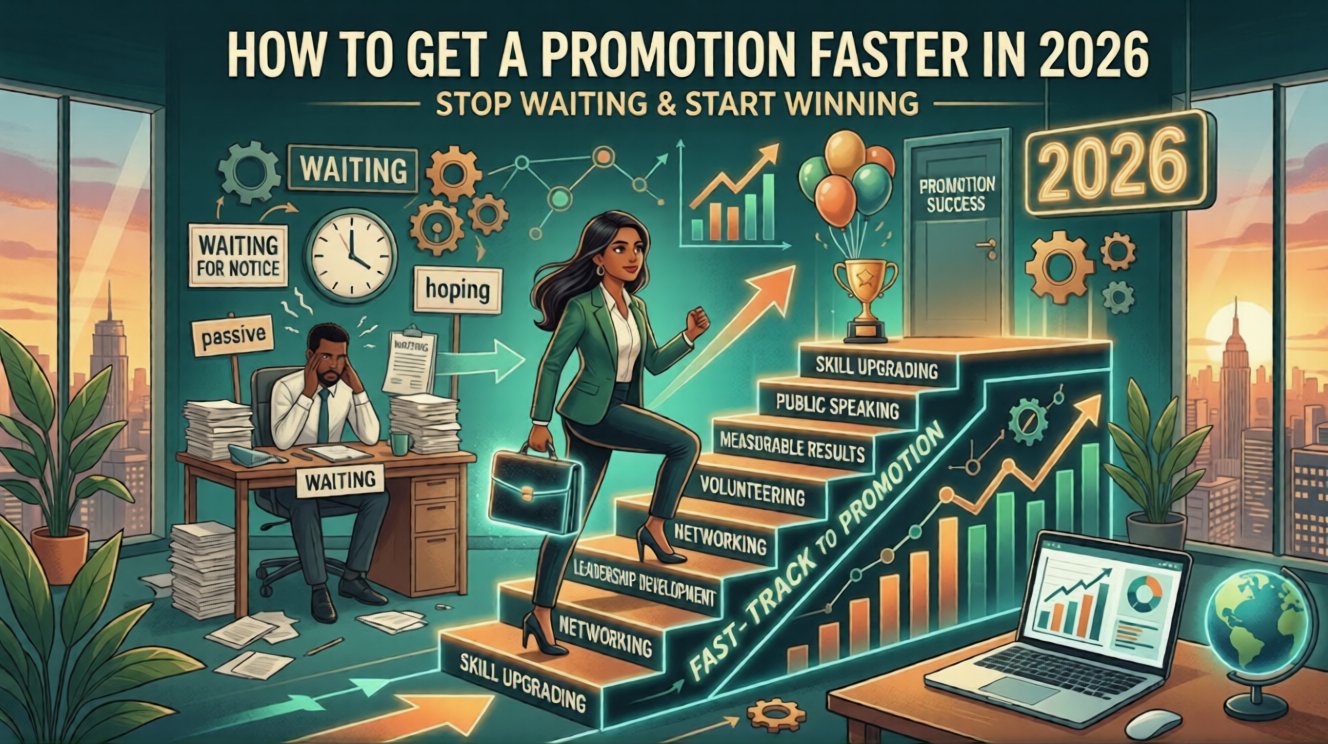
Introduction: The Old Rules Are Gone
Let me guess. You show up on time. You hit your deadlines. You never complain. You’ve been doing this for—what—18 months? Two years? And yet, that promotion feels like a mirage. You see less experienced people leapfrog you, and you’re quietly thinking: “What are they doing that I’m not?”
Here is the hard truth for 2026: Promotions are no longer a reward for time served. They are a reward for visible value created. You can wait for your boss to notice you—or you can make it impossible for them to ignore you.
The good news? You don’t need to work 80-hour weeks or become a shameless self-promoter. You just need a smarter strategy.
Grab a coffee. Let’s map out your fastest path to that title (and that paycheck).
Step 1: Understand the “Promotion Math” (Most People Get This Wrong)
Your boss wakes up with one question: “How do I make my team look good to my boss?”
If you want a promotion, stop asking *”What do I need to do?” and start asking “What problem is keeping my boss up at night?”*
The Formula for 2026:
Visibility + Impact + Trust = Promotion Speed
Visibility= Your boss’s boss knows your name (in a good way).
Impact = You save time, save money, or generate revenue.
Trust = Your boss doesn’t have to check your work.
Most people focus only on Impact. But in 2026, invisible impact is worthless. You can be the best coder in the company, but if leadership doesn’t know your name, you will stay a “great individual contributor” forever.
Your move: This week, identify ONE metric your boss cares about. Then ask: “How can I move that number?”
Step 2: The “Upward Delegation” Hack (Bosses Love This)
Here is a secret that will change everything. Your boss is overwhelmed. They have 27 things on their to-do list that they hate doing.
If you can take two of those things off their plate—permanently—you become invaluable.
How to do it without sounding needy:
Say: “I noticed you spend hours on [boring report]. I’d love to learn how to own that for you. Could you show me once?”*
Then: Execute it so flawlessly that they forget it ever existed.
Why this works: You are not asking for a promotion. You are behaving like someone who deserves one. And when review time comes, your boss will realize they cannot function without you.
Engage with me here: Think about your boss’s least favorite task. Could you learn it in two weeks? Yes? Then you have your first move.
Step 3: Play the “Visibility Game” Without Being Annoying
No one likes a bragger. But in 2026, quiet humility is career suicide. You need a system.
The 3-3-3 Visibility Rule (per month):
3 updates :to your boss (short bullet points of your wins via Slack or email).
3 shout-outs :to teammates in public channels (what goes around comes around).
3 questions : in company-wide meetings (shows curiosity and engagement).
Pro Tip: When you solve something big, send a one-sentence update to your boss with the subject line: “Small win worth sharing.”Example: “Hey—automated the weekly report. Saved the team 4 hours a week. No action needed, just wanted you to know.”
That is not bragging. That is documenting your value. And documentation gets promoted.
Step 4: Learn the “One Level Up” Skill (The 2026 Shortcut)
Here is the biggest mistake I see: People try to get promoted by doing their current job perfectly. But perfection at your current level just earns you… more of your current job.
To get promoted, you must demonstrate the skills of the level above you.
Want to go from Associate to Manager? Start managing something small (a project, a vendor, an intern).
Want to go from Manager to Director? Start thinking about budget, strategy, and cross-team politics.
The formula: Do your job 80% perfectly (good enough) and spend 20% of your energy on “next-level” work.
Real example: A customer support agent who creates a training guide for new hires is acting like a team lead. Guess who gets the lead role when it opens?
Step 5: The “Promotion Conversation” Script (Use This Verbatim)
Do not wait for your annual review. That is too late. You need to plant seeds 3–6 months in advance.
Schedule a 15-minute meeting with your boss. Say this:
“I love working here, and I want to grow into [Target Role] over the next [3–6 months]. I’m not asking for a title change today. I’m asking: If I wanted to make that decision easy for you, what specific outcomes would I need to hit? Can we write down 3 measurable goals together?”*
Why this works:
You are not demanding. You are collaborating.
You get a written checklist. Hit those goals, and your boss cannot say no.
You shift from “hoping” to “executing.”
Warning: If your boss cannot give you 3 measurable goals, you have learned something valuable. That boss will never promote you. It is time to look externally.
Conclusion: Promotions Are Earned, But They Are Also Claimed
Here is the truth they don’t teach in school: No one is going to tap you on the shoulder and hand you a promotion because you are “due.”
The people who move up faster are not smarter or harder working. They are just more intentional. They understand that promotions are a negotiation, not a reward. They make their value visible. They solve their boss’s headaches. And they ask for what they want—clearly and professionally.
You have everything you need to start today. Pick one step from this article. Do it this week. Then pick another.
The only difference between you and that person who just got promoted? They started before they felt ready.
So start.
Frequently Asked Questions (FAQs)
Q1: How long should I stay in a role before asking for a promotion?
A: Forget the calendar. Look at *impact*. Have you consistently exceeded expectations for 6–9 months? Have you taken on responsibilities outside your job description? If yes, you are ready—even at 12 months. In 2026, fast movers get promoted every 12–18 months, not every 3–5 years.
Q2: What if my company has a “freeze” on promotions?
A: Then ask for a *title change without a raise (builds your resume) or a budget for a certification (invests in you). If they say no to everything, update your LinkedIn. A company that cannot promote during a freeze will not promote you when times are good either.
**Q3: Should I threaten to leave to get a promotion?
A: Rarely. Only do this if you actually have another offer and you are willing to walk. Empty threats destroy trust. Instead, use the script from Step 5. If they still say no after you hit your goals, then look elsewhere—quietly.
Q4: How do I get promoted if I work remotely in 2026?
A: Over-communicate. Remote workers get promoted slower because they are “out of sight, out of mind.” Fight this by:
– Recording quick Loom videos of your wins.
– Over-sharing progress in Slack (without spamming).
– Scheduling monthly 1:1s with your skip-level manager (your boss’s boss).
– Visiting the office quarterly if possible.
Q5: I asked for a promotion and got rejected. Now what?
A: Do not get emotional. Ask for *specific feedback in writing. Say: “I appreciate the honesty. To be considered next cycle, what exactly needs to be different?” Then give it 60–90 days. If you execute their feedback and still get rejected, you have your answer: It is time to leave. Some companies will never promote from within. That is not your failure; that is their broken culture.
Q6: Does job hopping really work in 2026?
A: Yes—but strategically. The data shows that people who change companies every 2–3 years earn 10–20% more than those who stay. However, do not leave for just 5%. Leave for a title bump (e.g., Coordinator → Manager) or a 20%+ raise. And never leave angry. Exit gracefully. Your next employer will call your old one.
Ready to make your move? Pick one action from this article right now:
– ✅ Schedule that 15-minute meeting with your boss.
– ✅ Write down one of their headaches you can solve.
– ✅ Send that “small win” email today.
Your promotion clock starts the moment you stop waiting and start acting. Go get it.