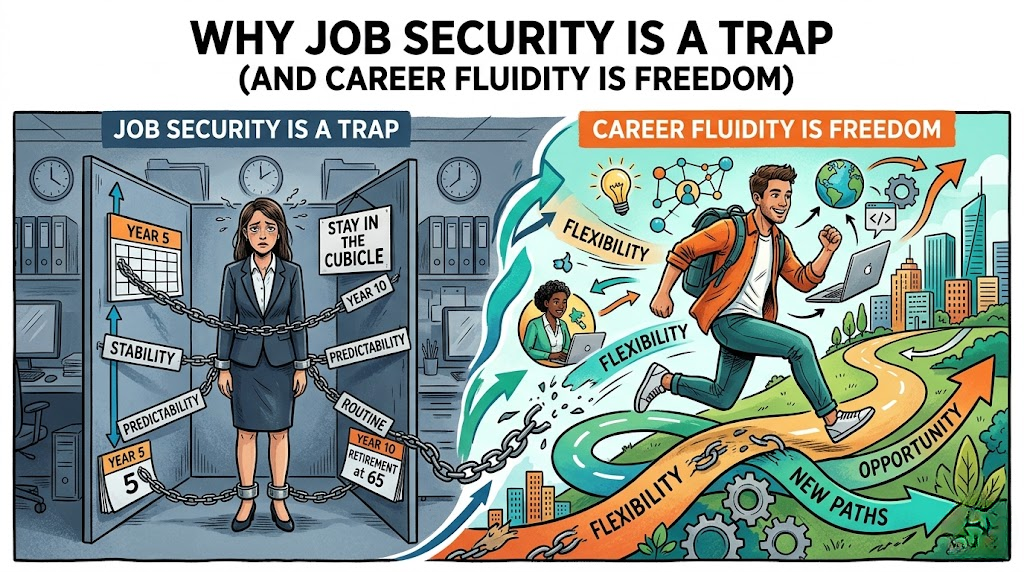
Let me paint you a picture. Why Job Security Is a Trap (And Career Fluidity Is the Only Real Freedom)
It’s a Tuesday morning. You walk into the office, coffee in hand, the same way you have for the last eleven years. You know every face in the hallway. You know which elevator is fastest. You know the exact rhythm of this place.
Then, your manager calls you into a conference room you’ve never sat in before.
There’s an HR rep you don’t recognize. There’s a manila folder on the table.
And in sixty seconds, eleven years of loyalty becomes a severance package and a LinkedIn recommendation.
Sound familiar? It should. It has happened to millions of professionals just like you. Good people. Loyal people. People who believed in the unspoken contract between an employee and their employer.
But here is the brutal, uncomfortable truth nobody told you at graduation:
Job security was never real. It was a story your company needed you to believe.
Today, I am going to break that story wide open — and hand you something infinitely more powerful in its place.
The Comfortable Cage (The Illusion of Job Security)
The concept of job security is one of the most brilliant pieces of corporate psychology ever engineered.
Think about what it actually does.
It rewards compliance over ambition. It makes you grateful for stability instead of hungry for growth. It convinces you that the absence of immediate danger is the same thing as safety.
It is not.
A caged bird is safe. It is also slowly dying.
Every mass layoff in history has one common victim profile: the loyal, long-tenured employee who never built an external safety net because they trusted the cage. The 2008 financial collapse proved it. The 2020 pandemic demolitions proved it again. And the current wave of AI-driven restructuring is proving it right now, at scale.
The cage doesn’t protect you. It just makes sure you’re close enough to grab when the company needs to cut costs.
The Compounding Cost of Staying Still
Here is a number that will make you feel physically uncomfortable.
Employees who strategically change jobs every two to three years can earn up to 50% more over the course of their career than those who stay loyally in one place.
Read that again.
While you waited patiently for your 3% annual raise — a raise that didn’t even beat inflation — someone with your exact skill set walked across the street, handed a competitor their resume, and got a 20% salary jump.
The reason is sinister in its simplicity:
- Companies pay a market premium to attract new talent.
- They pay a loyalty discount to keep existing staff.
You are being financially penalized for your commitment. And the longer you stay without expanding your skills, the worse it gets. Your expertise slowly calcifies around one company’s specific processes, tools, and culture. You become deeply valuable to them, and quietly invisible to everyone else.
That is not security. That is a slow-motion trap.
What Career Fluidity Actually Means
Before you misread this, let’s be crystal clear.
Career fluidity is not reckless job-hopping. It is not burning bridges or chasing every shiny object on LinkedIn.
Career fluidity is a strategic operating system for your professional life. It is built on four unshakeable pillars:
- Continuous Skill Compounding: You are always learning something that makes you harder to replace and easier to hire. Your skills appreciate like a well-managed investment.
- Network Sovereignty: You are not dependent on your company’s internal ecosystem. You maintain an external network so powerful that opportunities find you.
- Income Diversification: You refuse to let one employer hold 100% of your financial future hostage. You build multiple streams — consulting, freelancing, digital products, investments.
- Market Awareness: You always know where your industry is heading. You see the disruptions coming before your industry does, and you position yourself ahead of the wave.
The Portfolio Career: Your Financial Force Field
The future of work doesn’t look like a ladder. It looks like a portfolio.
The highest-earning, most resilient professionals of the next decade won’t have a single “job.” They will have a diversified career portfolio — a collection of income-generating activities that no single company can disrupt.
It looks something like this:
- The Primary Role: Your main, full-time income engine. Chosen for growth, not just comfort.
- The Consulting Lever: A side practice where companies pay for your expertise hourly or project-based.
- The Digital Asset: An online course, a newsletter, a YouTube channel — something that earns while you sleep.
- The Investment Layer: Your money working independently of your labor.
When one income stream takes a hit, the others carry you. When your employer downsizes, you don’t spiral. You simply redirect.
This is not a fantasy for the self-employed elite. This is a deliberate, buildable architecture for anyone willing to start.
The Real Enemy Is Between Your Ears
Here is the part no career coach wants to say out loud.
The biggest obstacle to career fluidity isn’t your boss, your industry, or your age.
It is your psychology.
The human brain is hardwired to interpret certainty as safety. Change feels like threat, even when the “certainty” you’re clinging to is a slowly crumbling foundation. This is called the Status Quo Bias, and it is costing professionals millions of dollars in lost lifetime earnings.
The shift you need to make is monumental but simple:
- Stop thinking like an employee. Employees wait to be told their value.
- Start thinking like a CEO of your own career. A CEO proactively manages their assets, identifies risks early, and pivots without emotion when the data demands it.
Your career is the most valuable business you will ever run.
Act like it.
The Cage Door Is Already Open
You were never locked in. You just believed you were.
Every single day you remain in a role that doesn’t grow you, a company that doesn’t value you, or an industry that is quietly disappearing beneath your feet — you are choosing the comfort of the cage over the exhilaration of the sky.
Career fluidity is not chaos. It is not instability. It is the most profound form of professional control available to you.
When no single employer holds the keys to your survival, you become completely, unapologetically free.
The question is no longer “Is my job secure?”
The question is: “If I lost my job tomorrow morning, how many hours would it take before I had three new opportunities lined up?”
That answer is your real measure of security.
🎯 Your Next Move Starts Right Now
Don’t close this tab and drift back into comfortable numbness.
Do this one thing today:
Open a blank document and answer these three questions brutally honestly:
- If my employer disappeared tomorrow, how would I replace my income — and how fast?
- What specific skill am I building right now that a competitor would pay a premium for?
- What is one income stream I could start building this month, outside of my salary?
If you can’t answer all three with confidence, you don’t have job security.
You have a beautiful, comfortable, career-killing trap.
The cage door is open. Drop a comment below — what is the very first step YOU are taking toward career fluidity this week?