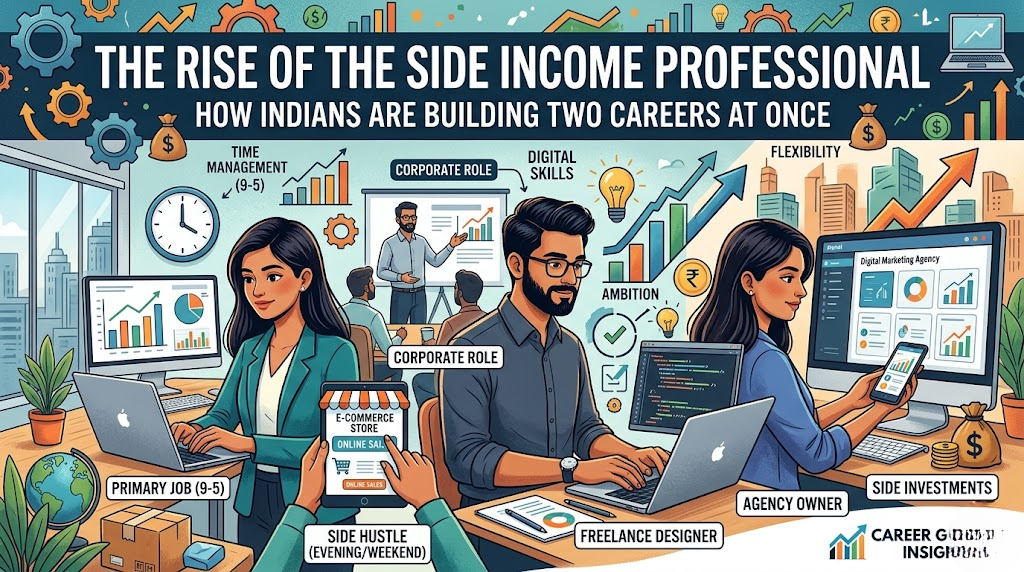
One job pays the bills. The second one builds the future. Meet the new India — working smarter, earning more, and refusing to depend on a single salary.
Riya is a 26 year old graphic designer from Indore. Every morning she goes to her full time job at a local marketing agency. She earns a decent salary. She is good at her work. But at 7pm, when she gets home, she opens her laptop again.
Not to check work emails. Not to finish office tasks.
She opens Fiverr. She has four international clients — two in the UK, one in Dubai, one in the US. She designs logos, social media posts, and brand kits for them. Last month, she earned more from these side projects than from her main job.
Riya is not special. She is not unusual. In 2026, she is one of millions of Indians quietly building a second career — right alongside their first one.
This is the rise of the side income professional. And it is changing the way Indians think about money, work, and career security forever.
The Numbers Tell the Story
- India has over 15 million freelancers — and this number is growing fast
- The average Indian freelancer earns around ₹20 lakh per year
- 23% of Indian freelancers earn more than ₹40 lakh per year
- India’s freelance market is expected to grow at 25% every year until 2033
- 60% of Indian freelancers are under 30 years old
- 82% of freelancers say they found more work opportunities in 2025 than the year before
Why Are So Many Indians Starting a Second Income Now?
This is not just a fashion trend. There are real reasons why millions of working Indians are choosing to build a second source of income — even when they already have a job.
Reason 1: One salary is not enough anymore
Rent is going up. Food is more expensive. School fees keep rising. A single salary used to be enough to live comfortably. For many people today, it barely covers the basics. A second income is no longer a luxury. For many families, it has become necessary.
Reason 2: Jobs are not as safe as they used to be
In the last few years, many big companies — including tech companies — have done mass layoffs. People who thought their jobs were permanent lost them overnight. This taught many professionals a very important lesson: depending on one employer is a risk. Having a second income means that even if your main job disappears tomorrow, you still have money coming in.
Reason 3: The internet made it easy
Ten years ago, if you wanted to find freelance work, you had to know the right people. You had to make phone calls. You had to be in the right city. Today, a software developer in Nagpur can find a client in New York in 20 minutes. A teacher in Bhopal can tutor a student in Singapore on Zoom. A writer in Kochi can write blogs for a company in London. The internet removed every barrier that used to stop people from earning globally.
Reason 4: Remote work changed everything
The pandemic showed people that work can happen from anywhere. Companies got comfortable hiring remote workers. Professionals got comfortable working from home. This created the perfect environment for side income — because now you can work your full time job from home and use the same laptop to do freelance work in the evenings.
“India’s gig economy now includes over 15 million people earning substantial side income. Economic pressures have transformed side income from optional to essential for many professionals.” — CRISIL 2026 Report
Who Is the Side Income Professional?
Forget the old image of the “freelancer” — the struggling artist or the person between jobs. The side income professional of 2026 looks very different.
They have a full time job. They are a software engineer, a teacher, a marketing manager, a doctor, a CA, a designer, or an HR professional. They are good at their main job and they want to keep it.
But they have also built something on the side. A skill they are monetising. A service they are selling. A piece of content that earns them money while they sleep.
They are not doing this because they hate their job. They are doing it because they understand something that the previous generation did not always know: having only one income stream is a financial risk. Having two or three is a strategy.
What Kind of Side Work Are Indians Doing?
Here are the most popular ways Indians are building a second income right now:
Freelance Writing and Content Creation: Writers, bloggers, and content creators are in very high demand. Companies around the world need blog posts, website content, product descriptions, and social media writing. A good freelance writer in India can earn ₹10,000 to ₹40,000 per month working just 10 to 15 hours a week. Platforms like Upwork, Fiverr, and Contra make it easy to find clients.
Graphic Design and Video Editing: If you know tools like Canva, Adobe Photoshop, Premiere Pro, or CapCut, companies will pay you to create content for them. Logo design, social media graphics, YouTube thumbnails, reels editing — the demand is huge and growing. Many Indian designers earn in dollars from international clients.
Online Teaching and Tutoring: India has some of the best teachers in the world. Platforms like Vedantu, Unacademy, Teachable, and even YouTube allow teachers to reach thousands of students. Online tutoring pays between ₹500 and ₹2,000 per hour depending on the subject. Many professionals teach what they know — coding, finance, English, design — and build a loyal student base over time.
Software Development and IT Work: Indian developers are among the most hired freelancers in the world. A freelance developer in India can earn $18 to $80 per hour from international clients. Many IT professionals work their 9 to 6 job and then take on one or two freelance projects on the side. Some of them eventually earn more from freelancing than from their salary.
Digital Marketing: Every business in India — small shops, startups, restaurants, coaching centres — needs help with Instagram, Google ads, SEO, and WhatsApp marketing. If you understand digital marketing, you can offer these services to local businesses and earn a solid side income. No need for international clients. Your own city has enough demand.
Selling Online: Platforms like Meesho, Amazon, Flipkart, and Instagram Shops have made it easy for anyone to sell products online. Many professionals run a small online business on the side — selling handmade products, reselling goods, dropshipping, or even selling digital products like templates and eBooks.
Consulting and Coaching: If you have 5 to 10 years of experience in any field, people will pay you for your knowledge. Career coaches, finance consultants, HR advisors, and marketing mentors are all in demand. One hour of consulting can earn you ₹2,000 to ₹10,000 depending on your experience and field.
The Real Math: What Does a Second Income Actually Look Like?
Let us look at some real numbers that show what is possible.
A content writer working 12 hours a week on the side can ern ₹15,000 to ₹30,000 per month extra.
A graphic designer taking 3 to 4 freelance projects per month can earn ₹20,000 to ₹50,000 per month extra.
A software developer doing one freelance project per month can earn ₹30,000 to ₹80,000 per month extra.
An online tutor teaching 10 hours a week can earn ₹20,000 to ₹40,000 per month extra.
Now add that to a regular salary of ₹40,000 to ₹60,000 per month — and you see how fast things change. In 12 months, a professional with a good side income can save enough to clear debt, build an emergency fund, go on a trip they always wanted, or invest seriously for the first time.
The average Indian freelancer earns around ₹20 lakh per year. 23% of them earn more than ₹40 lakh. This is not side income anymore. For many people, this is life-changing money.
The Challenges Are Real Too — Here Is What Nobody Tells You
Building a second income is exciting. But it is also hard. Let us be honest about the challenges.
Time is your biggest problem. After a full work day, it is not easy to sit down and do more work. Many people start with great energy and burn out within two or three months. The solution is to start small. Even 5 to 7 hours a week is enough to begin.
Finding your first client is the hardest part. Everyone struggles with this. The trick is to not wait until you are perfect. Start with small projects. Work for lower rates at the beginning. Collect reviews and testimonials. Use your existing network — tell your friends, ex-colleagues, and family what you are offering. Your first client is almost always someone who already knows you.
Irregular income is stressful. Some months are great. Some months are slow. This unpredictability is one of the biggest reasons people give up on freelancing. The solution is to always keep building — even when you are busy. Never stop reaching out, posting content, or talking to potential clients just because you currently have enough work.
Taxes and paperwork can be confusing. In India, freelance income is taxable. You may need to register for GST if your income crosses ₹20 lakh per year. Income from freelancing falls under “profits and gains from profession” under the Income Tax Act. Many freelancers use Section 44ADA for simplified tax filing. Talk to a CA once your income starts growing — it will save you a lot of trouble later.
58% of freelancers in India have experienced not receiving payment for work they completed. Always use a written agreement. Take an advance before starting work. Use invoicing tools to track payments. Protect yourself before you begin any project.
How to Start Your Side Income Journey — Step by Step
You do not need to quit your job. You do not need a big investment. You just need to start.
Step 1: Pick one skill you already have. Do not try to learn something brand new before starting. What do you already know how to do well? Writing? Teaching? Designing? Coding? Accounting? Start there.
Step 2: Create a simple profile on one platform. Upwork, Fiverr, LinkedIn, or Internshala — choose one. Fill it completely. Write clearly about what you offer and who you can help. Upload examples of your work even if they are just personal projects.
Step 3: Tell your network. Post on LinkedIn that you are now available for freelance work. Message 10 people you know and tell them what you are offering. Your first client is probably already in your contacts list.
Step 4: Do your first project for a fair price, not for free. Many people make the mistake of working for free to build a portfolio. You do not need to do this. Charge a fair, small amount. Even ₹500 for a small task is better than free. It builds a professional relationship.
Step 5: Collect a review or testimonial after every project. This is the most important step. A good review on your profile is worth more than any advertisement. Ask every client — no matter how small the project — to leave a review.
Step 6: Slowly raise your rates as your experience grows. Most side income professionals undercharge when they start. As you build a track record, increase your rates every few months. This is how ₹500 per hour becomes ₹2,000 per hour within two years.
The Mindset Shift That Makes All the Difference
The biggest thing that separates people who successfully build a second income from those who try and give up is not skill. It is not time. It is mindset.
Most Indians grow up being told: get a good job, keep it, do not take risks. One job. One salary. Stay safe.
That thinking made sense 20 years ago. It does not fully make sense today.
The most financially secure professionals in India right now are not the ones with the highest salary. They are the ones with multiple income streams. They have a salary coming in every month. They have freelance income. Some of them have content that earns them money passively. They are not depending on one company, one manager, or one economy.
This is not a side hustle. This is a strategy. And in 2026, more and more Indians are figuring this out — one project at a time.
Conclusion
A few years ago, having a side income was seen as something you did when you were struggling. Today, it is something you do when you are smart.
India has over 15 million freelancers. The average Indian freelancer earns ₹20 lakh per year. The market is growing at 25% every year. The demand for Indian professionals — from global companies, from local startups, from individuals — has never been higher.
You have skills that people will pay for. You have evenings and weekends that can become productive. You have platforms that connect you to clients all over the world in minutes.
One salary is a starting point. Two incomes is a safety net. Three income streams is financial freedom.
The side income professional is not working two jobs out of desperation. They are building two careers out of choice. And in the process, they are creating a kind of security that no single employer can ever take away from them.
Your second career is waiting. All you have to do is start.
Frequently Asked Questions
What is a side income in simple words? A side income is money you earn outside of your main job. It can come from freelancing, online teaching, selling products, consulting, or any skill you use to help others for payment. You keep your regular job and earn extra money on the side.
How much can I realistically earn from a side income in India? It depends on your skill and how much time you put in. A beginner can earn ₹10,000 to ₹30,000 per month with part time effort. With experience and regular clients, many Indians earn ₹50,000 to ₹1 lakh or more per month from their side work. The more consistent you are, the more you earn.
Do I need to pay tax on my side income in India? Yes. Any income you earn — including freelance and side income — is taxable in India. If your freelance income is below ₹50 lakh per year, you can use the simple tax option under Section 44ADA. If your income crosses ₹20 lakh per year, you also need to register for GST. It is a good idea to speak with a CA once your side income starts growing regularly.
Can I do side work while working a full time job? Yes, most people do. Many professionals do their side work in the evenings and on weekends. You do not need to quit your job to start earning on the side. Just make sure your employment contract does not have a clause that stops you from doing outside work — some companies have this condition.
What is the best platform to find side income work in India? For skilled work like writing, design, and coding — Upwork, Fiverr, and Freelancer.com are the most popular. For teaching — Vedantu, Unacademy, and Teachable work well. For local work — LinkedIn and local Facebook groups are very effective. Start with one platform, build your profile well, and focus on getting your first few reviews.
How do I find my first freelance client? Start with the people you already know. Tell your friends, ex-colleagues, and family what you are offering. Post on LinkedIn. Join relevant WhatsApp groups and communities in your field. Many people find their first client simply by telling their network what they are now available to do. You do not need to wait for clients to come to you — go to them first.
Is side income a long term career option? It absolutely can be. Many Indians start with a side income and eventually make it their main income. But even if you keep your full time job forever, a side income gives you financial security, new skills, and more control over your life. You are never fully dependent on one employer — and that freedom is worth more than people realise until they have it.
Tags: #SideIncome #FreelanceIndia #GigEconomy #IndiaCareer #WorkFromHome #FreelancingIndia #CareerGrowth #ExtraIncome #IndianFreelancer