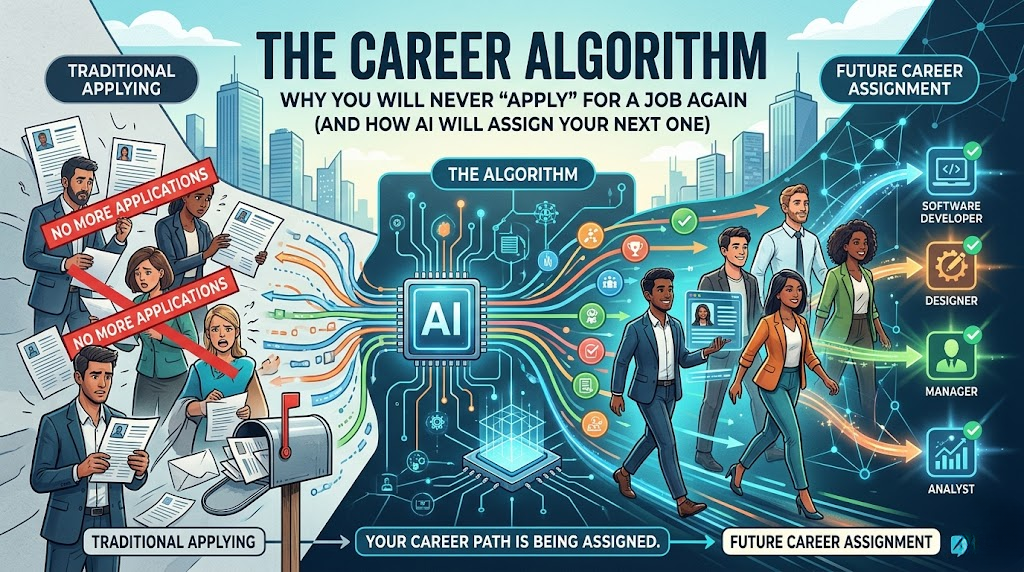
We need to talk about the “Black Hole.”
You know exactly what I mean. You spend two hours tweaking your resume, filling out a massive Workday portal, and writing a cover letter. You hit “Submit.”
And then… nothing. Silence. Just a robotic rejection email three months later.
The modern job hunt is a soul-crushing, broken system. It relies on humans reading pieces of paper that everyone knows are exaggerated.
But the game is fundamentally changing.
We are witnessing the death of the “Apply” button. Within the next few years, you won’t hunt for jobs anymore. An algorithm will find you, verify your worth, and assign you your next career move.
Here is how the “Career Algorithm” works—and how you can rig it in your favor.
The Death of the Resume
A resume is a self-reported marketing document. Algorithms don’t trust marketing; they trust data.
Right now, elite AI recruiting platforms are bypassing the Applicant Tracking Systems entirely. They don’t care about your formatted PDF. They are aggressively scraping your Digital Exhaust.
They scan your GitHub commits, your Substack articles, your LinkedIn comments, and your portfolio links. They bypass what you say you can do, and mathematically map what you have actually done.
If your skills exist only in a private Word document, to the AI, you do not exist.
Predictive Talent Mapping (The AI Knows You Want to Quit)
Here is where the psychology gets wildly futuristic.
Companies aren’t waiting for you to get frustrated and apply. The algorithms are predicting your burnout before you even update your LinkedIn status.
- The Tenure Trigger: The AI knows the average shelf-life of your role is 2.4 years.
- The Market Shift: It sees that your current company’s stock just dipped and your VP just quit.
- The Match: It instantly flags you as “Highly Receptive” to a new offer.
You aren’t applying. A recruiter’s AI agent is simply sliding into your inbox precisely when you are most vulnerable, offering a role perfectly calibrated to your skill gaps.
The “Pre-Matched” Economy
Imagine a dating app, but for high-income corporate placements.
In the Career Algorithm era, the friction of the interview is gone. You don’t have to prove your technical competence—the AI has already verified it.
You enter the interview stage pre-vetted with a 95% compatibility score. The human hiring manager isn’t there to grill you on your hard skills. They are only there to check your emotional intelligence.
The heavy lifting is done. You have essentially been “assigned” the role by the math.
How to Hack the Career Algorithm Today
If you want to command premium salaries in this new era, you must stop acting like a job hunter and start acting like a data set.
You must feed the machine.
- Show Your Work in Public: Publish your case studies. Write teardowns of industry problems on LinkedIn.
- Context Over Keywords: Stop stuffing your profile with buzzwords like “Synergy” and “Leadership.” Use concrete, searchable data: “Scaled a React app to 10k users.”
- Connect the Nodes: Ensure your professional profiles link to your actual projects. Make it effortless for the scraping bots to verify your brilliance.
You Are Now the Product
The anxiety of job hunting is over. The era of algorithmic assignment is here.
Your goal is no longer to beat the competition in an interview room. Your goal is to make sure your digital footprint is so undeniable, so aggressively public, that the AI cannot help but assign you the best role on the board.
Your Next Step: Stop hiding your expertise. Go to your LinkedIn profile right now. Change your “About” section from a boring summary into a bulleted list of three specific, data-backed problems you have solved in the last year.
Feed the algorithm. Once you update it, drop a “Done” in the comments below!