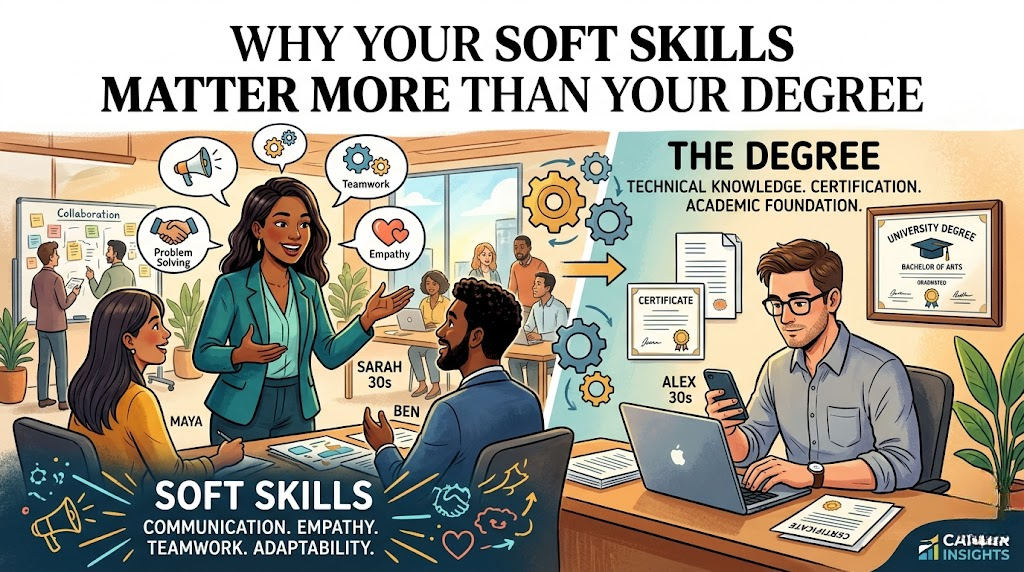
Your degree helped you get started. But your soft skills decide how far you go. Here’s why.
Think about two people applying for the same job.
Person A has a top degree from a famous college. Person B has an average degree from a regular college — but for the last three years, they have been leading teams, solving problems, and helping their colleagues every single day.
Who gets the job?
Most of the time in 2026 — it’s Person B.
This is happening everywhere right now. In IT companies. In banks. In hospitals. In factories. Companies are changing the way they hire people. Your degree still matters. But it is no longer the only thing that matters.
So what do companies care about now? They care about skills you cannot learn from a textbook. Skills you build by working hard, talking to people, making mistakes, and growing from them.
These are called soft skills. And they could be the most important thing for your career right now.
Quick Numbers Worth Knowing
- 92% of recruiters say soft skills are as important as — or more important than — technical skills
- 89% of employees who get fired are let go because of poor soft skills — not poor technical skills
- 85% of long-term career success comes from soft skills and attitude
- 70% of companies now hire based on skills — not just degrees
What Are Soft Skills? And Why Do People Ignore Them?
Soft skills have a problem. The name sounds weak. When people write “good communicator” or “team player” on their resume, it feels like filler. Like they had nothing else to say.
But soft skills are not weak at all. They are actually very hard to learn. And very hard to fake.
Here is a simple way to think about it. You can teach someone a new software tool in two or three weeks. But can you teach someone in two or three weeks to stay calm when everything is going wrong? To speak clearly when they are nervous? To understand how a colleague is feeling — even when that colleague says nothing?
No. These things take years to build. That is exactly why companies are willing to pay more for people who have them.
Big companies lose an average of $62.4 million every year because their employees cannot communicate well. That is not a small problem. That is a very expensive one.
Are Degrees Still Important in 2026?
Yes — but not in the way they used to be.
A few years ago, if you did not have a degree, most companies would not even read your application. In 2019, about 73% of companies checked your GPA before giving you an interview. Today, only 42% do that.
Big companies like Google, IBM, Apple, Bank of America, and Delta Air Lines have removed the degree requirement for many of their jobs. IBM even has a special programme where they hire people without degrees and train them from scratch.
Why? Because they found something interesting. Employees hired without degrees actually stay at the company 34% longer than employees hired with degrees. They work just as well. And there are more of them available.
“Companies are looking less at your degree and more at what you can actually do.” LinkedIn Skills on the Rise 2026
The Top Soft Skills Companies Want Right Now
Here are the soft skills that hiring managers are looking for the most in 2026:
1. Communication Can you explain your ideas clearly? Can you write a simple email? Can you speak in a meeting without confusing people? Communication is the number one skill companies want. It sounds basic. But most people are not as good at it as they think.
2. Analytical Thinking This means being able to look at a problem, break it into smaller parts, and find a solution. 7 out of 10 companies say this is one of the most important skills they look for.
3. Adaptability Things change fast at work. New tools. New processes. New managers. New goals. The people who can change with the situation — without falling apart — are extremely valuable. AI cannot do this for you.
4. Professionalism and Accountability This means showing up on time. Finishing what you start. Saying sorry when you make a mistake. Not making excuses. It sounds very simple. But hiring managers in 2026 say this is the second most important soft skill they look for. Many people struggle with it.
5. Emotional Intelligence This is the ability to understand your own feelings — and the feelings of the people around you. Good managers have high emotional intelligence. It helps them build trust, handle conflict, and keep their team happy. No machine can replace this.
6. Critical Thinking and Problem-Solving This is not just about solving problems. It is about asking the right questions first. Why is this problem happening? Is this the real problem — or just a symptom of something bigger? People who think this way become very important to their organisations.
Here Is the Truth Nobody Tells You
The skills that get you hired and the skills that get you promoted are two very different things.
A software developer gets hired because they can code. But they get promoted to team leader because they can explain things clearly, manage people well, and stay calm under pressure. That has nothing to do with coding.
A finance professional gets hired because they can do numbers. But they become a manager because they can present ideas with confidence, build good relationships, and help junior team members grow. That has nothing to do with spreadsheets.
Hard skills — what they get you: A job interview. A first job. A chance to prove yourself.
Soft skills — what they get you: Promotions. Leadership roles. Respect from your team. A long and growing career.
AI Is Actually Making Soft Skills More Important
Many people are scared that AI will take their jobs. And yes — AI is replacing some tasks. But look at which tasks it is replacing. Data entry. Basic writing. Simple research. These are mostly technical tasks — hard skills.
What AI cannot do? Build real trust with a person. Handle a difficult conversation. Inspire a team that has lost motivation. Make a judgment call when the rules do not apply. These are human skills. Soft skills. And as AI does more of the technical work, these human skills become more and more valuable.
LinkedIn’s 2026 report says the fastest-growing skills in the job market are a mix of AI knowledge and human skills like communication and leadership. The future belongs to people who have both.
How to Build Your Soft Skills — Starting Today
This is the question most people ask: “Okay, but how do I actually get better at soft skills?”
The answer is practice. Real practice. In real situations.
To improve communication: Speak up in your next team meeting. Write a short post on LinkedIn about something you learned. Record yourself speaking and watch it back. Yes, it feels awkward. That awkward feeling is where the growth happens.
To improve adaptability: Volunteer for a project you have never done before. Help a team in a different department. Learn something new — just for the challenge of learning it. Being a beginner again trains your mind to handle change.
To improve emotional intelligence: Start by listening better. In your next conversation, focus fully on the other person. Do not think about what you will say next. Just listen. Ask questions. This one small habit, done regularly, changes how people see you.
The results are real. 63% of people who worked on their soft skills saw direct improvement in their job performance. Companies that invest in soft skills training are expected to grow revenue by 26%.
You do not need another degree to grow your soft skills. You need real practice, in real situations, with real people. Start small. Start today.
Conclusion
Your degree is a piece of paper that says you studied something. Your soft skills are proof of who you are at work — how you think, how you talk to people, how you handle pressure, and how you treat others.
The best companies in the world are no longer just looking at your certificate. They are watching how you behave. How you speak. How you lead. How you bounce back when things go wrong. These things are now the real requirements for getting hired and growing your career.
If you are a student — do not only focus on your grades. Focus on how you show up every single day.
If you are already working — know that your next promotion will depend more on your people skills than your technical skills.
And if you are hiring someone — do not just look at their resume. Look at the person. The one who will carry your team forward is the one who makes others around them better.
Hard skills open the door. Soft skills build the career. The sooner you understand this, the faster you will grow.
Frequently Asked Questions
What are soft skills in simple words? Soft skills are how you behave and communicate at work. Things like speaking clearly, working well with others, staying calm under pressure, and being reliable. They are different from technical skills like coding or accounting — which are about what you know how to do.
Is a degree still useful in 2026? Yes, a degree is still useful. Some jobs like doctor, lawyer, or engineer still need one. But for many jobs today, companies care more about what you can do than what certificate you have. 70% of companies now hire based on skills — not just degrees. So your degree is a starting point, not a guarantee.
Which soft skill should I work on first? Start with communication. It is the most in-demand soft skill according to hiring managers in 2026. If you can explain ideas clearly, write well, and speak confidently — you will stand out in almost any job or industry.
Can I learn soft skills on my own? Yes. You do not need a course or a trainer to start. The best way to build soft skills is through real experience. Speak up more at work. Take on new challenges. Listen carefully to people. Reflect on what went well and what did not. These small habits, done every day, make a big difference over time.
How do I show soft skills in a job interview? Tell real stories. Instead of saying “I am a good team player,” say “In my last job, my team had a big disagreement before a deadline. I spoke to each person separately, understood what they needed, and helped us find a solution together.” That kind of story shows soft skills — it does not just describe them.
Will AI replace soft skills jobs? No. AI is very good at technical tasks — writing simple content, analysing data, processing information. But AI cannot build real relationships, handle emotional situations, or lead a team through a difficult time. These are human skills. As AI takes over more technical work, human soft skills become more valuable — not less.
What is skills-based hiring? Skills-based hiring means a company hires you based on what you can do — not just based on your degree or GPA. More and more companies are doing this now. For job seekers, it is good news. It means your real experience, your projects, and how well you communicate matter just as much as your academic results.
#SoftSkills #CareerGrowth #JobSearch2026 #CareerTips #GetHired #FutureOfWork #SkillsBasedHiring