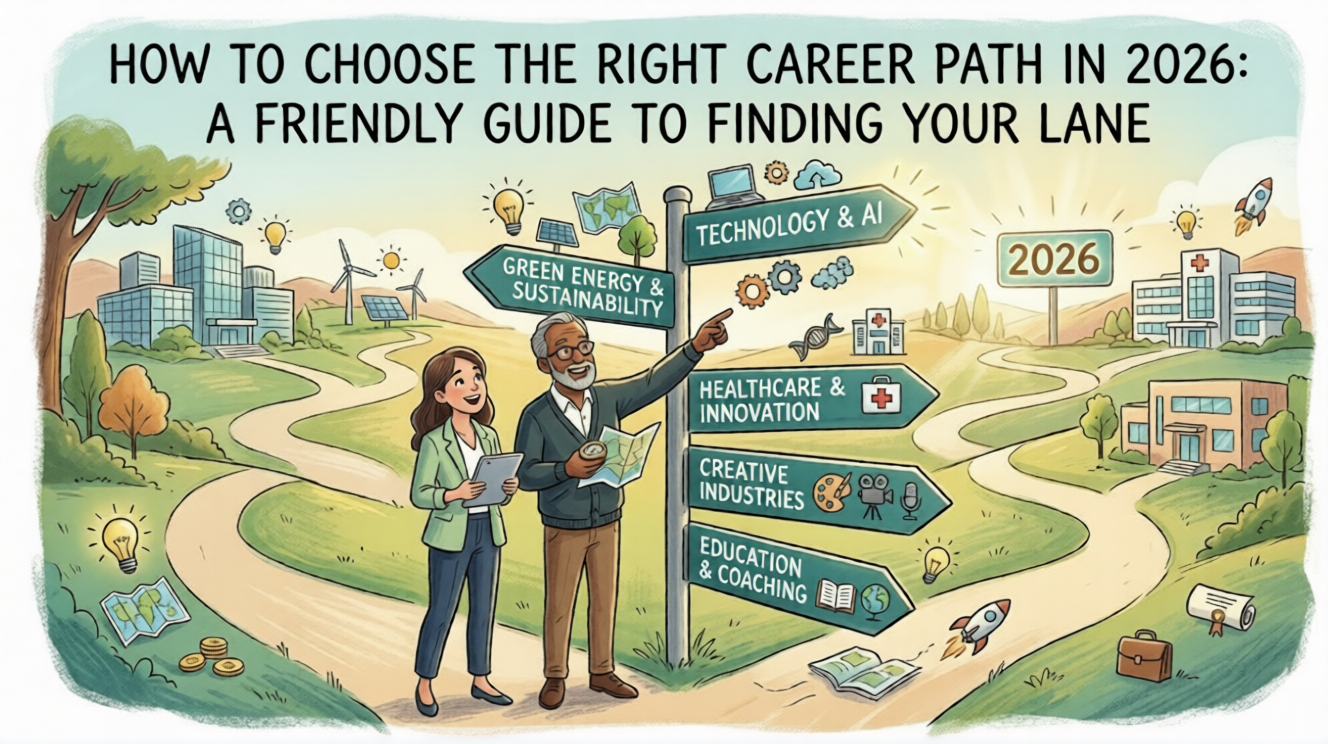
introduction: It’s a New World Out There
Let’s be real for a second. If you’re reading this in 2026, you’ve probably noticed that the “job market” looks nothing like it did five years ago. AI isn’t coming; it’s already here. The “climate economy” is booming, remote work has split into “digital nomad” and “AI-augmented local” roles, and frankly, the old advice of *”just follow your passion”* feels a little… vague.
If you are feeling overwhelmed, stuck, or worried that you’re falling behind—take a breath. You are not late to the party. You are exactly on time.
Choosing a career path in 2026 isn’t about predicting the future perfectly. It’s about aligning *who you are* with *what the world actually needs*. And the best news? You don’t have to get it right on the first try anymore.
Let’s walk through how to find your lane without losing your mind.
Step 1: Stop Asking “What Am I Passionate About?” (Ask This Instead)
Passion is a great fuel, but a terrible GPS. In 2026, the most successful career-changers ask three specific questions:
1. What problems do I enjoy solving? (e.g., organizing data, calming angry customers, fixing broken code, teaching a concept).
2. What does the market pay for? (Check live job boards for “GenAI Operator,” “Sustainability Analyst,” or “Elderly Tech Navigator”).
3. What can I tolerate doing for 6 hours a day? (Brutal honesty here saves you later).
Pro Tip:Write down three tasks you lose track of time doing. Not the “dream job” title—the actual tasks. Those tasks are your raw materials.
Step 2: Know the 3 Hot “Horses” of 2026
You don’t have to be a coder to win in this economy. Right now, the career landscape looks like three racing horses. Pick the one that fits your energy level:
The AI Collaborator: You don’t fight AI; you manage it. Roles like Prompt Engineer, AI Workflow Designer, or LLM Trainer. Best for: Curious minds who love efficiency.
The Human Touch Specialist: As AI gets smarter, empathy gets rarer. Think Mental Health Coaches, Sales Closers, Senior Care Coordinators, or Mediators. Best for: High-EQ people who hate spreadsheets.
The Green Transformer: The climate transition is creating millions of jobs. Solar Supply Chain Manager, Battery Recycling Tech, Carbon Accounting Analyst. Best for: Hands-on builders and systems thinkers.
Engage with me here: Which of those three buckets makes your shoulders feel lighter? Seriously, pick one.
Step 3: The “Try Before You Buy” Method (No More 4-Year Mistakes)
You would not marry someone before a first date, so why commit to a 4-year degree or a certification before testing the waters?
The 2026 Playbook:
Take a Micro-Internship (1 week). Platforms like Forage or Paragon One let you simulate real work at Goldman Sachs or Deloitte for free.
Shadow via AI. Use tools like CareerVillage’s AI coach to interview virtual mentors in your dream role.
Build a “Zero-Cost MVP.” Want to be a social media manager? Run a 30-day page for a friend’s bakery. Want to be a UX designer? Redesign your coffee shop’s receipt.
Remember: Action cures anxiety. You don’t need clarity to start; you need to start to get clarity.
Step 4: Future-Proofing (The “Hybrid Skill” Secret)
The days of “I am a marketer” or “I am a coder” are fading. In 2026, you are a stack of skills.
The safest career path combines one *hard skill* (data analysis, coding, accounting) with one soft skill (storytelling, negotiation, empathy) and one digital tool (Slack, Notion ) .
Example: Accountant + Storyteller + Excel = Boring.
Example: Accountant + Storyteller + AI Visualization = Financial Forensic Consultant (makes $140k+).
Step 5: The “Energy Audit” (Your Secret Weapon)
Here is the part no LinkedIn influencer tells you. You can love the idea of a career but hate the energy of it.
Ask yourself:
– Do I want to talk to people all day (Sales, Nursing, Teaching)?
– Or do I want to work alone in deep focus (Coding, Writing, Lab Work)?
– Do I need variety (Emergency Medicine, Journalism)?
– Or routine (Data Entry, Compliance)?
Be honest. Choosing a path that fits your natural energy level is more important than salary. A high salary in a job that drains your soul is actually a debt.
Conclusion: You Are Allowed to Change Your Mind
Here is the secret truth of 2026: Careers are no longer ladders; they are jungle gyms. You will move sideways, diagonally, and sometimes down to go up later.
The “right” career path isn’t a single destination you find. It’s a direction you choose today, knowing you have the power to turn left in two years.
So, grab a coffee (or tea). Do that energy audit. Pick one small action from Step 3. And start moving. The world doesn’t need you to be perfect; it needs you to show up.
You’ve got this.
Frequently Asked Questions (FAQs)
Q1: Is college still worth it in 2026?
A:It depends. For licensed professions (Doctor, Engineer, Lawyer), yes. For tech, creative, or business roles? Often, a portfolio or micro-credential beats a degree. Look into “income-share agreements” or employer-funded bootcamps first.
Q2: What if I pick the wrong path and waste years?
A: You cannot “waste” time. Every job teaches you what you don’t like, which is just as valuable as knowing what you like. Plus, skills are transferable. A failed sales role taught you resilience; a boring admin job taught you systems. That is not waste; that is data.
Q3: Are remote jobs still a thing in 2026?
A: Yes, but they have evolved. Pure remote is mostly for senior tech roles. The new sweet spot is “Hybrid 2.0”: 2 days in office for collaboration, 3 days at home for focus. If you want fully remote, specialize in asynchronous work (writing, coding, design).
Q4: I am 35+ and want to switch completely. Am I too old?
A: Stop right there. You are not too old; you are experienced. You bring soft skills (management, crisis handling) that 22-year-olds do not have. Leverage that. The average age of a successful career-changer is 39. You are exactly on time.
Q5: How do I know if AI will take my job?
A: Don’t ask if AI will take your job. Ask if *someone who knows AI will take your job. Learn to be the “human in the loop.” AI automates tasks, not roles. Focus on judgment, creativity, and emotional connection—AI is terrible at those.
Ready to take the next step? Share this article with one friend who is also feeling stuck. Having an accountability partner doubles your chances of making a move before summer.