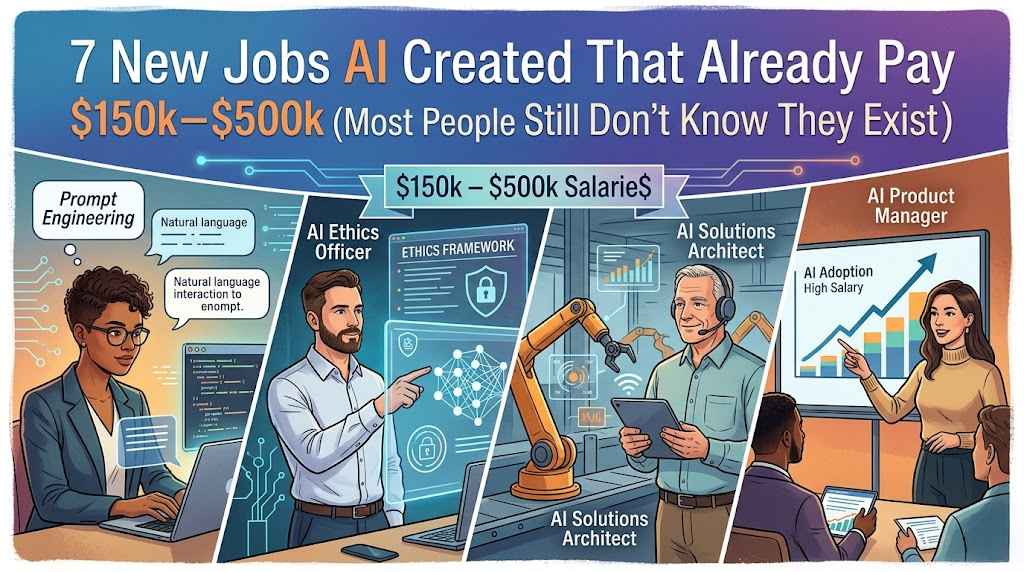
(Most People Still Don’t Know They Exist)
While the internet argues about which jobs AI is destroying, a quiet revolution is happening. New roles are being minted. New salaries are being set. And most people? They don’t even know these jobs exist yet.
You’ve seen the doom headlines.
“AI takes 300,000 jobs.”
“ChatGPT replaces writers, coders, analysts.”
And you nod. You worry. You wonder what’s left.
But here’s what nobody is telling you.
While AI dismantles old roles on one side of the economy, it is building entirely new ones on the other — roles that pay more than most people earn in a decade of grinding the traditional path.
Roles that didn’t exist five years ago.
Roles that companies are desperately trying to fill right now.
Roles you’ve probably never heard of.
Until today.
First, The Numbers That Will Shock You
Before we dive into the roles, let’s establish the scale of what’s happening — because this is not small.1 In Q1 2025 alone, the U.S. recorded **35,445 open AI roles** — up 25.2% from the year before. 3 Gartner projects that by 2025, AI will have **created 4.2 million jobs while eliminating 2.3 million.** New job roles are appearing thanks to the rapid development of AI technology.
That’s a net gain of nearly 2 million jobs.
And the compensation? 1In some specialized roles, total pay can climb past $400,000 once equity and bonuses are factored in.
This is not a distant future. This is right now.
Here are the 7 roles you need to know about.
Job #1 — Chief AI Officer (CAIO)
The Executive Role That Didn’t Exist Five Years Ago
Salary Range: $351,000 – $643,000+
This is the C-suite position the AI revolution created from scratch.1 Chief AI Officers sit at the executive level, defining AI strategy across the entire organization. They decide which AI initiatives get funded, ensure ethical AI deployment, manage cross-functional teams, and report directly to the CEO on how AI drives competitive advantage. 2 The average CAIO pulls in **$351,766** — but top earners at leading tech firms can hit **$643,731.** This executive role didn’t exist five years ago. Now it’s one of the most coveted positions in corporate America.
And here’s the thing. Every major company needs one. Most don’t have one yet.
The demand is outpacing the supply at a breathtaking rate.
What it takes to get here:
- 7 Most CAIOs have 10–15+ years of experience in AI and technology leadership. The path typically includes technical roles, management positions, and strategic leadership before ascending to the C-suite.
- The ability to 1explain “black-box” AI decisions to non-technical stakeholders is crucial. Executives paying $200,000+ salaries expect you to articulate why a model made specific predictions, what business risks exist, and which investments will deliver ROI. Technical brilliance matters less if you can’t translate it into business value.
The CAIO isn’t just a tech job. It’s a strategy job with a tech foundation — and a half-million-dollar ceiling.
Job #2 — AI Research Scientist
The People Building the Minds of Tomorrow
Salary Range: $300,000 – $893,000+
If the CAIO directs the strategy, the AI Research Scientist builds the future.2 They push the boundaries of what’s possible with AI, developing breakthrough algorithms that could change everything.
And the compensation is almost hard to believe.2 Meta throws around **$489,000 packages** for these roles, while OpenAI pays up to **$440,000 base salary.** Google’s DeepMind division has been known to hit **$893,000 for senior positions.**
Why so much? Because 8the most intense battle centers over a small pool of fewer than 1,000 AI research scientists who can build today’s most advanced large language models.
When supply is that scarce and demand is that explosive, salaries go vertical.
- 8 Software engineers at venture-backed startups are receiving median base-salary offers of **$200,000 — a 25% increase from 2022.**
- 5 As one tech recruiter observed: “Mid to senior research scientists can today expect total pay of **$500K to $2M** at Big Tech groups.”
This role requires deep technical expertise — PhD-level ML knowledge. But for those who have it?
The world is literally bidding for you.
Job #3 — AI Prompt Engineer
The Most Accessible Six-Figure Job in Tech History
Salary Range: $126,000 – $335,000+
Here’s where it gets really interesting.
Because this is the role that broke all the rules.14 When Anthropic posted a “Prompt Engineer and Librarian” position with a salary **up to $335,000**, the tech world took notice. This wasn’t a role requiring a PhD or decades of coding experience — it was for someone who could **effectively communicate with AI.**
Let that sink in.
A $335,000 job. For communication skills.15 A Prompt Engineer crafts inputs for generative AI models — questions, instructions, or requests — that produce **optimized and valuable outputs.** Think of them as the translators standing between human intention and machine intelligence.
The demand is staggering:
- 7 Demand for this skill has surged **135.8% in a single year.**
- 13 According to Glassdoor, the median total annual pay is **$126,000.**
- 14 Big Tech — Google, Microsoft, Amazon, and Meta — actively recruit prompt engineers, with salary ranges spanning **$110,000–$250,000.**
And the barrier to entry?18 You don’t need a coding background. A lot of the skills needed for the job are just **clear communication and effective writing.**
This is the first time in tech history that a $200K+ job opened up to people who are simply exceptional at thinking and communicating clearly. That is an extraordinary moment.
Who’s hiring:14 AI Companies like OpenAI, Anthropic, Cohere, and Midjourney offer cutting-edge challenges, often with remote-first cultures and significant equity packages. Enterprises like JPMorgan Chase, Nationwide Insurance, and hospital systems hire prompt engineers for AI integration.
Job #4 — AI Product Manager
Where Business Strategy Meets the AI Frontier
Salary Range: $182,000 – $900,000
Netflix. The word alone commands attention.2 AI Product Managers bridge the gap between technical AI capabilities and business strategy, turning complex algorithms into market-ready products. Netflix made headlines with their **$300,000 to $900,000 salary range** for this role.
That’s not a typo.
Nine hundred thousand dollars. For one person.2 Meta’s AI Product Managers average **$352,000,** while the industry standard sits around **$182,587.** These professionals are literally worth their weight in gold because they can translate AI magic into money-making products.
What makes this role so valuable?1 The ability to explain AI decisions to non-technical stakeholders is crucial for high compensation. Executives paying $200,000+ expect you to articulate why a model made specific predictions, what business risks exist, and which investments will deliver ROI.
The person who can stand in the boardroom, point at the AI, and say “here’s exactly how this makes us money” — that person gets paid like a surgeon.
Skills you need:
- Business strategy and product roadmapping
- Enough technical understanding to speak credibly with engineers
- 21 AI Product Managers define product requirements, prioritize features, and collaborate with cross-functional teams to ensure successful product launches. They also analyze market trends, gather customer feedback, and iterate on product features to maximize value.
Job #5 — AI Ethicist / AI Ethics Officer
The Guardian of Humanity in the Age of Machines
Salary Range: $150,000 – $350,000
This one surprises people.
Ethics pays? Yes. More than most people make in five years of traditional work.
Here’s why. As AI starts making decisions about your loan applications, your cancer diagnosis, your job interview, and your parole hearing — someone needs to make sure it isn’t biased, broken, or secretly discriminatory.
That someone is the AI Ethicist.21 AI Ethicists focus on the ethical implications of AI technologies and their impact on society. They analyze AI systems to identify potential biases, discrimination, and ethical dilemmas, and develop frameworks for responsible AI development and deployment — ensuring that AI technologies align with ethical principles and respect human values.
Why the demand is only going up:22 Demand for AI ethicists is heavy in industries like healthcare and finance due to increasing regulations. As AI becomes embedded in critical decision-making, the need for oversight is likely to grow — making this one of the **fastest-growing non-technical AI careers.**
Career ceiling:3 Senior-level professionals can ascend to Chief AI Ethics Officer or VP of Responsible AI — earning **$200K–$350K.** 22 Projected job growth for this role: **45.3% from 2024 to 2029.**
This might be the only job in the world where having strong moral convictions is literally a competitive advantage worth $300K a year.
Job #6 — AI Red Teamer
The Most Urgent Role Nobody Has Heard Of
Salary Range: $130,000 – $230,000+
Imagine being paid to break things.
Specifically — to try to break AI systems before the bad guys do.
That’s an AI Red Teamer.28 AI Red Teamers proactively test AI systems — especially LLMs and generative AI — for security vulnerabilities, safety risks, biases, and failure modes through **adversarial simulation.**
They approach the AI the way a hacker would. They look for cracks. They find the breaking points. They write the reports.28 Microsoft’s AI Red Team is notably interdisciplinary, including cybersecurity experts, a neuroscientist, a linguist, and national security specialists. They have red-teamed over 100 generative AI products and published a whitepaper on their methodology in January 2025.
The talent crisis driving these salaries:34 According to the IAPP’s 2025 AI Governance Profession Report, **only 1.5% of organizations** believe they have enough people to manage AI safety properly. That gap is the main reason this work commands the rates it does — and that gap is not going to close quickly.
The salary:29 AI Red Team Specialists earn **$130K–$220K**, with a growth rate of +55%. Senior-level specialists at major security firms and Big Tech push toward 35 **$160,000–$230,000.**
The best part? The barrier to entry is surprisingly low:28 This is the newest role in AI governance with one of the lowest barriers to entry — CTF rankings, published research, and open-source contributions carry more weight than years of experience.
You don’t need a decade of credentials. You need a hacker’s mindset, intellectual curiosity, and the willingness to learn a new framework this weekend.
Job #7 — AI Solutions Architect
The Builder Who Connects the Business World to the AI World
Salary Range: $200,000 – $400,000+
Every company wants AI. Almost none of them know how to actually build it.
That’s where the AI Solutions Architect walks in.2 They design AI solutions for enterprise clients, translating business needs into technical architectures. They’re the person who sits across the table from a Fortune 500 CEO, listens to their business problem, and then designs the exact AI system to solve it.
Why they get paid so much:2 Strategic roles at companies like Nvidia and Microsoft command salaries **exceeding $200,000** because they directly drive revenue through client solutions.
And for senior specialists with a track record of enterprise-level AI deployments? 10Total compensation can reach $320K–$500K with equity included.
The skills that make this role:
- Deep understanding of AI/ML architecture
- Ability to translate business requirements into technical specifications
- 21 AI Architects collaborate with stakeholders to understand requirements, select appropriate AI technologies, and oversee implementation — ensuring that AI solutions are **scalable, reliable, and aligned with business goals.**
This role sits at the rare intersection of deep technical knowledge and executive-level communication.
The people who master both?
They write their own salary.
The Uncomfortable Truth About This Moment
Here it is, plainly.7 The window of maximum opportunity won’t stay open forever. As more professionals develop AI skills, the premiums we see today will normalize. The massive salary gaps **represent temporary market inefficiency** — and they favor early movers who build expertise now.
The salaries you just read are not permanent.
They exist because demand is ferocious and supply is tiny.
The gap will close.
The question isn’t whether these jobs will become more competitive.
The question is: Where will you be when that happens?
Already inside the industry — or watching from the outside?
Your Action Plan — Starting Today
Here’s the move:
| Step | Action | Why It Matters |
|---|---|---|
| Step 1 | Pick ONE role from this list that aligns with your existing skills | Don’t start from zero. Start from leverage. |
| Step 2 | Spend 1 hour researching the skills required for that specific role | Clarity beats motivation every time. |
| Step 3 | Identify one free or affordable certification that moves you toward that role | Google AI, Coursera, DeepLearning.ai, HackTheBox |
| Step 4 | Follow 3 people on LinkedIn who already have the job title you want | Reverse-engineer their path. Learn what they learned. |
| Step 5 | Apply or freelance in that space within 90 days | Speed is the differentiator in emerging markets. |
The Closing Bang
The greatest career shifts in history happened when most people were looking the other way.
The internet created millionaires. Most people watched.
Social media created empires. Most people scrolled.
AI is creating entire categories of new, high-paying careers.
And most people?
They’re still reading headlines about what AI is taking away.
The $150K–$500K jobs listed in this article are real, open, and hiring right now — for people brave enough to pivot, disciplined enough to learn, and fast enough to move before the crowd figures it out.
The economy is being rebuilt in real time.
The only question is whether you’re going to be one of the people building it.
The creatives who read this and act will look back on 2025 as the year everything changed. The ones who don’t will wonder what happened.
You already know which one you want to be.
📌 Know someone stuck in a dying career? Share this article. It might be the most important thing they read this year.