Ask ten people what they want from their career in five years and nine of them will say some version of the same thing: “Something better than this.”
That is not a plan. That is a wish. And the distance between a wish and a plan is exactly what separates the people who look back at 40 amazed at what they built — and the people who look back wondering where the time went.
The painful truth is that most people operate their careers on autopilot. They take the next job that finds them. They say yes to whatever is in front of them. They mistake busyness for progress. And then, somewhere around year seven or eight, they wake up to the quiet horror of being accidentally mid-career.
“Your career is the longest project you will ever manage. Most people treat it like an inbox — responding to whatever lands, instead of deciding what matters.”
This article is not a motivational pep talk. It is a working framework. By the time you finish reading, you will know exactly how to map out a five-year career plan that is honest, strategic, and built to flex with the world as it changes around you.
Let us get into it.
Before the framework
Why Every Career Plan You Have Made So Far Has Failed
Before we build anything, we need to acknowledge something uncomfortable: you have probably tried to plan your career before. Maybe in a journal. Maybe in a performance review goal-setting section. Maybe just in your head on a Sunday night. And it did not stick.
That is not a discipline problem. It is a design problem.
Most career planning fails for three specific reasons, and understanding them is the first step to building something that actually works:
The Problem
Plans are too rigid. They treat your career like a train on a fixed track — one destination, one route, no detours allowed.
The Fix
Build a plan with a fixed direction and flexible paths. Know where you are heading. Stay loose on exactly how you get there.
The Problem
Plans are too abstract. “Become a leader” or “grow professionally” are not goals. They are feelings dressed up as goals.
The Fix
Every goal must pass the So What test — if you hit it, what specifically changes in your day-to-day life? If you cannot answer that, the goal is not real yet.
The Problem
Plans ignore the market. You can plan your career in a vacuum all you want — but skills, industries, and opportunities evolve whether you are watching or not.
The Fix
Build your plan around skill value, not job titles. Titles change. Valuable skills compound. Chase the skill, and the title will follow.
The mindset
Stop Thinking in Job Titles. Start Thinking in Leverage.
Here is the mental shift that makes everything else click: the goal of a career plan is not to get a specific job. It is to build a version of yourself who cannot be ignored by the market.
Think of it in three layers:
Layer 1 — Skills: What can you do that is rare and valuable? This is the foundation. Everything else is built on top of this.
Layer 2 — Reputation: Who knows you can do it? Skills without visibility are invisible. The world does not reward the best-kept secret.
Layer 3 — Relationships: Who will go to bat for you? Almost every career-defining opportunity comes through a person, not a job board.
Your five-year plan is not a ladder. It is a compounding machine. Every skill you build makes the next skill easier to acquire. Every relationship you invest in opens doors you cannot yet see. Every year you operate with intention puts distance between you and the people who are just showing up.
The people who build remarkable careers do not get lucky more often. They build the kind of leverage that makes luck irrelevant. Now let us build yours.
The framework
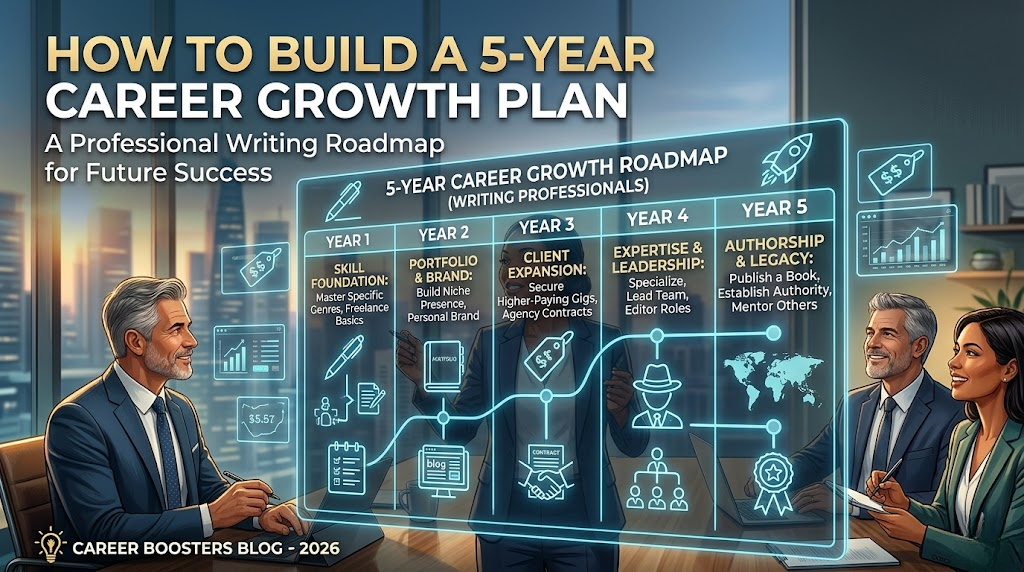
The 5-Year Career Growth Plan — Phase by Phase
Each year of your plan has a primary job to do. Not a list of goals — a job. One clear focus that every decision in that year should answer to. Here they are:
Foundation — Know Exactly Where You Stand
AuditMost people skip this year entirely. They already have a sense of where they are, they think, so they jump straight to planning where they are going. This is the mistake that quietly kills every plan that follows.
You cannot navigate from a location you have not clearly identified. Year One is about producing a brutally honest inventory of yourself — your skills, your market value, your network health, your energy drains, and the gap between where you are and where you want to be.
This question is uncomfortable because it forces you to evaluate yourself the way the market evaluates you — not the way you see yourself from the inside.
- Write a skills inventory — list every hard and soft skill, then rank them by market rarity (not just personal comfort)
- Research what people in your target role at Year 5 actually earn and what their resumes look like — then map the gap
- Have three honest conversations with people who know your work — ask them what you are genuinely great at and what quietly holds you back
- Identify your one critical gap — the single skill or credential that, if closed, would most change how the market sees you
- Define your 5-year destination in concrete terms: role, industry, income, and daily work environment
Skill Stack — Build Your Unfair Advantage
BuildYear Two is where the work begins — but it is more precise than “learn new things.” The goal is to build a skill stack that makes you genuinely rare.
A skill stack is the idea that two or three skills in combination create far more value than any single skill alone. Being good at data analysis is useful. Being good at data analysis and communication and product strategy — that combination is almost impossible to find, and companies will pay handsomely for it.
Your job in Year Two is to identify the two or three skills that, layered on top of your existing foundation, create a combination your market values and struggles to find.
- Pick one deep skill to develop with deliberate practice — this takes 6–12 months of focused effort, not casual exposure
- Pick one adjacent skill that most people in your field do not bother learning — this becomes your differentiator
- Seek projects (inside or outside your current role) where you can apply new skills in real stakes situations — learning without application is just trivia
- Track skill progress quarterly — not by how much you have learned, but by what you can demonstrably produce with it
Visibility — Make Your Work Known
SignalYear Three is where most ambitious people make their biggest mistake: they keep their heads down. They have built real skills. They are doing genuinely good work. And they assume the work will speak for itself.
It will not. Work does not speak for itself. You have to speak for it.
The world is not a meritocracy where the best person always rises. It is an information market. The people who advance are the ones whose value is most legible — most easy to see and understand — to the people who make decisions. Year Three is about making your value legible.
- Choose one public channel — writing, speaking, a professional community — where you will share what you know and build a track record
- Volunteer for high-visibility projects inside your organisation, especially cross-functional ones where you interact with senior stakeholders
- Begin building a focused external network — not collecting contacts, but investing in ten to fifteen real relationships in the ecosystem you are moving toward
- Document your wins — build a running record of outcomes you produced, not just tasks you completed. This becomes your negotiation arsenal.
Leverage — Make the Strategic Move
MoveBy Year Four, something will have quietly happened: you will have accumulated leverage you did not have before. Real skills. A reputation. Relationships that trust you. You are no longer playing defence in your career — you are playing offence.
Year Four is when you convert that leverage into a strategic move. This might mean a major promotion. A lateral jump to a more valuable industry. A move to a company where the ceiling is higher. Or — if you have been building toward it — the launch of something of your own.
The critical distinction: a strategic move is planned and timed, not taken because an opportunity happened to appear. This is the year where your preparation meets its moment.
- Map the specific move you identified in Year One — is it still the right destination, or has your target evolved? (It is allowed to evolve.)
- Activate your network deliberately — not cold applications, but warm conversations with people who are already in the room you want to enter
- Negotiate from a position of prepared strength — you have three years of documented outcomes, developed skills, and market knowledge. Use them.
- Be willing to take a counter-intuitive step — sometimes the fastest path forward is a lateral move, a step sideways into a faster-growing sector, not a direct climb
Compound & Reset — Harvest and Begin Again
ReflectYear Five has two jobs, and they are equally important: consolidate what you have built, and start the next plan.
The most successful professionals do not treat five-year plans as one-time events. They treat them as operating cycles. The plan is never done. You reach the destination, take stock of what compounded and what did not, and immediately begin the audit for the next cycle — from a starting point that is dramatically better than five years ago.
Year Five is also the year to double down on what your five years revealed about you: the kind of work you do in a state of genuine flow, the environments where you perform best, the problems you find endlessly interesting. This self-knowledge is a career asset most people severely undervalue.
- Conduct a full year-five audit — revisit the Year One self-assessment and measure, honestly, how far you have moved
- Identify what compounded most — which investments of time and energy produced disproportionate returns? Build next cycle around those.
- Mentor someone one or two years behind you — teaching is the most efficient way to consolidate your own knowledge and build the reputation of someone who develops people
- Draft the next five-year plan — from a new starting line, with five years more experience, market knowledge, and self-awareness than you had the first time
What kills the plan
The Six Mistakes That Quietly Derail Even the Best Career Plans
Knowing the framework is only half the battle. Here are the six traps that cause well-intentioned plans to die a quiet death — and how to avoid each one.
Confusing activity with progress
Taking courses, attending networking events, reading career books — all of this can feel like movement while producing none. Progress is measured in capability produced and opportunities generated, not hours invested.
Chasing prestige instead of trajectory
The company name on your resume impresses people at dinner parties. The skills and relationships you build compound in your actual career. A lower-prestige job with more autonomy, faster growth, and genuine mentorship will almost always outperform the prestigious role where you are one of a hundred identical people in a rotation.
Waiting for the perfect time to make a move
There is never a perfect time. There is only the question of whether you are ready enough. If you are waiting until you feel completely prepared, you will wait until the opportunity has moved on to the person who moved faster.
Treating the plan as a sacred document
The plan is a tool, not a contract. Industries shift. Your interests evolve. A new opportunity appears that you could not have predicted. The people who rigidly refuse to adapt are not disciplined — they are inflexible. Update the plan when reality demands it. Just make sure you are updating it deliberately, not abandoning it at the first sign of difficulty.
Neglecting the relationship layer entirely
Skills get you in the room. Relationships determine what happens once you are in it. The professionals who advance fastest are not always the most talented — they are often the most trusted. Trust is built slowly, in small deposits over time. You cannot manufacture it in a sprint when you need it.
Reviewing the plan only when it feels off-track
Set a quarterly review — 30 minutes, four times a year. Look at what the plan said you would do. Look at what you actually did. Close the gap without judgment, and keep moving. Careers that get reviewed regularly stay alive. Careers left unreviewed drift.
Practical tools
Three Tools to Make This Plan Survive Contact With Real Life
1. The Annual Career Letter
Every year, on the same date, write yourself a letter. Write it in second person: “This year, you did X. You built Y. You fell short on Z.” Be honest. Then write what the next twelve months need to look like, and why. Seal it (digitally or otherwise) and open it exactly a year later. The gap between what you wrote and what happened is the most useful career data you will ever collect about yourself.
2. The Skill Proof Document
Create a private, running document — not a resume — where you log every real outcome you produced. Not job descriptions. Outcomes. Numbers changed. Problems solved. Decisions influenced. This document is the raw material for every negotiation, interview, and career conversation you will ever have. Most people try to reconstruct this from memory when they need it. Build it in real time, and you will always be prepared.
3. The Monthly Relationship Deposit
Identify twelve people — one for each month — who are important to your career trajectory. They do not all need to be senior. Some should be peers growing alongside you; some should be people you are actively learning from; some should be people you can genuinely help. Each month, invest meaningfully in one of those relationships. Not networking — investing. Share something useful. Ask a real question. Show up for something that matters to them. Do this for five years and you will have a network that functions like a career insurance policy.
None of this is easy. Building a deliberate career over five years requires making choices that other people are not making, investing time that other people are spending elsewhere, and staying with the plan when the results are not yet visible. The compounding only becomes obvious in retrospect. That is both the challenge and the advantage — because most people will not do it, the ones who do move into genuinely uncontested territory.
The bottom line
Five Years From Today, You Will Have Lived Them Regardless
Here is the thing about the next five years of your career: they are going to happen whether you plan them or not. The only question is whether you are an active architect of that time or a passive recipient of whatever it brings.
The people you admire — the ones who seem to have built careers that look almost implausibly good from the outside — did not get there by accident. They got there because at some point they stopped responding to their career and started designing it. They asked better questions. They made fewer random moves and more calculated ones. They built skills with intention and protected relationships with care.
That is the whole secret. There is no shortcut. There is only the decision to begin — and the discipline to return to the plan, every quarter, and keep moving.
Start with Year One. Do the audit. Ask the uncomfortable question. Write down what you find.
Everything else follows from that first act of honest attention.
The best time to build your career plan was five years ago.
The second best time is today.
Pick one question from Year One. Answer it honestly, in writing, before you open anything else. That single act of intentional attention separates the career you have from the career you are capable of.