Career & Employment
Government vs Private Jobs in 2026: Which One Actually Wins?
The answer isn’t what your parents told you. And it isn’t what your ambitious friend told you either. The truth sits somewhere far more complicated — and far more personal.
Picture two people graduating on the same day, from the same college, with the same marks. One joins a government bank. The other joins a startup. Fast-forward ten years — and their lives look nothing alike. One has a pension, a predictable weekend, and grey hair that started appearing much later. The other has stock options, a passport full of stamps, and an anxiety that never fully sleeps.
Neither of them is wrong. Neither of them is entirely right. And in 2026, the gap between these two worlds has never been both wider and narrower at the same time.
This article doesn’t hand you a winner. It hands you a mirror.
The world has changed. Have the jobs?
For decades, the debate was simple. Government jobs meant security. Private jobs meant money. You picked your priority, you picked your path.
But 2026 has scrambled that script completely.
The private sector has been battered by three consecutive years of global tech layoffs, AI-driven restructuring, and post-pandemic recalibration. Meanwhile, governments across South Asia, Southeast Asia, and Africa are undergoing digital transformation — suddenly competing with the private sector on salaries, offering lateral entry, and building roles that didn’t exist five years ago.
The old map is outdated. Let’s draw a new one.
of Gen Z workers now rank job security as their top career priority
average private-sector salary premium over entry-level govt roles
of laid-off tech workers considered government jobs in 2024–25
The salary illusion
Let’s start with the number everyone talks about first and understands last: salary.
On paper, a mid-level private sector professional earns significantly more than their government counterpart. A software engineer at a mid-size tech company in Bengaluru earns ₹18–25 LPA by year five. A government engineer at the same experience level? Closer to ₹8–12 LPA — including all allowances.
Case closed, right? Not even close.
What the salary figure hides is everything around it. The government employee receives HRA, dearness allowance, medical coverage for the entire family, a subsidised loan, and — the crown jewel — a pension. Not a market-linked one. A guaranteed, inflation-adjusted monthly income for life after retirement.
Run the numbers over 30 years with compounding, pension value, and healthcare costs factored in — and the gap shrinks to something uncomfortable for the private sector cheerleaders.
That said — if you’re skilled, ambitious, and in a high-demand field, the private sector ceiling is stratospheric. A government job will never make you wealthy. It will make you secure. Those are profoundly different things.
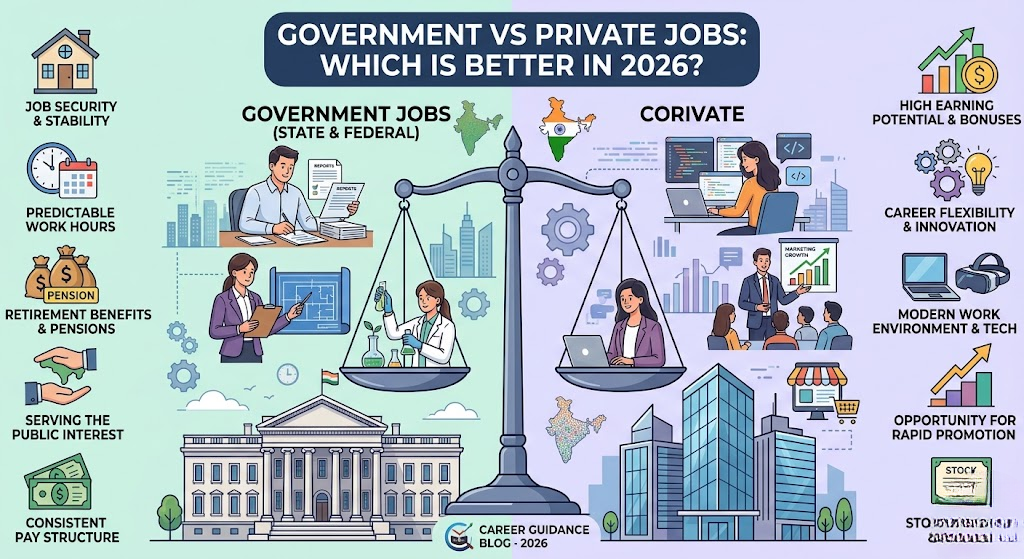
The comparison, laid bare
Government Job
- Guaranteed pension & post-retirement income
- Full family medical coverage, often free
- Near-zero risk of sudden layoff
- Fixed working hours, strong work-life rhythm
- Societal respect & community status
- Subsidised housing loans & LTC benefits
- Structured, predictable career progression
Private Job
- Significantly higher base salary potential
- Stock options, bonuses, performance pay
- Faster career growth and promotions
- Exposure to cutting-edge technology
- Global mobility and remote work options
- Dynamic, stimulating work environment
- Entrepreneurial pathways and networks
The layoff era changed everything
Between 2022 and 2025, over 600,000 tech workers were laid off globally in waves that seemed to arrive without warning. People with stellar performance reviews, impeccable skills, and irreplaceable domain knowledge — gone, in a Friday afternoon email.
This shook something fundamental in an entire generation’s relationship with private employment.
Suddenly, “job security” stopped being a phrase that made young professionals roll their eyes. It became something they whispered about at dinner tables. Something they started weighing seriously — perhaps for the first time.
Government jobs don’t evaporate in economic downturns. They don’t restructure you out of existence when a new AI tool makes your role redundant. That permanence — once seen as dull — now looks like armour.
Security verdict
If your deepest fear is financial instability or sudden income disruption, a government job provides a psychological floor that no private employer — regardless of prestige — can match. In a volatile world, that floor is worth more than most salary calculators will ever tell you.
Growth: the speed vs depth paradox
Here’s where it gets genuinely complicated.
Private sector careers can accelerate at a pace that would make a government employee dizzy. A talented individual in tech or finance can move from junior to director in six to eight years. Their skills compound. Their network expands. Their options multiply.
Government careers move on tracks. Seniority comes largely with time. The bureaucratic ladder is real, and for genuinely ambitious people, it can feel like running in place — technically progressing, but never fast enough.
But here’s what nobody talks about: depth.
Government officers — IAS, IPS, IFS, and their equivalents globally — often wield influence over entire districts, industries, and populations. They shape policy, manage crises, and leave legacies that outlast any product launch. That kind of impact is extraordinarily rare in the private sector.
So the question becomes: do you want to go fast, or do you want to go deep?
The quality of life nobody mentions
At 9 PM on a Tuesday, the government officer is home. The private sector professional is still on a call.
This isn’t always true — but it’s true often enough to matter deeply across decades. Government jobs, almost universally, offer more predictable hours, more guaranteed leave, and a cleaner boundary between professional and personal life.
Private sector high-performers often speak of a creeping erosion of time — weekends that dissolve into “urgent” tasks, vacations interrupted by Slack notifications, relationships quietly damaged by availability expectations that never switch off.
This is not small. It compounds over fifteen, twenty, thirty years. The “better salary” person and the “secure job” person, at 55, may look at their lives and find the trade-offs were far less obvious than they appeared at 25.
Who should choose what — honestly
Choose a government job if…
You value stability over speed. You have family responsibilities or financial dependents. You want to serve at scale. You’re risk-averse by nature — and that’s completely valid. You value leisure time, community, and a life outside work. You want a retirement you can actually plan around.
Choose a private job if…
You thrive under pressure and change. You have highly specialised, marketable skills. You have the risk tolerance to absorb career shocks. You want to build wealth, not just income. You’re energised by fast-moving environments and want to work at the edge of what’s possible.
The real answer nobody wants to hear
There is no objectively better choice. There never was. The debate was always a proxy for something deeper — a question about identity, values, and the kind of life you actually want to live.
A government job in 2026 is not the stagnant, outdated option it was once caricatured as. And a private job is not the guaranteed path to wealth and fulfillment that its advocates promise.
Both can be brilliant. Both can be wrong for you.
The people who regret their choice are almost always the ones who made it based on someone else’s definition of success — a parent’s approval, a peer’s salary, a society’s prestige hierarchy.
The people who don’t regret it? They chose the life that matched who they actually are. Not who they were supposed to be.
Start asking who you are — and which path serves that person best.”
Statistics referenced are compiled from global workforce trend reports (2024–2026), India’s National Career Survey 2025, and public employment data from the Ministry of Labour & Employment.