Leadership & Career Growth
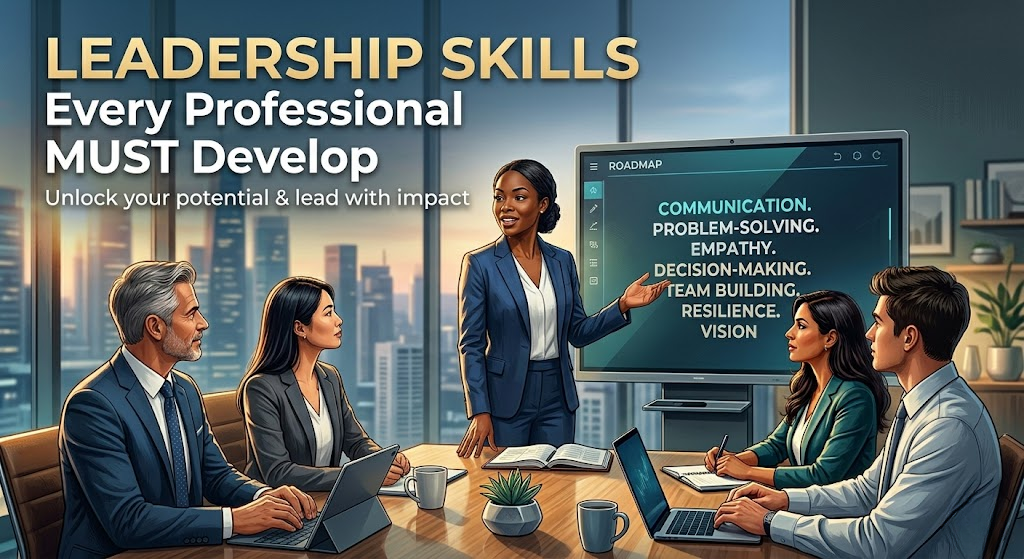
Leadership Skills Every Professional Must Develop
Your technical skills earned you the job. They will not earn you the career. The gap between a professional who plateaus and one who rises — at every level, in every industry — is almost always this: leadership.
Arjun and Priya joined the same company on the same day, as graduate engineers. Both were sharp. Both worked hard. Both got strong first-year reviews. By year three, Arjun was widely considered the more technically gifted of the two — his solutions more creative, his code cleaner, his instincts faster. He knew it. Everyone knew it. By year five, Priya was his manager. Nobody was surprised except Arjun. He had spent three years mastering the tools of his work. Priya had spent three years mastering something harder: herself, and the people around her.
This story plays out in every industry, every organisation, every year. And it contains a lesson that most professionals learn too late.
Technical excellence is your entry ticket. Leadership is the game itself.
Why leadership is no longer optional — for anyone
There was a time when leadership development was considered a specialisation — something you pursued after being formally promoted into a managerial role. That model is obsolete.
In 2026, flat hierarchies mean professionals influence decisions without formal authority. Remote and hybrid teams require communication clarity that was never tested when everyone sat in the same room. AI is rapidly absorbing the technical execution layer — the coding, the analysis, the drafting — leaving the distinctly human skills of judgement, motivation, vision, and emotional management as the remaining competitive differentiators.
Put plainly: the skills that AI cannot replicate are the skills that define leadership. Which means leadership development is no longer preparation for a future role. It is the most urgent professional investment available to you right now.
of organisations say they currently have a significant leadership capability gap
more likely to be fully engaged — employees working under highly effective leaders
of companies develop leaders well — despite 83% calling it an urgent priority
The eight skills that define effective leaders
These are not soft skills. Soft implies optional, supplementary, nice-to-have. Every skill below is backed by decades of organisational research linking it directly to team performance, retention, promotion velocity, and long-term career outcomes. They are also learnable — none requires a personality transplant, only deliberate, sustained practice.
Emotional Intelligence (EQ)
The foundation beneath every other leadership skill
Emotional Intelligence is the ability to recognise, understand, and regulate your own emotions — and to accurately read and influence the emotions of others. Research by psychologist Daniel Goleman established that EQ is a stronger predictor of professional success than IQ in virtually every role above entry-level. Leaders with high EQ create psychologically safe teams, navigate pressure without triggering panic, and make better decisions because they’re not clouded by reactive emotion.
How to develop it: Practise the pause — the deliberate gap between stimulus and response. Journal your emotional reactions weekly, looking for patterns. Ask trusted colleagues how they experience you under stress, not just at your best.
Strategic Communication
The multiplier that amplifies every other skill you have
You can have the best idea in the room. If you cannot communicate it — to a sceptical board, to an overwhelmed team, to a single stakeholder who holds the decision — it dies with you. Strategic communication is not about being eloquent or charismatic. It is about adapting your message to your audience, your medium, and your moment with precision. Leaders who communicate strategically earn alignment faster, face less resistance, and consistently move things forward where others stall.
How to develop it: Write more than you speak — the discipline of writing forces clarity. Read every important email before sending and ask: what will the reader feel, not just know? Voluntarily present to small groups, then larger ones. After key conversations, ask: “What did you take from that?” — the answer will often surprise you.
Decision-Making Under Pressure
The capacity that separates leaders from managers
Leadership is fundamentally a series of decisions — most of them arriving with incomplete information, competing inputs, and an unforgiving deadline. People who freeze, over-consult, or decide reactively under these conditions cost their organisations dearly and erode their teams’ confidence rapidly. Strong decision-makers don’t have better information than everyone else. They have better frameworks, clearer first principles, and the discipline to decide with what they have rather than waiting for certainty that never arrives.
How to develop it: Run pre-mortems before major decisions — imagine it has already failed, and ask why. Set a personal decision deadline and stick to it. Study second-order thinking: ask “and then what?” at least twice before concluding. Review past decisions honestly: not just what happened, but what your reasoning was at the time.
Conflict Resolution
The skill most professionals avoid — and most teams desperately need
Avoiding conflict is not the same as resolving it. Unaddressed tension doesn’t disappear — it accumulates interest. It becomes passive resistance, disengagement, gossip, and eventual team fracture. Leaders who can navigate disagreement — between people, priorities, or competing visions — in ways that reach workable resolutions without destroying relationships are extraordinarily rare and disproportionately valuable. They are also almost always the ones in the room when the hardest conversations happen.
How to develop it: Practise separating the person from the problem — the issue is the issue, not the individual. Learn to name the tension in the room before it names itself destructively. Sit with silence in difficult conversations rather than rushing to fill it. Start with understanding before moving to resolution: most conflicts escalate because people don’t yet feel heard.
Coaching & Developing Others
The shift from doing to enabling — where real scale begins
The ceiling of any team is set by its leader’s coaching ability. A manager who solves every problem creates dependency — the team gets things done, but only when the manager is there. A manager who coaches creates capability — and the team’s collective output eventually exceeds anything the manager could produce alone. This is the shift from individual contributor to true leader: you stop measuring yourself by what you do, and start measuring yourself by what your people become.
How to develop it: Replace “here’s what to do” with “what do you think we should do?” in your one-on-ones. Ask more questions than you answer. When someone brings you a problem, resist solving it immediately — ask them to bring you their top two options first. Celebrate learning from failure, not just outcomes. Your team’s growth is your performance metric.
Adaptability & Change Leadership
The defining leadership skill of a decade that won’t slow down
The pace of change across every industry in 2026 is faster than at any previous point in recorded professional history. Leaders who resist change manage decline. Leaders who lead change — who can maintain direction through ambiguity, bring uncertain teams with them, and reframe disruption as opportunity without sounding naive — create futures. Adaptability is not cheerful optimism in the face of difficulty. It is the disciplined ability to change course without losing sight of purpose.
How to develop it: Deliberately expose yourself to new contexts — different industries, disciplines, and ways of thinking. Examine your own resistance to change before expecting others to embrace it. Study how organisations navigated past disruptions: what distinguished those that adapted from those that didn’t? Build a personal practice of regular reflection and course-correction.
Vision & Strategic Thinking
The difference between managing the present and shaping the future
Tactical competence keeps the engine running. Strategic vision determines where the engine should go. Without it, the most capable team in the world is efficiently executing the wrong plan. Vision is not grand proclamation — it is the rigorous, honest work of understanding where your team, organisation, or industry is heading, what the threats and opportunities are, and what direction is genuinely worth following. Leaders who think strategically attract better people, make better resource decisions, and consistently outperform those who confuse activity with progress.
How to develop it: Force yourself to look 18 months ahead, in writing, regularly. Read across industries — the best strategic insights often come from patterns observed in unexpected places. Ask “and then what?” until you’ve traced the second and third-order consequences of any plan. Write your predictions down and review them honestly — the gap between prediction and outcome is your curriculum.
Accountability & Ownership
The rarest trait in most organisations — and the most visible
Accountability is rare. In most organisations, the default response to failure is to soften blame, spread responsibility, or attribute poor outcomes to external factors. Leaders who genuinely own their decisions — including the ones that go wrong — build trust at a rate no other skill can match. They are the people everyone wants on their team, because everyone knows that what they commit to, they will either deliver or honestly explain why they didn’t. That reliability, in a world of plausible deniability, is a competitive advantage that compounds over a career.
How to develop it: Practise saying “I was wrong” and “I should have done this differently” specifically and publicly — not as performance, but as habit. Stop using passive language around failure (“the results weren’t great” → “I made the wrong call on this”). When you miss a commitment, acknowledge it before anyone has to ask. Over time, this becomes the foundation of your professional reputation.
Where to start — based on where you are
Not every skill is equally urgent at every career stage. Here’s where to direct your energy first.
EQ and Accountability first. These compound earliest — and their absence is most visible at the start.
Communication and Conflict Resolution. You’ve just inherited all of a team’s unresolved tensions — learn to hold them.
Strategic Communication and Accountability. Lead before the title arrives — these are the signals that earn it.
Coaching and Decision-Making. You’re being evaluated on your team’s output now, not just your own. Adjust accordingly.
Vision and Adaptability. At this level, your job is the future — not the present. If you’re managing the day-to-day, something is wrong.
EQ, Communication, and Accountability — the trilogy that creates informal authority. Influence precedes the role.
How leaders actually develop — and how they don’t
What genuinely builds leaders
- Seek feedback specifically — not “how did I do?” but “what’s one thing I should stop doing?”
- Take on projects that stretch you past comfort, in low-stakes environments first
- Study leaders you admire — their decisions, not just their outcomes
- Reflect on your failures with the same rigour you apply to your successes
- Build a personal board of advisors who will tell you what you need to hear
- Read widely — across industries, disciplines, history, and biography
What produces the illusion of growth
- Attending one-day workshops that feel transformational but produce no lasting change
- Confusing authority with leadership — the title is not the skill
- Waiting for a leadership role before practising leadership behaviours
- Avoiding conflict and calling it maintaining harmony
- Mistaking busyness for effectiveness — activity is not output
- Managing your team the way you wish you were managed — ask them what they actually need
The leadership training industry’s open secret
The global leadership development industry is worth over $370 billion. Most of it sells comfort, not change. Two-day offsite workshops feel transformational in the moment — insights feel profound, conversations feel honest, the post-workshop energy feels real. But research consistently shows that without sustained follow-through, structured practice, and genuine accountability structures, over 90% of workshop-acquired insight evaporates within six weeks. Real leadership development happens in the arena — in the difficult conversation you didn’t avoid, the decision you made under pressure, the team member you stretched instead of rescued. The classroom is preparation. The work is the education.
The truth about leadership that nobody puts in a framework
Every framework for leadership development — including this one — is a simplification. Leadership in practice is messier, more contextual, and more deeply personal than any list can capture.
The best leaders are not the ones who have memorised the frameworks. They are the ones whose teams trust them, even in uncertainty. Whose rooms feel different when they leave. Who create the conditions for others to do their best work — not by commanding, but by removing obstacles, communicating clearly, making decisions when needed, and owning the outcomes fully.
That kind of leadership is built not in a training room but in the accumulation of ten thousand small moments — the meeting where you listened instead of talked, the email where you admitted you were wrong, the crisis where you stayed calm when everyone else didn’t, the conversation where you told someone a hard truth with enough care that they thanked you for it.
If you’re just starting your career
Begin with EQ and Accountability — they cost nothing, start immediately, and will define your professional reputation faster than any technical skill. Every interaction is practice. The colleague you helped without being asked. The deadline you met when it would have been easy to miss. The feedback you gave honestly and kindly when silence would have been safer. Start now. You are already in the arena.
If you’re a manager feeling out of your depth
That discomfort is not a sign you shouldn’t be there. It is the feeling of growing. The worst managers are the ones who feel entirely comfortable — because comfort at that level usually means avoiding the things that most need doing. Start with communication and conflict resolution. Have the conversation you’ve been postponing. Ask your team what you’re missing. The willingness to ask is already a leadership behaviour.
If you’re a senior professional approaching the top
At this stage, your most important leadership work is what you leave behind. The team you built, the decisions you modelled, the culture you shaped through your own behaviour over years. Invest in coaching others. Develop your successor. Think in decades. The mark of exceptional senior leadership is not what the organisation achieves while you’re there — it’s what it continues to achieve after you’ve gone.
It’s a practice you choose — every day,
in every small moment nobody is watching.”
Research referenced includes Daniel Goleman’s Emotional Intelligence studies (Harvard Business Review), DDI Global Leadership Forecast 2025, Gallup State of the Global Workplace Report 2025, and McKinsey research on leadership development ROI. Individual development timelines vary significantly by role, context, and deliberateness of practice.