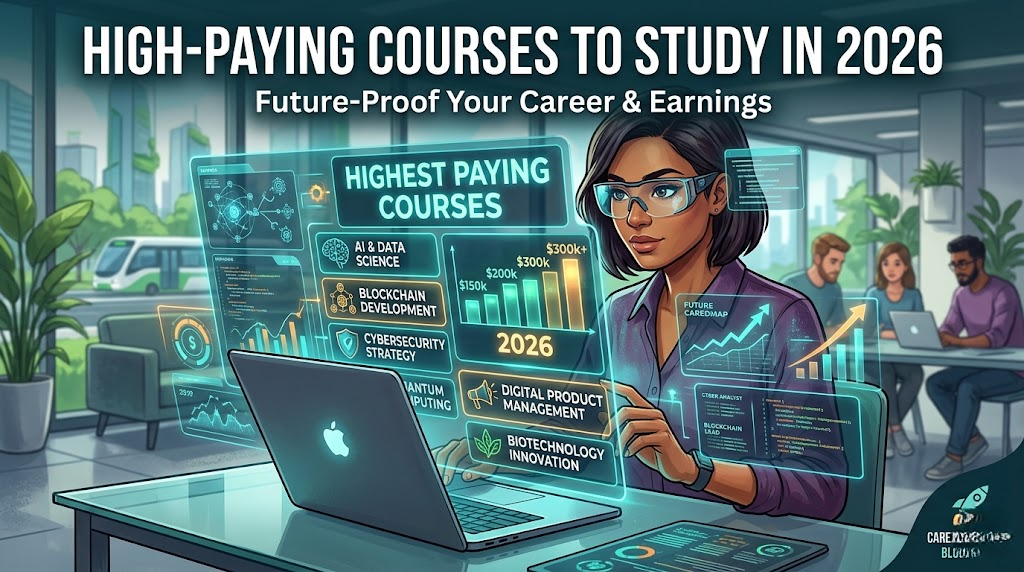
Let’s start with a truth that nobody in the traditional education system wants you to hear: Two people graduate this year. One spends ₹20 lakh and four years getting a degree. The other spends ₹30,000 and six months learning the right skill. The second one gets a higher salary.
This isn’t a hypothetical. This is the 2026 job market, and it operates by completely different rules than the one your parents navigated.
The gap between high-demand skills and traditional education has never been wider. Companies aren’t waiting for universities to catch up — they’re hiring people who can do the work today. Salaries for the right skill sets have shot past what most white-collar careers offer after a full decade of experience.
This article is your corrective. We’ve researched global hiring trends, salary data, and industry reports to bring you the 10 most financially rewarding courses you can invest in right now — along with realistic salary expectations, what you’ll actually learn, and exactly where to learn it.
Read every one. Even the ones you don’t expect to interest you. The career-defining insight often comes from the course you almost skipped.
Why 2026 Is a Career Inflection Point Nobody’s Talking About
Every year feels like a “year of change” in career advice circles. 2026 genuinely is one — and for a specific reason. We are now living through the second wave of AI adoption. The first wave (2022–2024) was about AI tools being created. This wave is about companies restructuring their entire workforce around those tools.
What that means practically: roles that were considered “safe” are contracting. Roles that require human judgment, technical fluency with AI systems, creative problem-solving, and deep domain expertise are exploding in demand. The salary premium for being on the right side of that divide is not 10% or 20%. In some fields, it’s 400%.
Early movers into high-demand skills capture the highest salaries. As more people enter a field, base salaries normalize. In AI engineering, the window is still very wide. In some other fields, like basic digital marketing, it has mostly closed. This guide helps you identify which windows are still open — and how wide.
With that context established — let’s get into the courses themselves. We’ve ranked them not by prestige, but by a simple metric: earning potential vs. time to job-readiness.
Artificial Intelligence & Machine Learning
If there is one field where the skill-to-salary ratio is completely irrational in your favour right now, it’s AI and ML. Companies are not just hiring AI talent — they are competing desperately for it. There are more open roles than qualified candidates, and that imbalance is expected to last well into the next decade.
An AI/ML engineer in 2026 doesn’t just build models — they are the person in a company who determines whether the business automates a process, saves millions, or falls behind competitors who did. That strategic value is reflected directly in compensation.
You don’t need a PhD to enter this field. What you need is strong Python fundamentals, understanding of core ML algorithms, hands-on experience with frameworks like TensorFlow or PyTorch, and the ability to work with real datasets. A well-built portfolio project can genuinely outweigh a formal degree at many companies.
- Python
- TensorFlow / PyTorch
- Large Language Models
- Neural Networks
- MLOps
- Computer Vision
- Prompt Engineering
Data Science & Advanced Analytics
Data Science has shed its buzzword status and matured into a mission-critical function inside virtually every major company. Every swipe, click, purchase, and interaction generates data — and businesses are only as smart as their ability to interpret it.
What separates a 2026 data scientist from the 2020 version? The 2026 version works with AI tools rather than against them. They’re not just building dashboards — they’re building decision engines that tell leadership exactly where to invest, where costs are leaking, and what customers want before customers know themselves.
Data science is also uniquely versatile. The skills are applicable in healthcare, finance, e-commerce, government, sports, entertainment, and agriculture. This is a course that doesn’t lock you into one industry — it gives you leverage everywhere.
- Python / R
- SQL
- Data Visualization
- Statistical Modeling
- Pandas / NumPy
- Power BI / Tableau
- A/B Testing
Cybersecurity & Ethical Hacking
Here’s a statistic that should make you stop scrolling: the global cybersecurity workforce gap in 2025 was 4 million unfilled positions. Not 4,000. Not 4 lakh. Four million. And with every organisation going digital, every government moving data online, and cybercriminals deploying their own AI tools, that gap is only growing.
Cybersecurity professionals are not just well-paid — they are untouchable in recessions. Companies cut marketing budgets. They cut hiring. They never, ever cut security teams after a data breach costs them tens of millions.
The most immediately lucrative entry point is ethical hacking (penetration testing) — where companies literally pay you to attack their own systems and find vulnerabilities before criminals do. It is among the most intellectually thrilling, well-compensated, and recession-proof careers of 2026.
- Network Security
- Ethical Hacking
- CEH / CISSP Certification
- SIEM Tools
- Cloud Security
- Incident Response
- Zero Trust Architecture
Cloud Computing (AWS / Azure / GCP)
Every server, every application, every AI model you use runs somewhere. And increasingly, that “somewhere” is a cloud platform. The global cloud market is projected to hit $1.6 trillion by 2030 — and every rupee of that market needs engineers to build, maintain, and secure it.
What makes cloud computing particularly attractive as a career course is the certification pathway. AWS, Azure, and Google Cloud have structured certification tracks that are globally recognised and directly tied to salary increases. Many professionals have documented salary jumps of 30–60% after earning a single cloud certification.
Cloud skills also combine beautifully with every other course on this list. An AI engineer with cloud expertise earns far more than one without. A cybersecurity professional who specialises in cloud security is among the most sought-after in the world.
- AWS / Azure / GCP
- Kubernetes
- Docker
- DevOps Pipelines
- Serverless Architecture
- Cloud Security
- Infrastructure as Code
The highest earners don’t just study one field — they stack complementary skills. Cloud + AI, Cybersecurity + Cloud, Data Science + Product Management. Each combination creates a rare profile that commands significantly higher salaries than either skill alone. As you read through these courses, look for your natural combination.
Full-Stack Web Development
Some careers in this list are new. Full-stack development is not — and that’s precisely the point. Web development has been consistently well-paid for over a decade because the need never stopped growing. There are more websites, apps, SaaS products, and digital experiences being built today than at any point in history, and that number will only increase.
What has changed in 2026: the full-stack developer who integrates AI tools into their workflow builds in half the time and is valued at nearly double. GitHub Copilot, AI-powered debugging, and automated testing have not replaced developers — they’ve created a new tier of developer who can do the work of three.
Full-stack is also the most freelance-friendly course on this list. The global freelance market for web developers remains massive. An Indian developer working for international clients at global rates can earn extraordinarily well relative to local cost of living.
- HTML / CSS / JS
- React / Next.js
- Node.js
- SQL + NoSQL
- REST APIs / GraphQL
- Git & Version Control
- AI-Assisted Coding
Product Management
Product managers are the people who decide what gets built — not how. They sit at the intersection of business, technology, and user experience. And in 2026, as companies compete furiously on product quality and user retention, the value of a brilliant PM has never been higher.
What makes this role extraordinary is its salary ceiling. Senior PMs at top tech companies frequently earn more than engineers with twice the experience. A Principal Product Manager at a FAANG-equivalent company earns compensation packages that enter seven-figure territory. And unlike pure engineering roles, the PM role compounds in value as you accumulate business intuition and leadership experience.
The path into PM is varied — many come from engineering, design, or business backgrounds. What matters is your ability to think strategically, communicate across teams, and make data-informed decisions. The right course accelerates this dramatically.
- Product Strategy
- User Research
- Roadmapping
- A/B Testing
- SQL (basic)
- Stakeholder Communication
- OKRs & Metrics
UX / UI Design & Design Systems
Here’s something most people miss: users don’t experience technology — they experience design. Every app you love, every website that feels effortless, every product you keep coming back to is the work of UX designers who mapped every interaction with painstaking precision.
In 2026, design has become even more strategic. As AI generates more content and code, the human ability to create experiences that feel intuitive, trustworthy, and emotionally resonant has become a true differentiator. Companies building AI products desperately need designers who can make complex systems feel simple.
Design is also one of the best fields for freelancers and remote workers. Design work is 100% digital, clients are global, and a strong portfolio on Behance or Dribbble can attract international opportunities that pay in dollars and pounds.
- Figma (essential)
- User Research
- Wireframing
- Prototyping
- Design Systems
- Interaction Design
- Accessibility (WCAG)
Performance Marketing & Growth
Standard digital marketing has become commoditised. But performance marketing — the subset focused on measurable ROI, paid acquisition, and growth engineering — remains extraordinarily well-paid because it directly connects to revenue. When you can prove that every rupee you spend returns five, you are not a cost centre. You are the closest thing to a money printer a company has.
The 2026 version of this role is deeply intertwined with AI tools. Campaigns are now built, tested, and optimised with AI assistance. The professionals who thrive are those who understand the strategy deeply enough to direct the AI, read the data clearly enough to know what’s working, and are creative enough to craft messages that cut through noise.
Additionally, skilled performance marketers who go independent can scale to serious income relatively fast — through freelancing, running their own agency, or building their own brand-driven business.
- Meta / Google Ads
- SEO / SEM
- Marketing Analytics
- Email Automation
- Conversion Optimisation
- Funnel Design
- AI Tools (Jasper, Perplexity)
Blockchain Development & Web3
Blockchain development is the most volatile but also one of the most financially extraordinary fields on this list. After the turbulent years of 2022–2023, blockchain infrastructure has quietly matured. In 2026, real-world asset tokenisation, decentralised finance, and enterprise blockchain adoption are creating demand for developers with smart contract and Layer 2 expertise that most universities don’t even teach.
The key insight here: blockchain developers are rare. Unlike Python developers, who are abundant, Solidity and Rust developers for blockchain are genuinely scarce. Scarcity drives up compensation significantly. A junior blockchain developer with a good portfolio can command salaries that would take a traditional developer five years to reach.
This is a field that rewards independent learners and builders. The best blockchain developers in the world learned largely through building — writing smart contracts, deploying on test networks, and contributing to open-source protocols.
- Solidity
- Rust (for Solana)
- Smart Contracts
- DeFi Protocols
- Web3.js / Ethers.js
- Hardhat / Foundry
- NFT Standards
Finance, CFA & FinTech
Finance has been a high-paying field for generations. But in 2026, it’s been transformed by a new layer: financial technology, quantitative analysis, and AI-assisted investment research. The finance professionals who are thriving are those who combine traditional financial literacy with modern data and tech skills.
The CFA (Chartered Financial Analyst) designation remains one of the most globally respected and well-compensated credentials in the world. In investment banking, private equity, and hedge funds, it is effectively the entry ticket to the serious money. Meanwhile, FinTech roles — at companies building the next generation of banking, payments, and lending — are hiring at the intersection of finance and engineering at premium salaries.
If you have any affinity for numbers, markets, and economic thinking, finance in 2026 is vastly more accessible and lucrative than it has ever been. And the ceiling — for those who reach fund management, investment banking, or financial consulting — is virtually limitless.
- CFA Level I–III
- Financial Modelling
- Excel / Python for Finance
- Valuation
- Risk Management
- Algorithmic Trading
- Blockchain in Finance
Quick Comparison: All 10 Courses at a Glance
Use this table to shortlist based on what matters most to you — whether that’s maximum salary ceiling, fastest time to first job, or demand stability.
| # | Course | India Avg Salary | Global Avg Salary | Time to Job-Ready | Demand Level |
|---|---|---|---|---|---|
| 1 | AI & Machine Learning | ₹12–60 LPA | $110K–$220K | 8–14 months | 🔥 On Fire |
| 2 | Data Science & Analytics | ₹8–35 LPA | $95K–$175K | 6–12 months | 🔥 On Fire |
| 3 | Cybersecurity | ₹7–40 LPA | $90K–$180K | 6–10 months | 🔥 On Fire |
| 4 | Cloud Computing | ₹9–38 LPA | $105K–$175K | 4–8 months | 🔥 On Fire |
| 5 | Full-Stack Development | ₹6–28 LPA | $85K–$155K | 6–12 months | ✅ High |
| 6 | Product Management | ₹15–60 LPA | $120K–$200K | 3–6 months | ✅ High |
| 7 | UX / UI Design | ₹6–30 LPA | $80K–$155K | 4–8 months | ✅ High |
| 8 | Performance Marketing | ₹5–28 LPA | $70K–$140K | 3–6 months | 📈 Rising |
| 9 | Blockchain / Web3 | ₹10–50 LPA | $100K–$200K+ | 6–12 months | 📈 Rising |
| 10 | Finance / CFA / FinTech | ₹8–45 LPA | $90K–$200K+ | 12–36 months | ✅ High |
How to Choose the Right Course for You
Reading about ten courses is only useful if you actually pick one and start. Here is a framework to cut through the paralysis. Ask yourself these five questions in order:
- What do I actually enjoy doing? Money follows sustained effort. You will outwork anyone if the work doesn’t feel like work. If you love building things, go development. If you love patterns and puzzles, go data or cybersecurity. If you love people and communication, go PM or marketing.
- How much runway do I have? If you need income within six months, choose cloud certifications or performance marketing. If you have 12–24 months to invest, AI/ML and data science offer the highest long-term returns. Finance (CFA) requires the most patience but delivers exceptional career longevity.
- Do I want a job, freelance work, or my own business? Full-stack, UX design, and digital marketing are the best freelance-friendly courses. AI/ML and cloud are best optimised for high-paying employment. Product management leads to senior leadership.
- What existing skills can I build on? If you have a commerce background — finance or performance marketing is a natural bridge. Engineering background? AI/ML, cloud, or full-stack. Creative background? UX/UI. Business background? PM or growth marketing.
- Am I willing to keep learning after the course ends? Every field on this list evolves. The highest earners are not the ones with the most certificates — they are the ones who never stopped updating their knowledge. Pick a field you’ll stay curious about for years.
Before enrolling in anything, spend 30 days exploring your top two choices for free — YouTube, free course previews, reading industry blogs. The one you find yourself voluntarily spending more time on is your answer. Genuine curiosity about a subject is the single most reliable predictor of success in it.
The Uncomfortable Truth About Course-Hopping
Every year, thousands of people read lists like this one, feel inspired, enroll in a course, make it 40% through, and then see a new “Top Courses of [Next Year]” article and restart the cycle. This is called course-hopping, and it is the single most effective way to stay at exactly zero despite years of effort.
The courses on this list are not shortcuts. They are investments that pay off if and only if you complete them, build real projects, and put in the repetitions. A completed, mediocre project that you deployed and can talk about in an interview is worth more than a half-finished certification from the world’s best programme.
What separates the people who triple their income from those who collect certificates is not talent. It is the unromantic, unsexy, consistent daily practice of building something real with what they’ve learned. The course is the map. You still have to walk the territory.
Your Career Is the Highest-Return Investment You’ll Ever Make
The courses in this list represent something more than career options. They represent the chance to be on the right side of the largest economic shift of our generation. The skills economy is already here. The only question is whether you’re learning the skills the market will pay for — or the ones it used to.
Pick one. Start today. Go all the way through it. That simple sequence, followed through, changes everything.