Future of Work
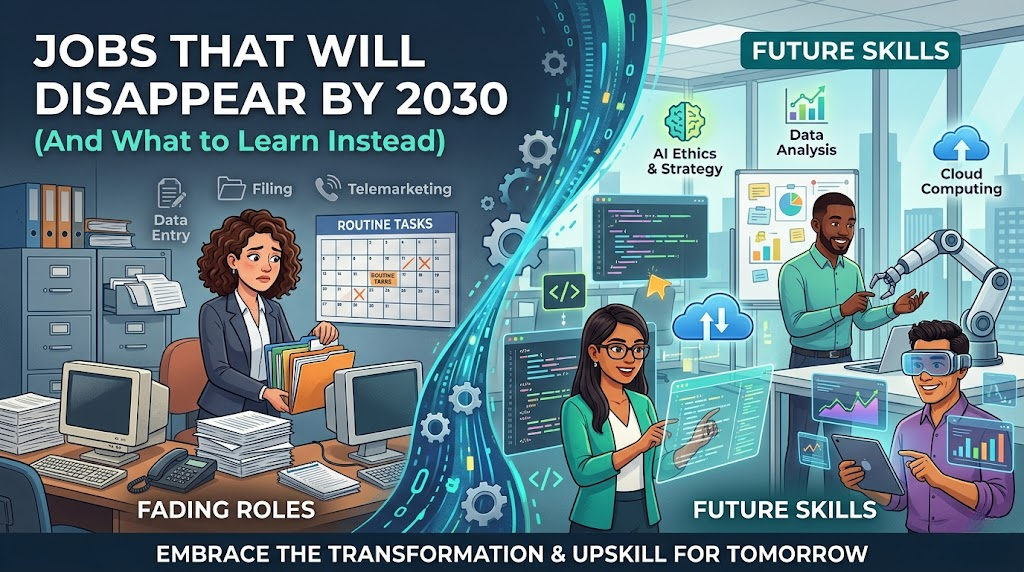
Jobs That Will Disappear by 2030 — And What to Learn Instead
This isn’t a scare story. It’s a survival guide. Because the people who will thrive in 2030 aren’t the ones who panicked — they’re the ones who started preparing in 2025.
Somewhere right now, a data entry operator is typing numbers into a spreadsheet. A toll booth collector is handing out change. A junior translator is converting documents from one language to another. A call centre agent is reading from a script. They are all doing their jobs well. They are all about to be replaced — not by a smarter person, but by a cheaper algorithm.
This is not speculation. This is arithmetic.
The World Economic Forum estimates that 85 million jobs will be displaced by automation and AI by 2025. But 97 million new ones will emerge. The crisis isn’t the disappearance of work — it’s the mismatch between what people know how to do and what the future needs them to do.
The question isn’t whether your industry will be disrupted. It’s whether you’ll be the person who saw it coming — and moved first.
Why 2030 is the real deadline
We’ve been hearing about automation for decades. So why believe the warnings now?
Because this time, something fundamentally different is happening. Previous waves of automation replaced physical labour — machines took over factories, assembly lines, warehouses. What’s happening now is categorically different: AI is replacing cognitive labour. The things we assumed were safe because they required thinking, language, judgement — those are exactly what large language models, computer vision, and robotic process automation are best at.
And 2030 is when the current wave of AI tools — already deployed in beta across industries — reaches full commercial scale. The transition isn’t coming. It’s already begun. 2030 is simply when the door closes on the people who waited too long.
jobs displaced globally by automation by 2025, per WEF estimates
of workers’ core skills will be disrupted in the next five years
new roles expected to emerge from the AI-driven economy by 2025
The jobs on the chopping block
Let’s be specific. Vague warnings about “automation” help nobody. What follows is an honest, research-backed look at the roles most at risk — and critically, what you should be learning instead if you’re in them.
Learn Instead
Data Analysis & Visualisation
Interpreting data, spotting trends, building dashboards — skills AI assists but cannot replace.
Learn Instead
Financial Planning & Advising
Complex money decisions — retirement, insurance, investment — still need a human who earns trust.
Learn Instead
Strategic Storytelling & Brand Voice
High-stakes narrative — brand identity, long-form journalism, emotionally resonant copy — remains deeply human territory.
Learn Instead
Customer Experience Design
Designing the systems, scripts, and escalation paths that make AI support feel human — a rapidly growing discipline.
Learn Instead
Financial Strategy & Forensic Accounting
Tax planning, fraud detection, M&A advisory — complex judgement that requires both numbers and intuition.
Learn Instead
AI-Augmented Legal Practice
Lawyers who know how to direct, verify, and build on AI legal tools are now worth 3× those who don’t.
Learn Instead
Luxury & Experiential Travel Curation
High-net-worth clients paying for bespoke, off-grid, transformative experiences still want a human curator who truly knows.
The pattern nobody is naming
Look closely at the jobs above and you’ll notice something. It’s not just any job that’s disappearing. It’s a specific type of job — one defined by predictability, repetition, and the absence of genuine judgement.
AI is exceptional at pattern recognition within defined boundaries. It struggles — genuinely struggles — with moral ambiguity, contextual creativity, emotional attunement, and physical dexterity in unstructured environments.
Which means the jobs that survive aren’t necessarily the most prestigious or the most technical. A plumber, a therapist, a kindergarten teacher, a surgeon — these are far harder to automate than a lawyer who only does document review or a programmer who only writes boilerplate code.
The future belongs to people who work at the intersection of human and machine — people who can direct AI, verify its outputs, fill its blind spots, and bring the irreducibly human qualities that no model has yet been able to fake convincingly.
The real danger signal
If your entire job could theoretically be described as a set of rules or instructions — if someone could write a detailed manual for exactly what you do — you are vulnerable. The solution is not to work harder at the same thing. It is to move toward tasks that resist instruction.
The six skills that will matter most by 2030
Forget the long lists of trendy buzzwords. These are the six categories of skill that the research — and the hiring data — consistently points to as durable through the transition.
Directing, prompting, and critically evaluating AI outputs in your field
Spotting what the algorithm missed — the edge cases, the contradictions
Empathy, trust-building, conflict resolution — still entirely human territory
Persuasion, narrative, and nuanced writing that moves people, not just informs
The ability to learn new tools rapidly — the skill beneath all other skills
Deep knowledge in one field, combined with AI tools — the highest-value combination
The honest question you need to sit with
Here is something the career advice industry rarely says: learning a new skill is not enough if your personality and work style are fundamentally misaligned with where the market is heading.
A person who is deeply uncomfortable with ambiguity, who finds creative problem-solving draining, and who thrives on clear, structured tasks — they aren’t just facing a skills gap. They’re facing an identity question. And that’s okay. The answer for them might be to move toward the trades, toward physical craftsmanship, toward the roles that automation genuinely cannot touch because they exist in the messy, unpredictable physical world.
Electricians, surgeons, mental health counsellors, primary school teachers, civil engineers — these are not glamorous answers in the age of AI hype, but they are correct answers. And correctness matters more than glamour when it’s your livelihood at stake.
What to actually do this week
Knowing which jobs are dying is useful. Knowing what to learn is more useful. But actually starting — that’s the only thing that matters.
If you’re in a high-risk role right now
Don’t quit. Use your current job as funding for your transition. Spend 45 minutes every morning — before work, before the world wakes up — building the adjacent skill. Data analysis if you’re in data entry. Prompt engineering and AI workflows if you’re in content or research. Financial planning certifications if you’re in banking. The runway is still long enough, but only if you start now.
If you’re a student or recent graduate
You have the most leverage of anyone reading this. Your habits aren’t formed. Your identity isn’t locked. Learn AI tools in your domain the way your parents learned to type — not as a special skill, but as basic literacy. Then pair that with one deep, human-centred competency: persuasion, strategy, empathy, leadership. That combination is the most employable profile of the next decade.
If you’re a manager or employer
The people in your team who are quietly upskilling — who are curious about AI, who ask uncomfortable questions, who challenge your assumptions — protect them. They are your organisation’s future. The people doing exactly what they’ve always done, perfectly, are a liability you haven’t recognised yet.
This isn’t the end. It’s a filter.
Every major technological shift in history has looked, at first, like a catastrophe. The printing press threatened scribes. The automobile ruined the horse-carriage industry. The computer made typists obsolete. And in each case, the total number of jobs — eventually — grew.
But “eventually” is cold comfort if you’re the person whose livelihood disappears in the transition. The historical pattern offers hope for the species. It offers little protection for the individual who wasn’t watching.
2030 is not an apocalypse. It is a filter. It will separate the people who adapted from the people who assumed that what worked yesterday would work tomorrow.
You are reading this. That means you’re already asking the right questions. The next step is not to read more articles. The next step is to open a new tab, find a course, and begin.
It punishes the unadapted.
There is still time — but not unlimited time.”
Data referenced from the World Economic Forum Future of Jobs Report (2023–2025), McKinsey Global Institute Automation Research (2024), and NASSCOM India Tech Workforce Report 2025. Job displacement figures are projections based on current automation trajectories and are subject to variance by region and sector.