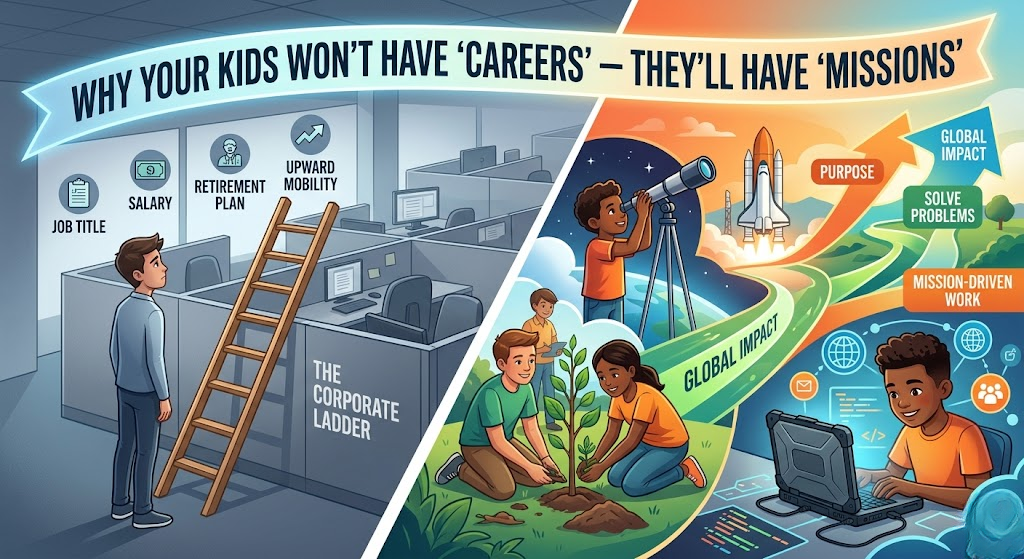
You’re still giving your child career advice designed for a world that no longer exists. The data is in. The rules have changed. And the parents who understand this first will raise the generation that shapes tomorrow.
Think back to when you were a kid.
Someone asked you the question.
“What do you want to be when you grow up?”
And you answered. Maybe you said doctor, teacher, engineer, lawyer.
And the adults smiled. Nodded. Said something like “that’s wonderful.”
Fast forward to today.
You’re the adult. And you’re asking your child the same question.
“What do you want to be when you grow up?”
And here’s the thing nobody in that conversation is talking about.
That question is already obsolete.
Not slightly outdated. Not in need of a refresh.
Obsolete.
Because the world your child is growing into doesn’t operate on the “be something” model anymore.
And the parents who figure this out first — the ones who stop asking what their children want to be and start asking what they want to do — are going to raise the generation that runs the future.
Let’s talk about why.
The Numbers Every Parent Needs to Hear
Let’s start with the facts. Because they’re more unsettling than most parents realize.3 According to a Dell Technologies report, a whopping **85% of the jobs that will exist in 2030 haven’t yet been invented.**
Read that number carefully.
Not some of the jobs. Not many of the jobs.
Eighty-five percent.11 Amid fast technological and societal transformation, the careers awaiting Generation Alpha — those born between 2010 and 2025 — are largely still conceptual. Around **two in three Gen Alphas** will work in jobs that do not currently exist, and from AI co-designers to neuro-lens developers, the job market they are projected to enter will be unlike any the world has ever seen.
And the seismic shift in how we value the traditional path to those jobs?16 In 2010, **75% of US adults** said college was “very important.” In 2025, only **35%** said the same, according to Gallup data.
In fifteen years, confidence in the traditional path has been cut in half.
The generation you’re raising isn’t just entering a different job market.
They’re entering a different reality.
The Career Model Is Quietly Collapsing
Here’s the old model. You know it by heart.
Graduate. Find an entry-level job. Work your way up. Retire.
Simple. Predictable. Comforting.
And dying.19 “The old model was: graduate, find an entry-level job, climb from there,” ZipRecruiter’s Bachaud said. “What we’re seeing now is something less linear, yet their outcomes are actually improving.”
Less linear. That’s an understatement.20 The tasks that used to be handled by junior employees are being automated, outsourced, or absorbed by artificial intelligence, with leading tech CEOs predicting AI’s impact will speed up the **decline of junior-level hiring in 2026.** 19 The ZipRecruiter report found that entry-level job openings are **drying up**, making it harder for recent graduates to start the climb up the corporate ladder.
The first rung of the ladder is disappearing.
And the concept of the ladder itself?
Transforming into something else entirely.17 With artificial intelligence and automation on the rise, their careers will be far from linear. In fact, the new model is a **portfolio career** — individuals master skills and take them with them to each new job instead of relying on a lifelong career in one company.
Not a ladder. A portfolio.
Not a title. A collection of problems solved.
The Classroom Is Still Teaching for a World That No Longer Exists
Here’s the uncomfortable conversation nobody wants to have at school board meetings.3 Elementary and high school haven’t changed much since the Industrial Revolution, when the future most kids faced was working on an assembly line. Children still listen for the end-of-class bell — similar to the end-of-the-workday horn — and many still sit in rows of desks, like in widget-making factories. “Schools are built for the jobs of the 18th and 19th centuries,” says Rafael Gomez, University of Toronto’s Centre for Industrial Relations and Human Resources.
And the results of this mismatch?38 The disconnect between what is taught in classrooms and the skills demanded by the modern economy has never been more apparent. The future is in trouble — not because technology is advancing too quickly, but because **education is failing to keep up with the times.** Many educational systems continue to prioritize rote learning and outdated subjects, while employers increasingly seek problem-solving abilities, digital literacy, adaptability, and creativity. 38 Students are tested on memory, **rewarded for conformity**, and rarely challenged to think critically or creatively.
Yet what are employers actually asking for?30 Employers value “durable skills” — a set of professional capabilities like teamwork, problem solving, critical thinking, and flexibility — that are essential in almost every job. In fact, a study by America Succeeds found that **70% of the most requested skills** in nearly 82 million job postings are durable skills.
The school is teaching the wrong subject.
The market is grading on a completely different exam.
And your child is caught in between.
Enter the Mission Economy
Now here’s where the story changes.
Because buried inside this disruption is something extraordinary.
Something that should make every parent lean forward.11 For Dimple Thakkar, founder of SYNHERGY, Gen Alpha’s future is not merely about new jobs — it’s about **entirely new career philosophies.** 11 “Want a bolder prediction? In 20 years, ‘job’ might be a dated concept,” Thakkar said. “Instead, people may talk in terms of **missions, reputations, or ecosystems.**”
Missions. Reputations. Ecosystems.
Not job titles. Not org charts. Not retirement plans.
Missions.
And the next generation? They already feel this shift in their bones.26 They are asking questions earlier than any generation before them: *Does this work matter? Does this organization reflect my values? Will I feel proud of what I do here?* As a result, career success is no longer defined solely by compensation or status, but by **purpose, alignment, and meaning.** 26 Recent workforce data from 2025–2026 reinforces this shift, showing that **89% of Gen Z workers** say purpose is essential to their job satisfaction, with nearly half willing to reject employers whose values do not align with their own.
And the even younger generation — Gen Alpha?12 **67% of 6 to 9-year-olds** say they want to have a career that helps them **save the planet.**
Six and nine years old.
Not asking for the corner office. Not dreaming about the salary.
Asking how their work can save the world.
That is a fundamentally different starting point than any generation before them.
Career vs. Mission: The Complete Breakdown
The shift from “career” to “mission” isn’t just philosophical. It’s practical. It changes everything about how your child will choose work, evaluate opportunities, and define success.
Here’s the full comparison:
| The Old Career Model | The New Mission Model |
|---|---|
| “What job can I get?” | “What problem am I here to solve?” |
| Defined by titles and hierarchy | Defined by impact and values |
| Linear ladder | Fluid, multidirectional web |
| Loyalty to one company | Loyalty to a craft and a cause |
| Stability through tenure | Stability through adaptability |
| Success = salary and title | Success = purpose and contribution |
| Asks: “Who will hire me?” | Asks: “What change can I lead?” |
| Follows a track | Follows a compass |
26 Gen Z — and their younger siblings in Gen Alpha — are not rejecting ambition. They are **redefining it.** They are not asking organizations to choose between profit and purpose, but to pursue both with honesty and accountability.
This isn’t soft. This isn’t idealistic.
This is the new performance standard.
Who Gen Alpha Actually Is (And Why It Should Excite You)
Before we talk about what parents must do — you need to understand who you’re raising.11 “Gen Alpha will be AI-native,” Rooholamini told Newsweek. “They would be able to program systems via voice or AR/VR glasses. I suspect Gen Alpha would be more attuned to AI, similar to how Gen Z was more attuned to mobile devices, and we should expect to see more creative-tech hybrid roles, sustainability-focused jobs, and digital health or extended reality (XR) related careers.” 11 Their digital fluency and exposure to AI from a young age may place them in a unique position to **design**, not just *participate in*, the future of work.
They won’t just use the tools.
They’ll build the tools.
And their ambitions? Already massive.21 A significant portion of Gen Alpha — approximately **76%** — aspires to become their own boss or have a side hustle, showing a strong entrepreneurial spirit. This generation will likely prioritize flexibility, autonomy, and the ability to launch their own ventures, reshaping traditional career paths and workplace expectations. 28 From EDI to flexibility, there’s a thread that ties them all together. That thread is **purpose.** Gen Z and Gen Alpha want the work they do to have a purpose. They want to have a positive impact on the work they do. 29 With their technological fluency, desire for flexibility, commitment to inclusivity, and **push for purpose**, Gen Alpha will redefine what it means to work in the modern world.
This generation isn’t coming to collect a paycheck.
They’re coming to change something.
The question is whether we’re raising them in a way that lets them.
The 5 Things Every Mission-Ready Parent Must Do Differently
Here’s the pivot. The part that matters most.
Because knowing the problem doesn’t change anything.
Changing the approach does.
Shift #1 — Change The Question You Ask
Stop asking: “What do you want to be when you grow up?”
Start asking: “What problems do you care about most?”
The first question locks your child into a role. The second one unlocks a direction.30 More students are being encouraged to tap into their passions. Rather than steering them in one direction, more adults are seeing the wisdom in helping kids **connect their passions with tangible real-world problems** that make sense for them.
The child who says “I care about clean water” is already on a mission.
Your job is to fan the flame — not redirect them toward a safer title.
Shift #2 — Teach Durable Skills Over Degrees
9 The next generation of children will need to **create jobs, not just seek them.** They will draw on their curiosity, imagination, entrepreneurship, and resilience — the joy of failing forward. 3 Schools that want to truly future-proof their students should emphasize group work, interpersonal communication, and creative thinking. “You need the analytical skills you might get in math, but you also need **human skills that make our society better.**”
The durable skills — the ones machines can’t replicate — are the ones worth building:
- Critical thinking — the ability to question assumptions
- Empathy — the ability to understand humans at scale
- Adaptability — the ability to learn, unlearn, and relearn
- Communication — the ability to translate complexity into clarity
- Creativity — the ability to generate what hasn’t existed before
37 If a skill is easy to learn via a 10-minute video, it’s already being automated. Focus instead on **high-stakes empathy, complex negotiation, and moral philosophy.**
Shift #3 — Normalize Non-Linear Paths
Your child may not go to university. Or they may go for two years and pivot. Or they may build a business at 19.
All of these are valid.27 Degrees are becoming less relevant than skills. More employers are hiring based on **actual expertise** — hands-on experience and digital certifications — rather than mere credentials. 19 Nearly **38% of graduates** are now considering starting their own businesses, 32.5% are looking at gig work, 28% are exploring freelance work, and 11% are pursuing skilled trades.
The non-traditional path is becoming the mainstream path.
Raise your child to know that this isn’t failure.
It’s evolution.
Shift #4 — Build the Portfolio, Not Just the Resume
37 Stop building a resume. Start building a **public portfolio of problems you have solved.** In 2026, a link to a successful project is worth more than a thousand LinkedIn endorsements.
From the earliest age, encourage your child to:
- Make things. Projects, art, code, essays — anything tangible.
- Solve things. Real problems in their school, community, or online world.
- Document things. Their thinking, their process, their failures and iterations.
A 16-year-old with a portfolio of five real-world projects is more compelling to tomorrow’s employers than a 22-year-old with a degree and no visible work.
Proof of skill beats proof of attendance.
Shift #5 — Let Them Be Driven by Values, Not Just Salary
22 Gen Alpha is conscious of societal and ecological issues — they are **seeking purpose-driven careers.**
Don’t dampen this.
Don’t tell them to “be realistic.”25 The jobs of the future will require a blend of technical skills, creativity, and a strong commitment to addressing global challenges. As Gen Alpha prepares to step into these roles, their unique perspectives and abilities will help **shape the future of work and society** as a whole.
The child who is driven by values — not just salary — is the one who will work with obsessive dedication on the things that matter most.
Mission-driven people don’t burn out. They burn brighter.
A Glimpse at the Missions Your Kids Might Actually Run
What does a “mission” look like in practice?
Here are the emerging roles where tomorrow’s mission-driven professionals will thrive:
| Mission Area | Example Roles |
|---|---|
| Climate & Sustainability | Sustainability managers, environmental engineers, carbon credit architects |
| Human-AI Collaboration | AI co-designers, algorithmic ethics architects, prompt engineers |
| Health & Longevity | Longevity lifestyle coaches, biotech designers, neuro-lens developers |
| Digital Reality | XR experience designers, virtual workspace architects, spatial computing engineers |
| Robotics & Automation | Robotics AI engineers, robotics swarm engineers, quantum-AI infrastructure planners |
| Creator Economy | Digital community builders, immersive content creators, platform entrepreneurs |
11 For Gen Alpha, many traditional professions may give way to emerging roles created in response to **evolving digital, ecological, and social challenges.** 25 Generation Alpha is poised to enter a workforce shaped by rapid technological innovation, environmental challenges, and evolving societal needs. The careers projected to be popular among this generation reflect the trends that are **currently transforming industries** and will likely continue to do so in the coming decades.
The mission areas are already visible.
The missionaries just haven’t graduated yet.
What Happens If We Don’t Change
Let’s be clear about the alternative.
If we keep preparing children for the old world — for jobs, not missions — here’s what happens:38 Without urgent reform to prioritize critical thinking, adaptability, digital literacy, and future-focused skills, **the next generation risks being left behind** in an economy dominated by innovation and automation. 5 Statistical analysis of the association between the career aspirations of teenagers and projected labour market demand found that **the career aspirations of teenagers had nothing in common** with the projected labour market demand.
The children who dream of jobs that no longer exist.
The graduates who arrive at the workforce with theoretical knowledge and no practical edge.20 When the jobs that once served as on-ramps into the workforce disappear, organizations quietly erode their own future talent pipelines — and **an entire generation falls through the cracks.**
This isn’t a distant problem.
This is happening right now — to Gen Z.
Gen Alpha is watching.
And the parents who act now are the ones who ensure their children don’t become the cautionary tale.
The Closing Bang
The word “career” comes from a French word meaning a road — or a racecourse.
A fixed track. A predictable path.
But the next generation won’t be running on tracks.
They’ll be building them.3 If anything, our children may have more fulfilling lives than we do. With machines doing more and more of the tedious work, humans will increasingly be able to use their creativity and thinking skills, tackle bigger and more meaningful issues, and make their way in the world **on their own terms.**
That’s the promise inside this disruption.
The chaos is real. But so is the opportunity.
Your child doesn’t need a career plan.
They need a mission brief.
They need to know what they believe in. What injustice makes them angry. What problem keeps them up at night. What kind of world they want to leave behind.
That is the foundation of a life’s work.
Not a job title. Not a salary band. Not a LinkedIn headline.
A mission.
And it starts with the questions you ask them at the dinner table tonight.
Your Action Plan — Start Tonight
You don’t need to overhaul everything at once. Start with one conversation.
| Action | Why It Matters |
|---|---|
| Ask your child what problems make them angry | Mission starts with a cause, not a career |
| Stop measuring success by grades alone | Durable skills don’t show up on report cards |
| Expose them to non-traditional paths | Entrepreneurship, apprenticeships, creator economy |
| Encourage a portfolio mindset early | Let them build, create, document, and share real work |
| Model purpose-driven work yourself | Children absorb what they observe more than what they’re told |
| Let them be driven by values | The mission-driven don’t burn out — they burn brighter |
The parents who raise mission-driven children will look back at this moment as the greatest parenting decision they ever made.
The ones who don’t will wonder why their child feels so lost in a world full of opportunity.
You already know which parent you want to be.
Now go have the conversation that changes everything.
Know a parent still giving their kids 1990s career advice? Share this. It might be the most important article their child never asked them to read — but desperately needed them to.