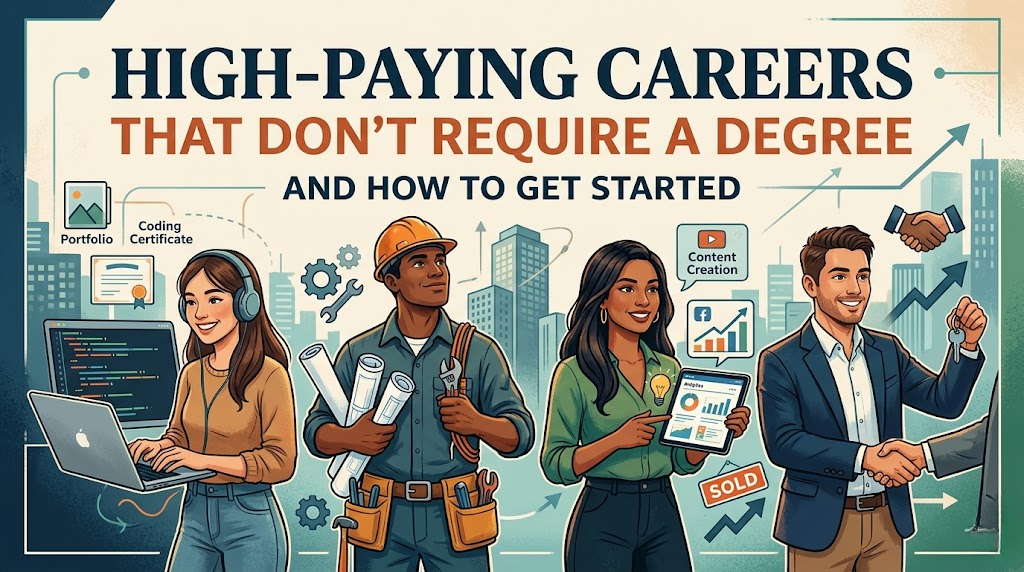
The best high-paying careers that don’t require a degree — and how to get started
Let’s have an honest conversation. For decades, we were sold one story: go to college, get your degree, land a stable job. But the world has changed — fast. Employers today are increasingly hiring based on what you can do, not what piece of paper you earned.
Tech giants like Google, Apple, and IBM have already dropped degree requirements from hundreds of their job listings. The World Economic Forum estimates that over 1 billion jobs will be transformed by skills-based hiring in the next decade. The shift is real, and it’s happening right now.
So if you’re someone who skipped college, couldn’t afford it, or simply felt it wasn’t the right path — this article was written for you. Here are the best high-paying careers that don’t require a degree, plus exactly how you can break into each one.
First — let’s bust the myths holding you back
You need a degree to earn good money.
Skilled developers, cloud architects, and cybersecurity analysts regularly earn more than doctors and lawyers — with zero college debt. Skills pay. Degrees are optional.
No degree means no respect in your field.
In skill-based careers, your portfolio, your results, and your reputation define you — not your graduation year. Nobody asks Elon Musk which university taught him to build rockets.
Learning without college takes forever.
Most of the careers below can be learned to a job-ready level in 3 to 12 months with consistent daily effort. That’s faster than one semester of most degree programmes.
The top high-paying careers that don’t require a degree
1. Software developer / web developer
₹5–28 LPA | $65K–$140K+Coding is arguably the most valuable skill you can learn today. Web developers build everything from landing pages to full-scale applications — and businesses pay handsomely for it. The best part? You can learn entirely for free online. Companies don’t care where you learned — they care whether your code works.
How to start: Learn HTML, CSS, then JavaScript. Pick a framework like React. Build 3–5 real projects. Create a GitHub portfolio. Apply for junior roles or freelance on Upwork and Toptal.
2. Cybersecurity analyst
₹6–24 LPA | $70K–$135K+Cyber threats are growing faster than the workforce to fight them. Every hospital, bank, startup, and government department needs people to protect their systems. In cybersecurity, certifications are the real currency — and the salaries reflect the urgency of the problem.
How to start: Get CompTIA Security+ first. Practice on TryHackMe or Hack The Box. Progress to CEH or OSCP. Entry-level analysts are hired based on certifications alone.
3. Cloud computing professional
₹8–35 LPA | $85K–$160K+AWS, Azure, and Google Cloud run the internet. Every company that stores data, runs software, or operates online depends on cloud infrastructure. Cloud professionals are among the highest-paid in all of tech — and their certifications are globally recognised, degree-independent gold standards.
How to start: Start with AWS Cloud Practitioner (free training available). Move to AWS Solutions Architect or Azure Administrator. Use free cloud tiers to build real projects.
4. Digital marketing specialist
₹3–16 LPA | $45K–$95K+Every business in the world needs to be found, followed, and trusted online. SEO, paid advertising, email marketing, social media strategy — these are skills that generate real revenue, and companies know it. Great digital marketers are hired for results, not resumes.
How to start: Complete Google Digital Garage and HubSpot Academy certifications (both free). Run campaigns for a local business or your own side project. Build a portfolio of measurable results.
5. Data analyst
₹4–20 LPA | $55K–$105K+Data is the most valuable resource in the modern economy — but raw data is useless without someone who can make sense of it. Data analysts translate numbers into business decisions, and their impact is measurable in ways that make them extremely valuable to any organisation.
How to start: Master Excel. Learn SQL. Get Google’s free Data Analytics Certificate on Coursera. Add Python or Power BI. Build 3–5 case study projects and publish them publicly.
6. UX/UI designer
₹4–22 LPA | $60K–$115K+Every app, website, and digital product you’ve ever used was designed by someone. UX/UI designers shape how products feel — and in a world where user experience drives customer loyalty, great designers are irreplaceable. The field is portfolio-driven, not degree-driven, and the creative freedom is immense.
How to start: Learn Figma (free). Complete Google’s UX Design Certificate. Design 3–5 detailed case studies. Share your work on Behance and Dribbble to attract clients and employers.
7. Content writer / copywriter
₹3–14 LPA | $40K–$85K+Words drive decisions — they make people buy, subscribe, click, and trust. Companies spend billions on content every year: blog articles, ad copy, email campaigns, social media, product descriptions. A writer who can combine creativity with strategy is worth their weight in gold.
How to start: Write consistently on a blog or Medium. Build 10 writing samples across different formats. Pitch businesses directly with specific ideas. Platforms like Contena and ProBlogger list paid opportunities.
8. Electrician / skilled tradesperson
₹3–16 LPA | $55K–$110K+Here’s the career nobody talks about enough: skilled trades. Electricians, plumbers, HVAC technicians, and welders are in serious demand globally — a shortage that’s only getting worse as older generations retire. These jobs can’t be outsourced, can’t be replaced by AI, and pay extremely well. Many experienced tradespeople run their own businesses and earn far more than their salaried peers.
How to start: Enrol in an ITI programme or find an apprenticeship in your area. Get licensed. Gain experience, build a client base, and eventually consider launching your own business.
9. Video editor / motion graphics designer
₹3–16 LPA | $45K–$90K+Video now dominates how the world communicates — YouTube, Instagram, corporate training, films, advertising. The demand for skilled video editors and motion designers is exploding, and nearly every professional editor you’ll meet is self-taught. Your reel is your resume — nothing else matters.
How to start: Learn DaVinci Resolve (professional-grade and completely free) or Adobe Premiere Pro. Edit your own videos. Build a 2-minute showreel. Pitch YouTubers, agencies, and brands directly on Instagram or LinkedIn.
10. Real estate agent / broker
₹4–25 LPA+ | $50K–$120K+Real estate rewards hustle, relationships, and deep local knowledge — none of which require a degree. Top agents earn commission income that dwarfs many white-collar salaries, and the best build empires that run almost on their reputation alone. If you’re a people person who thrives on sales and strategy, this career has virtually unlimited upside.
How to start: Get a state or national real estate licence. Join an established agency first. Learn your local market obsessively. Build your client network aggressively from day one.
The most important thing to remember: In every single career above, your portfolio and demonstrated results will open more doors than any degree ever could. Stop waiting for permission. Start building proof.
Your 5-step roadmap to getting started
Choose one career that genuinely excites you — not just the one that pays most. You’ll stick with it when things get hard only if you actually care about it.
Start learning today — YouTube, Coursera, Udemy, and free certification programmes have everything. Most skills are learnable in 3–6 months of focused daily effort.
Build your portfolio as you learn — real projects and case studies are what get you hired, not certificates alone. Document everything you make.
Get your first client or role — start small with freelance platforms, job boards, or cold pitching. The goal is your first proof point, not your dream job on day one.
Never stop upskilling — dedicate 30 minutes daily to growing your knowledge. The professionals who thrive long-term are the ones who treat learning as a lifestyle, not a phase.
Conclusion
The diploma on the wall is not the measure of your potential. Your curiosity, your willingness to put in the work, and your ability to demonstrate real value — those are the things that build careers worth having.
The internet has democratised education like nothing before it. The skills that used to require years of expensive university study can now be learned for free, on your own schedule, at your own pace. The opportunity is enormous — and it belongs to anyone willing to take it seriously.
So pick one career from this list. Open one browser tab. Watch one tutorial. Take one step. Your future doesn’t need a degree — it just needs you to start. 🚀