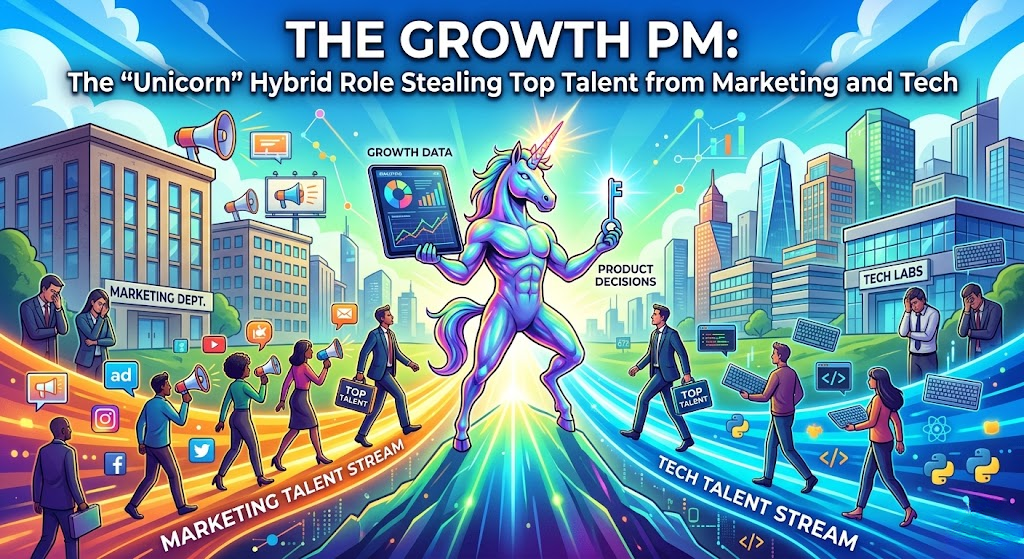
Marketing teams are exhausted.
They are burning millions of dollars on ads, dragging users to the front door, only to watch them immediately walk away.
Meanwhile, Product teams are frustrated. They just spent six months building a beautiful, flawless feature—and absolutely no one is using it.
The traditional wall between “Marketing” and “Product” is completely broken. But out of this frustration, the most lucrative, high-demand career path in modern tech has emerged.
Enter the Growth Product Manager.
If you are obsessed with human psychology, love diving into data, and want to build systems that scale effortlessly, you are about to discover your dream job.
The Death of the Traditional Silo
In the old days, the formula was simple. Marketing got the customer to the door. Product built the house inside.
But what happens when a user walks in the door and the hallway is dark, confusing, and full of friction? They churn.
A Growth PM doesn’t accept this. They are the architect of the hallway. They operate in the exact space where acquisition meets user experience, ensuring that every dollar marketing spends actually turns into a retained, paying customer.
Core PM vs. Growth PM (What’s the Difference?)
To understand the Growth PM, you have to understand what they don’t do.
A Core PM builds the hammer. They focus on the fundamental utility of the product. Does it work? Is it structurally sound?
A Growth PM figures out how to get 10,000 people to pick up the hammer, realize how perfectly it fits in their hand (the “Aha!” moment), and swing it every single day.
They don’t build the core features. They build the bridges to those features. They build frictionless onboarding, viral referral loops, and irresistible paywalls.
The Growth PM “Super-Stack”
Why are companies paying massive premiums for this role? Because it requires a rare, hybrid brain. You must be a left-brain analyst and a right-brain psychologist simultaneously.
Here is the toolkit you need to master:
- Behavioral Psychology: You aren’t just looking at clicks. You are decoding intent. Why did the user hesitate at step 3? What cognitive bias can we use to make upgrading feel like a no-brainer?
- Data Fluency: If you can’t read the data, you are just guessing. Growth PMs live in dashboards (Mixpanel, Amplitude, SQL) to find the hidden leaks in the user journey.
- High-Tempo Experimentation: Perfection is the enemy of growth. You must be obsessed with rapid A/B testing. You launch, you learn, you iterate. You fail fast so you can win big.
- Friction Hunting: Your primary job is to ruthlessly eliminate any barrier between the user and the value of the product.
Why This is the Ultimate Career Pivot
Customer Acquisition Cost (CAC) is at an all-time high. Ad platforms are becoming outrageously expensive.
Smart companies have realized a hard truth: Retention is the new acquisition.
It is infinitely cheaper to activate and keep the users you already have than to constantly buy new ones. This shift—known as Product-Led Growth (PLG)—has made the Growth PM the most valuable player on the corporate chessboard.
If you are a marketer tired of fighting algorithms, or a product manager tired of obscure feature backlogs, this is your escape hatch.
Become the Architect of the Engine
You don’t have to choose between being a creative storyteller and a technical builder.
The Growth PM is the ultimate synthesis. You get to treat the product itself as your greatest marketing channel. Stop fighting over ad budgets and start engineering irresistible user loops.
The market is begging for people who can bridge this gap. It’s time to step into the middle.
Your Next Step: Open your favorite app right now (Spotify, Notion, Duolingo, etc.). I want you to find the exact mechanism they use to get you to invite a friend or share a result.
Take a screenshot of that referral loop, and comment below on why you think it works—or why it fails!