Imagine this. Rahul spent four years earning his engineering degree. He attended every class, cracked his exams, and graduated with decent marks. His parents told everyone in the neighbourhood. There was a small celebration, a new suit, and a stack of printed resumes.
Six months later, Rahul is still at home. Not because he’s lazy. Not because he didn’t try. He’s applied to over 200 companies. He’s had a few interviews. But the offers just aren’t coming — or when they do, they pay barely enough to cover rent.
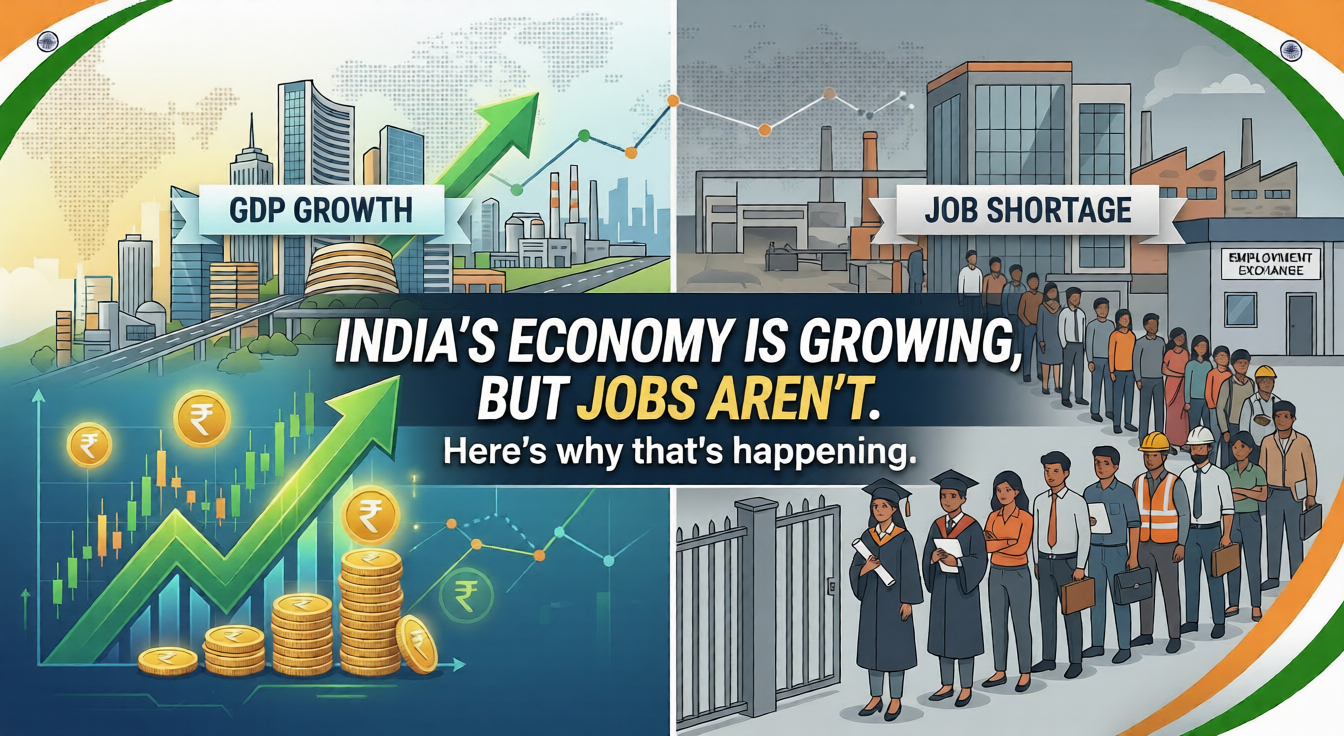
Meanwhile, the news channels are celebrating. “India’s GDP grows at 7%!” the headlines shout. “Fastest-growing major economy in the world!”
So what’s going on? If the economy is doing so well, why does Rahul — and millions like him — feel left behind?
First, What Does “Economy Growing” Actually Mean?
Think of the economy like a giant cooking pot. GDP — Gross Domestic Product — is just a measure of how much food is being cooked in that pot each year. When we say India’s GDP grew by 7%, we’re saying the total value of everything India produced — goods, services, tech, food, finance — grew by 7% compared to last year.
That sounds great. And in many ways, it is. India is building more infrastructure, exporting more software, and attracting more foreign investment than ever before.
But here’s the catch: a bigger pot doesn’t automatically mean more cooks are needed.
The Real Problem: Growth Without Jobs
Economists have a term for this — jobless growth. It’s when an economy expands, but employment doesn’t keep pace. The pie is getting bigger, but the number of people getting a slice isn’t growing proportionally.
India is stuck in this exact trap right now. We’re producing more, but not necessarily employing more. And for a country with one of the world’s largest young populations — over 65% of India is under 35 — that’s a ticking clock.
Why Aren’t Companies Hiring More?
This is the big question. Here are the real reasons:
1. Machines Are Taking the Easy Jobs
A decade ago, a bank needed dozens of people to process forms, answer phones, and manage data. Today? Software does most of that. Factories that once needed 100 workers now run efficiently with 30, thanks to automation.
AI is accelerating this further. Customer service bots, AI-generated content, automated logistics — these technologies are replacing repetitive, entry-level roles. And those are exactly the kinds of jobs that fresh graduates used to rely on to get their first foot in the door.
2. Companies Are Focused on Doing More With Less
After the pandemic, most businesses became obsessed with efficiency. Why hire five people when you can hire two highly skilled ones and give them better tools? From startups to large corporations, the goal is lean teams, not large ones.
This means hiring is happening — just not at the scale needed for a population our size.
3. The Skill Gap Is Real
Here’s an uncomfortable truth: many graduates are trained for a world that no longer exists. A traditional college degree in India often focuses on theory and rote learning, while companies today want people who can code, communicate clearly, analyse data, or manage digital tools.
It’s not that young people aren’t smart — it’s that the education system hasn’t caught up with what the job market actually needs.
4. Growth Is Concentrated in the Wrong Sectors
India’s biggest growth engines right now are IT, finance, and digital services. These are high-value industries — but they don’t employ millions of people. Compare that to manufacturing or construction, which employ far more people per rupee of output.
When growth happens primarily in tech and finance, it creates a lot of wealth, but not a lot of jobs.
5. The Gig Economy Is Masking the Problem
Swiggy. Zomato. Uber. Urban Company. Millions of young Indians are working in the gig economy — delivering food, driving cabs, completing freelance tasks. These platforms technically count as “employment,” but they offer no stability, no benefits, and no career growth.
It’s work, yes. But it’s not the kind of work that builds a future.
What’s It Actually Like for Young People?
Ask any 24-year-old in an Indian city and you’ll hear a version of the same story. Engineers doing data entry. MBAs working in call centres. Postgraduates accepting salaries that were considered starter pay a decade ago.
This is called underemployment — when people are working jobs far below their qualifications. It’s less visible than unemployment, but just as demoralising.
The competition for every decent job posting is brutal. A single opening at a reputable company might attract 5,000 applications. And with AI tools now helping people write better resumes and cover letters, even standing out in an application pile has become harder.
What Can You Actually Do About It?
Here’s the honest part — no one is coming to fix this for you overnight. But there are things within your control.
Learn skills that machines can’t easily replace. Critical thinking, creativity, emotional intelligence, storytelling, complex problem-solving — these are areas where humans still hold a clear edge. A person who can think and communicate well will always have an advantage.
Get comfortable being a lifelong learner. The idea of learning a skill once and using it for 40 years is dead. The people winning in today’s economy are the ones who keep updating themselves — through online courses, side projects, internships, and self-directed learning.
Think beyond the job application. India’s startup ecosystem is one of the most vibrant in the world. You don’t need lakhs of rupees to start something small. A freelance service, a local business, a niche content platform — entrepreneurship, even at a small scale, builds the kind of skills and resilience that no classroom can.
So, Where Does This Leave Us?
India’s economic growth story is real. But growth alone doesn’t guarantee dignity, opportunity, or stability for its people — especially its young people.
The gap between the economy’s performance and young Indians’ lived experience is wide. Bridging it will require smarter education, policy that encourages job-creating industries, and a culture that values skills over certificates.
But it also requires each of us to ask a harder question: Are we preparing for the economy that exists, or the one we were promised?
Rahul’s story isn’t a failure. It’s a symptom. And understanding that is the first step toward changing it.
The economy is growing. The question is — growing for whom?