Introduction
The news is designed to paralyze you.
Every morning, you are fed a diet of doom: inflation, layoffs, impending market collapse. The goal of the media is to keep you scared, because fear sells ads.
But while the masses are freezing in place, the “Smart Money” is moving.
In every recession, wealth isn’t destroyed—it is transferred. It moves from the fragile (luxury, hype-tech) to the antifragile (essentials, security, efficiency).
If you want to survive 2025, you don’t need “job security.” You need to be in a sector that thrives on chaos.
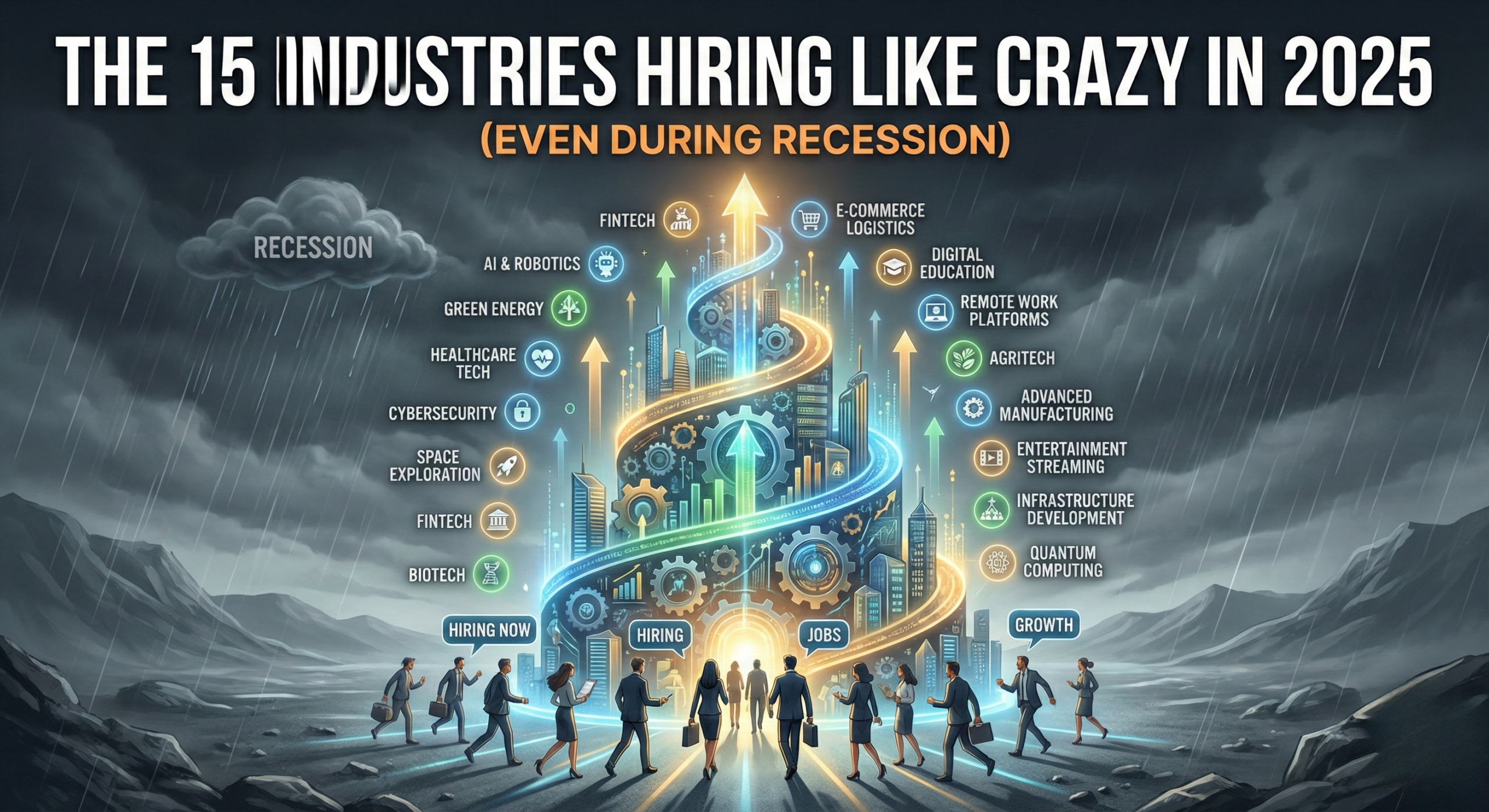
Here are the 15 industries hiring aggressively while everyone else is firing.
The “Panic” Economy (Fear Pays)
When the world gets scary, budgets for safety explode. You cannot put a price on survival.
- 1. Cybersecurity & Digital Forensics: In a recession, cybercrime skyrockets. A CEO will fire their entire PR team before they cut the budget that stops hackers from draining the company accounts.
- 2. Defense & Aerospace: Look at the geopolitical map. It is red hot. Governments are pouring billions into defense contracts. These jobs are recession-proof because they are backed by the limitless printing press of the Department of Defense.
- 3. Private Security & Asset Protection: As uncertainty rises, physical security for corporations and high-net-worth individuals becomes a top priority.
- 4. Corporate Restructuring & Insolvency: It’s grim, but it’s true. When companies fail, they hire armies of consultants and lawyers to manage the bankruptcy. It is the ultimate counter-cyclical field.
The “Discount” Economy (The Race to the Bottom)
When people have less money, they don’t stop spending—they just spend differently.
- 5. Discount Retail & Wholesalers: While luxury brands bleed, Wal-Mart, Costco, and Aldi see record profits. They need managers, logistics experts, and supply chain masters to handle the volume.
- 6. DIY & Home Repair: People stop hiring expensive contractors for renovations and start doing it themselves. Home Depot and Lowe’s (and the brands supplying them) hire massively in downturns.
- 7. “Efficiency” AI Implementation: Companies are desperate to cut costs. If you are an expert in using AI to automate workflows (doing more with less), you are the most valuable person in the room.
The “Biology” Economy (Demographics Don’t Care About GDP)
Your health does not check the stock market before failing. These industries are driven by biology, not economics.
- 8. Senior Living & Geriatric Care: The Baby Boomers are the wealthiest generation in history, and they are aging. There is a critical shortage of staff here.
- 9. Mental Health & Tele-Therapy: Financial stress triggers mental health crises. The demand for therapists and the apps that connect them (BetterHelp, Talkspace) is vertical.
- 10. Bio-Pharma & Clinical Trials: The race to cure cancer and Alzheimer’s doesn’t pause for a recession. Venture capital is still flowing heavily here.
The “Dirty Hands” Economy (The Un-Outsourceable)
You cannot ask an AI to fix a burst pipe. You cannot outsource a power grid failure to India.
- 11. Skilled Trades: The “Blue Collar” shortage is real. Electricians, plumbers, and welders are commanding six-figure salaries because there is zero competition.
- 12. Utilities & Green Infrastructure: The lights must stay on. Plus, government tax credits for green energy (solar/wind) are locked in for years. The hiring here is government-backed.
- 13. Agriculture Tech (AgTech): Food inflation is a major issue. Farms are hiring tech workers to help them grow more food with fewer resources.
The “Safe Havens”
- 14. Government & Civil Service: It’s not glamorous, and the pay is capped. But the benefits are ironclad, and the government rarely lays off during a recession—in fact, they often expand to absorb unemployment.
- 15. Education & Upskilling: When people lose their jobs, they go back to school. Universities, trade schools, and certification programs see a massive boom in enrollment during recessions.
Conclusion
You have a choice to make.
You can stay in a “Fragile” industry—one that depends on consumer confidence and excess cash (marketing, luxury, crypto, hospitality).
Or, you can pivot to an “Antifragile” industry—one that sells needs, safety, and efficiency.
The recession is coming. The wave is already forming. You can either be crushed by it, or you can grab a surfboard and ride it to the bank.
Your Move: Look at your current resume. Does it solve a “Want” or a “Need”? If it’s a “Want,” start upskilling for a “Need” tonight.