Introduction
You felt it, didn’t you?
The Finance Minister sat down, the applause faded, and the Sensex reacted. But while the news anchors are screaming about tax slabs and fiscal deficits, they are missing the silent earthquake that just hit the Indian job market.
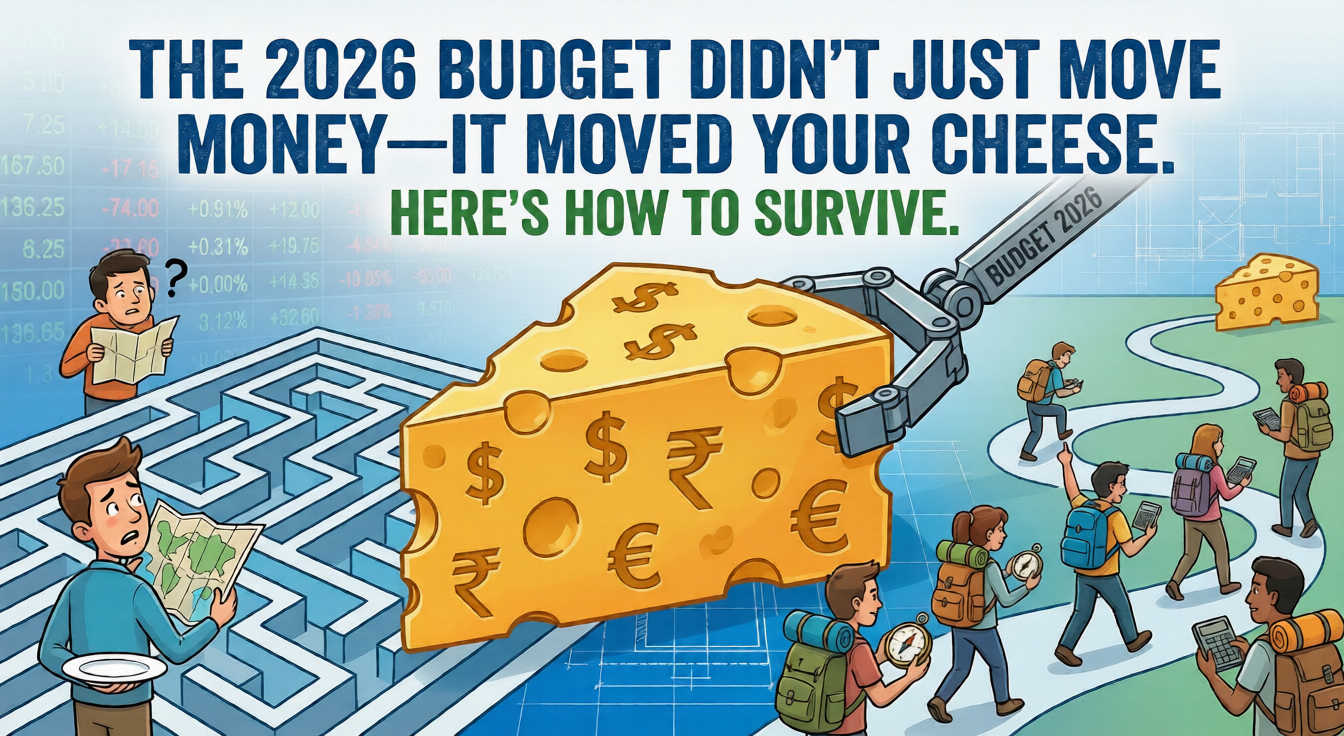
The Union Budget 2026 wasn’t a financial statement. It was a survival guide.
If you are sitting in a comfortable mid-level corporate chair, believing your job is safe because you’ve done it for ten years, I need you to listen closely: The rules of the game just changed.
This budget signaled the end of the “Volume Era” (cheap labor) and the dawn of the “Value Era” (specialized skills).
Here is the brutal truth about what this means for your paycheck, your career, and your future.
🧱 PART 1: The “Safe” Zones That Are Crumbling
The government has stopped subsidizing mediocrity. The heavy incentives for AI adoption and automation in this budget are a clear message to the corporate world: Efficiency over Headcount.
1. The “Generic” IT Worker is on Notice For two decades, Indian IT was built on labor arbitrage—hiring thousands to do repetitive coding or testing.
- The Shift: The 2026 Budget offers massive R&D tax benefits for “Deep Tech” and “AI Sovereignty.”
- The Reality: If your job involves writing basic code that an AI agent can write faster, you are in the blast zone. Companies are now incentivized to buy software, not hire seats.
2. The End of Low-Skill Manufacturing The PLI (Production Linked Incentive) schemes have been expanded, but with a catch. The focus is now on Industry 4.0.
- The Reality: The government wants factories, but they want smart factories. The manual assembly line worker is being replaced by the “Cobot Operator” (someone who manages collaborative robots).
🚀 PART 2: The New Gold Rush (Where the Money Went)
Fear sells newspapers, but opportunity builds empires. While some doors slammed shut, this budget kicked others wide open. If I were starting my career today, this is where I would look.
1. The “Green Collar” Revolution The allocation for the Green Hydrogen Mission and EV Infrastructure is astronomical. This is no longer about “saving the planet”—it’s about national energy security.
- The Opportunity: We don’t just need scientists. We need installers. We need EV fleet managers, Battery chem-techs, Solar Grid Architects, and Carbon Credit Auditors.
- Prediction: A “Carbon Auditor” will be as common and well-paid as a Chartered Accountant by 2030.
2. The Semiconductor & Hardware Renaissance With the first three major Fab plants now operational (thanks to previous policy continuity), the 2026 budget doubles down on the supply chain.
- The Opportunity: Chip design, embedded systems, and hardware testing. The era of pure software is ending; the era of “Software on Hardware” is beginning.
3. The Legitimacy of the “Solopreneur” Finally, the government acknowledged the invisible workforce. The new Social Security Framework for Gig Workers is a game-changer.
- The Reality: Freelancing is no longer “unemployment in disguise.” It is a recognized asset class. If you are a creator, a consultant, or a gig-coder, you just got a safety net.
🧠 PART 3: The “Viksit” Toolkit (How to Future-Proof Yourself)
So, what do you do? Do you panic? Do you go back to school?
The budget introduced the “Skill-First” Tax Incentives. This allows you to claim tax deductions on money spent upskilling in government-approved sectors (AI, Robotics, Green Tech).
Your 3-Step Action Plan:
- Step 1: Audit Your Routine. Look at your daily tasks. If 50% of your work is “copy-pasting” data or following a rigid script, you are a sitting duck. You need to move ‘upstream’ to strategy and oversight.
- Step 2: Become a “Hybrid.” The most valuable employees in 2026 are not specialists in one thing. They are hybrids.
- The Engineer who understands Ethics.
- The Farmer who understands Data Analytics.
- The Writer who understands Prompt Engineering.
- Step 3: Look Tier 2. The infrastructure spending is targeting cities like Indore, Surat, and Vizag. The next wave of high-paying jobs isn’t in a saturated Bangalore; it’s in these emerging tech-hubs where the cost of living allows you to actually build wealth.
💥 THE CONCLUSION
The 2026 Budget is a mirror.
If you look into it and see “more taxes,” you are missing the point. If you look into it and see a “roadmap,” you are going to win.
The government has laid the pavement for a high-tech, green, efficient superhighway. They cannot force you to drive on it. You can stay on the old dirt road of legacy skills, but don’t be surprised when the traffic stops moving.
The future doesn’t care about your past experience. It only cares about your current velocity.
🏁 YOUR CALL TO ACTION
Stop scrolling.
Open a new tab right now. Go to a job portal. Search for the term “Sustainable Energy Manager” or “AI Ethics Compliance.” Just look at the salary discrepancy between those roles and traditional roles.
Then, find one course—just one—that bridges the gap between what you know and where the money is going. Sign up. Today.
Be the Catalyst of your own career.
⚠️ DISCLAIMER: NOT FINANCIAL ADVICE
The analysis provided in this article regarding the Union Budget 2026 is for informational and educational purposes only. While we strive to interpret policy shifts and economic trends accurately, this content does not constitute professional financial, investment, or legal advice. Government policies, tax slabs, and specific allocations are subject to amendments and complex interpretations. Please conduct your own due diligence and consult with a certified Chartered Accountant (CA) or financial advisor before making any significant career, business, or investment decisions based on this information.
❓ FAQ: The Questions Screaming Inside Your Head
You’ve read the breakdown. Now the “What Ifs” are creeping in. Here are the blunt, honest answers to the questions you are too afraid to ask your boss.
Q1: “I’m in my late 30s/early 40s. Is it too late for me to pivot to AI or Green Tech?” The Catalyst: Absolutely not. In fact, you have an advantage. The 2026 Budget incentivizes specialized tech, but technology without context is useless.
- The Shift: A 22-year-old knows how to code the AI. You know how the business works.
- Your Move: Don’t try to become a coder. Become the bridge. Learn enough tech to manage the projects. A “Project Manager with AI literacy” is worth double a “Project Manager” who fears it.
Q2: “I work in a traditional BPO/Customer Support role. Am I going to lose my job next month?” The Catalyst: Next month? No. In the next 18-24 months? The risk is high.
- The Reality: The budget’s push for digital public infrastructure reduces the need for human intermediaries.
- The Fix: Pivot to “Complex Resolution.” AI handles the easy “Where is my refund?” queries. Humans handle the angry, complex, multi-layered problems. Sharpen your empathy and conflict-resolution skills—AI still sucks at that.
Q3: “You mentioned Tier 2 cities (Indore, Jaipur, etc.). Are there actually high-paying jobs there, or is it just hype?” The Catalyst: The hype has become reality. The budget allocates massive infrastructure spending to these “Counter-Magnet” cities to de-clog Metros.
- The Math: You might earn ₹15 Lakhs in Indore vs ₹20 Lakhs in Bangalore. But in Indore, your rent is half, your commute is 20 minutes, and your savings rate is double. The Wealth Effect is actually higher in Tier 2 right now.
Q4: “I’m a freelancer/Gig worker. Does the new social security really help me?” The Catalyst: Yes, because it creates a paper trail.
- The Benefit: Previously, banks hated lending to freelancers for home loans because “income was unstable.” With the government-backed social security registration, you now have a “proof of stability.” This legitimizes your career in the eyes of financial institutions.
Q5: “Where do I start? The list of new skills is overwhelming.” The Catalyst: Stop trying to learn everything. Pick one adjacency.
- If you are in Finance: Learn “Carbon Auditing” (Green Finance).
- If you are in HR: Learn “AI-driven Talent Analytics.”
- If you are in Marketing: Learn “Programmatic Advertising.”
- Rule of Thumb: Don’t change your industry; change your toolset within the industry.