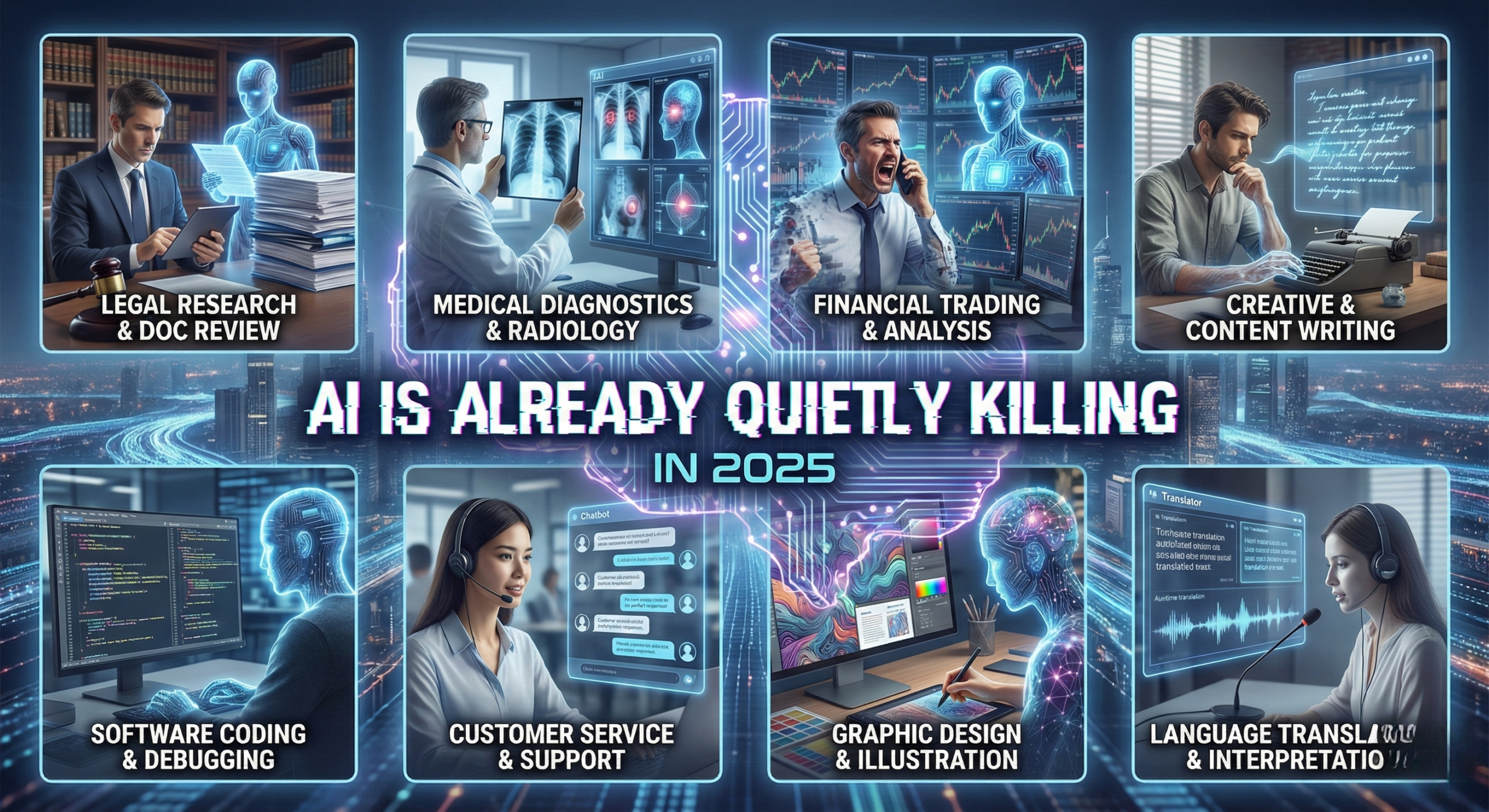
Okay, let’s be honest for a second. We all saw the headlines for years. “Robots are coming for your jobs!” And we’d look up from our laptops in our nice offices, in our “thinking” jobs, and give a nervous laugh. Not us, we thought. That’s for factory workers, for cashiers. Our jobs are safe. They require a human touch, judgment, creativity.
I need to tell you something in 2025: we were wrong.
Not wrong about the threat, but about where it would hit. The AI revolution isn’t a wave crashing on the shore; it’s a slow leak, seeping into the very foundations of professions we built our identities on. It’s not loud. It’s quiet. It’s a meeting where a VP says, “The AI draft is 90% there, just tweak it,” and suddenly your week of work is an afternoon of edits. It’s the cold sweat when you realize the tool you’re using isn’t just assisting you—it’s learning to replace you.
This isn’t a sci-fi rant. I’m in the trenches with you. I see the shifts daily. And I’m watching eight “safe” careers undergo a silent, profound transformation. Some are changing. Some are, frankly, being dismantled. The emotional rollercoaster is wild—the fear is visceral, the greed from the top is palpable, and the relief for those who adapt is the only light ahead.
Here’s what’s quietly happening:
1. The Content Machine Grinder.
Remember when we said AI writing was clunky? Throw that idea out. The panic I felt last year, seeing a tool spit out a solid first draft, has morphed into a dull anxiety. Now, it writes the whole blog series, the ad copy, the email campaign. The “relief” for execs is a cheaper, faster content mill. For the mid-level writer or marketer? It’s an identity crisis. You’re no longer the creator; you’re the editor, the prompt-typer, the brand-voice-polisher. If you can’t pivot to high-level strategy—the stuff the AI can’t grasp—you become a cost to be optimized out.
2. The Doctor’s Second Opinion.
This one chills me. We held up radiologists and pathologists as the untouchables. The greed for efficiency in healthcare found a way. The AI doesn’t get tired. It compares your scan to 100 million others in a heartbeat. The relief for patients is real—faster, maybe more accurate reads. But look into the eyes of a seasoned specialist lately? There’s a new anxiety. Their unparalleled skill is becoming a quality-control check on an algorithm’s work. The profession is bending under the pressure.
3. The Legal Eagle’s Nest is Getting Crowded.
All those junior lawyers and paralegals who paid their dues sifting through boxes of documents? That apprenticeship is evaporating. Corporate greed for lower legal bills is being fed by AI that does in minutes what took teams weeks. The relief for the firm’s partners is pure profit margin. The dread in the cubicles? Palpable. The path to being a lawyer is being rewritten, and it’s leaving a lot of bright minds wondering what their first rung on the ladder even is anymore.
4. The Number Crunchers.
I’ve got friends in finance who are genuinely scared. Being an “Excel wizard” used to be a golden ticket. Now? It’s a liability. AI models eat global data for breakfast and spit out forecasts and complex reports by lunch. The greed for an edge in the market is insatiable, and AI is the ultimate edge. The analyst who just crunches numbers is a dinosaur. The new value is in asking the brilliant, weird questions the AI wouldn’t think to ask. That’s a much, much harder game.
5. The Support System.
We all hate those stupid chatbots. The new ones aren’t stupid. They’re scarily good, handling complex issues with a calm, fake empathy. The relief for the C-suite is in the millions saved. But quietly, the humans who design the support systems—the scriptwriters, the flow-chart makers—are seeing their work become obsolete. The AI is learning and writing its own playbook now.
6. The Code Monkey (A Harsh Truth).
Not all programmers are at risk. But the guy who mainly builds standard login pages, basic dashboards, or simple apps? His world is shaking. The greedy hunger for a “quick MVP” is now satisfied by typing a description into an AI coder. The relief for startups is incredible. The anxiety for the junior dev? She has to be architect-level smart right out of the gate. The commoditized code work is drying up.
7. The Linguistic Artists.
This one hurts my soul. Translation isn’t just words; it’s art. But for 95% of business needs—manuals, websites, communications—AI does it instantly, cheaply, and scarily well. The relief for global business is immense. The profound, quiet loss is for the translator whose deep, cultural craft is now reserved for poetry and sensitive diplomacy, while their commercial work vanishes.
8. The Corporate Trainer.
That three-day seminar on compliance? It’s dead. AI builds a personalized micro-course for each employee in seconds. The relief for the company is total—trackable, scalable, efficient. And the trainer who flew city to city delivering the same PowerPoint? They’re now trying to become a “learning curator,” if their job even exists.
So, where’s the hope?
It’s in the gut check. The fear is useful—it tells us we need to move. The greed from above is a signal of where the wind is blowing. The relief comes when we stop competing with AI on its turf (speed, scale, data vomit) and reclaim our own.
Our value is in the messy, human stuff. The office politics navigate, the client who needs hand-holding through a crisis, the ethical line the AI would blindly cross, the truly novel idea that connects two unrelated things. It’s in trust, in nuance, in courage.
The silent culling is real. But it’s culling tasks, not necessarily us—if we’re smart, adaptable, and brutally honest about where real human value now lies. It’s time to roll up our sleeves and build that new, un-automatable role. Right alongside the machines.
FAQs: The Silent AI Shift in 2025
Q: This feels really alarmist. Is AI really “killing” these jobs, or is it just changing them?
A: That’s the critical question, and the wording is intentional to spark that exact thought. In most cases, it’s not about mass layoffs tomorrow (though some are happening). It’s about a quiet, fundamental change in the value of specific skills. The core tasks that defined these roles—drafting content, reviewing standard scans, grinding through discovery documents, building basic code—are being automated. The profession might survive, but it will look radically different, requiring higher-level strategic thinking. The “death” is of the job as we knew it, and not everyone will successfully make the jump to the new version.
Q: I’m in one of these roles. Should I panic and quit?
A: Panic is a terrible strategist. But complacency is career suicide. Don’t quit. Instead, audit your daily tasks. Honestly ask: “Which of these could a well-trained AI do right now?” Your goal is to shift your energy away from those tasks and toward the irreplaceable human elements: complex problem-solving, emotional intelligence, ethical judgment, building deep client/colleague trust, and creative direction. Start upskilling in those areas immediately.
Q: You mention “greed” from executives. Is this just about companies being cheap?
A: It’s the relentless pressure of efficiency and shareholder value. If a tool can do 80% of a task for 10% of the cost, the financial incentive is overwhelming. Frame it as “greed” or “smart business,” the outcome is the same. Understanding this force isn’t about casting blame; it’s about recognizing the non-negotiable economic reality driving these decisions. Your job security now depends on being part of the 20% of work that justifies the human cost.
Q: What about fields like therapy, nursing, or skilled trades? Are they truly safe?
A: “Safe” is a relative term, but these fields have a higher barrier due to their physical and deeply interpersonal nature. An AI can’t physically unclog a drain, hold a patient’s hand, or build the nuanced trust required for deep therapy. However, they will be augmented by AI (diagnostic aids, scheduling, data analysis). The most vulnerable roles are those primarily involving information processing, pattern recognition, and communication of standardized knowledge—which, it turns out, describes a shocking amount of “white-collar” work.
Q: I’m a student/young professional. What should I study or focus on?
A: Chase skills that are hard to quantify. Learn how to persuade, negotiate, and manage people. Study ethics, philosophy, and cross-cultural communication. Develop project and strategic vision. Become brilliant at asking the right questions, not just finding answers. Technical skills are still vital, but treat them as a foundation—your unique value will be built on top of that foundation with distinctly human capabilities.
Q: Is there any actual “relief” in this, or is that just sugar-coating?
A: The relief is real, but it’s not universal. It exists for two groups:
- Consumers/Patients/Clients who get faster, cheaper, and sometimes better services.
- Professionals who adapt early. For them, the relief is immense. They stop competing in the grind and start leveraging AI as a super-powered intern, freeing them to focus on more interesting, high-impact work. The anxiety transforms into a powerful advantage. The key is to be in that second group.
Q: What’s the single most important thing I can do right now?
A: Develop a relationship with the technology. Ignoring it guarantees obsolescence. Start using the AI tools in your field today, even clumsily. Understand their strengths and, more importantly, their blinding weaknesses. Your future role will be to cover for those weaknesses with human judgment, creativity, and oversight. You can’t do that if you’re afraid to touch them.