
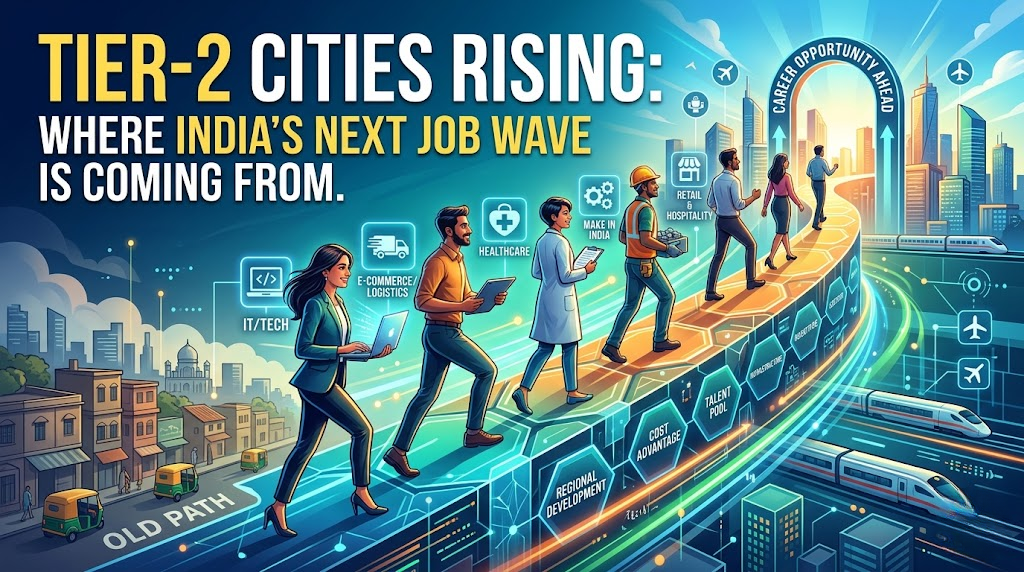
Tier-2 Cities Rising: Where India’s Next Job Wave Is Coming From
For decades, India’s job seekers packed their bags and headed to Mumbai, Bengaluru, or Delhi. That story is changing — fast. The next big wave of jobs isn’t in the metros. It’s already building in the cities you grew up in.
Picture this: You graduate from a good college in Indore, Jaipur, or Visakhapatnam. Everyone around you says the same thing — “Pack your bags. The real jobs are in Bengaluru or Mumbai.” So you go. You hustle. You pay ₹25,000 a month in rent for a shoebox apartment and spend two hours a day stuck in traffic just to reach your desk.
For millions of Indians, that has been the only script available. But something quietly remarkable has been happening over the last few years — and it has picked up breathtaking speed in 2025 and 2026.
The jobs are coming home.
From IT giants setting up Global Capability Centers in Coimbatore to pharma companies expanding in Bhubaneswar, from fintech firms hiring in Kochi to logistics companies building massive operations in Indore — India’s economic engine is no longer running only on metro fuel. Tier-2 cities are rising, and the opportunity wave they’re creating could be the most important career shift of this generation.
In this article, we break down exactly what’s happening, which cities are leading the charge, which sectors are creating jobs, and what it all means for you — whether you’re a fresh graduate, a mid-career professional, or an employer looking to build your next team.
The metro dream is getting expensive
Let’s be honest. Moving to Bengaluru or Mumbai was never just about the job. It was about the idea of opportunity. But today, that idea comes with a brutal price tag — sky-high rents, soul-crushing commutes, and a cost of living that quietly eats your salary before you can save a single rupee.
Something has shifted. Talented professionals are no longer automatically heading to the big cities. Many are choosing to stay home — or return. And the smart companies? They’re following the talent.
Hiring activity in Tier-2 and Tier-3 cities is growing at 21–23% year-on-year — nearly double the 14% growth seen in India’s biggest metros. This isn’t a trend anymore. It’s a transformation.
Why companies are making the move
It’s not charity. It’s smart business. Operational costs in Tier-2 cities run 25–35% lower than in metros. Office spaces are affordable. Employees are loyal. And the talent? It’s right there — skilled, motivated, and no longer willing to relocate just to land a decent job.
Global Capability Centers (GCCs) — the high-value tech and operations hubs of global corporations — have seen a staggering 40% rise in their presence in smaller cities like Coimbatore, Indore, and Visakhapatnam. These aren’t call centres. These are strategic business units doing world-class work.
“Jobs in Tier-2 cities are no longer limited to support roles or regional functions. They now represent some of the most advanced, strategic, high-growth opportunities in the country.” — Taggd India Decoding Jobs Report 2026
The cities you should be watching right now
These aren’t random picks. These are cities reporting double-digit hiring growth with solid industry backing and government support:
Which sectors are driving the jobs boom?
This isn’t just one industry waking up. Multiple sectors are simultaneously expanding their Tier-2 footprint — and that’s what makes this moment so powerful.
IT deserves special mention. Remote work normalized distributed teams, and digital transformation has flung the door open for regional hiring in software development, cloud, cybersecurity, AI, and product engineering. Government initiatives like IndiaAI (₹1.17 billion) and Digital India 2026 are specifically targeting job creation in regional tech hubs — with a target of 1 million AI/ML jobs by FY 2026.
What’s actually changed on the ground?
Infrastructure used to be the biggest excuse to avoid Tier-2 cities. That excuse is running out fast. New airports under the UDAN scheme have connected 88 cities and operationalized 618 routes, with plans to expand to 120 new destinations. Metro lines, highways, fiber broadband, coworking spaces, medical facilities — the quality-of-life gap is narrowing year by year.
Property prices tell the same story. In cities like Lucknow, prices have jumped nearly 24% recently — not because of a bubble, but because genuine demand is following genuine opportunity.
What this means for you — the job seeker
If you’re early in your career or thinking of making a move, the calculus has changed completely. A ₹8 lakh salary in Indore stretches significantly further than ₹12 lakh in Bengaluru once you factor in rent, transport, and cost of living. You get to build savings. You live near your family. You have a life outside of work.
And here’s the kicker — the jobs themselves are no longer inferior. With GCCs, tech companies, and multinationals all actively expanding into Tier-2, you could be doing cutting-edge AI, product, or finance work without ever needing to leave your hometown.
Tier-2 cities now account for 32% of all planned hiring in India — and Tier-3 cities are close behind with a 15–25% surge in early hiring signals. The decentralization of opportunity is not coming. It’s here.
India’s job revolution isn’t happening in glass towers in Bengaluru or the busy lanes of Bandra. It’s happening in Indore’s logistics parks, Jaipur’s IT zones, Coimbatore’s engineering campuses, and Visakhapatnam’s pharmaceutical clusters.
The cities that were once considered “second choice” are fast becoming the smart choice — for employers who want loyalty and cost efficiency, and for professionals who want careers without sacrificing the life they’ve built at home.
The numbers don’t lie. Hiring is growing nearly twice as fast in Tier-2 cities compared to metros. GCCs are flooding in. Governments are laying out the red carpet with subsidies, fast approvals, and infrastructure investment. The ecosystem is ready.
The next generation of India’s workforce doesn’t have to choose between ambition and roots. For the first time, they can have both. The question is no longer “should I move to a metro?” The question is — are you paying attention to what’s being built right where you are?
The wave is rising. The only decision left is whether you ride it — or watch it from a distance.