You know the feeling.
You’re staring at your monitor on a Tuesday afternoon, realizing you’ve climbed the wrong ladder. You’re good at what you do, but the passion evaporated years ago.
You want out. You need a pivot.
But then the anxiety kicks in. You have a mortgage. You have car payments. You have a lifestyle that relies on your current paycheck. The thought of starting over at the bottom, competing with 22-year-olds for an entry-level salary, makes you physically sick.
So, you slap on the golden handcuffs, swallow your misery, and keep typing.
Stop. What if I told you the idea of “starting over” is a massive corporate lie?
You don’t have to burn your career to the ground to build a new one. Today, I’m going to show you exactly how to transition into a completely different field while keeping—or even increasing—your current salary.
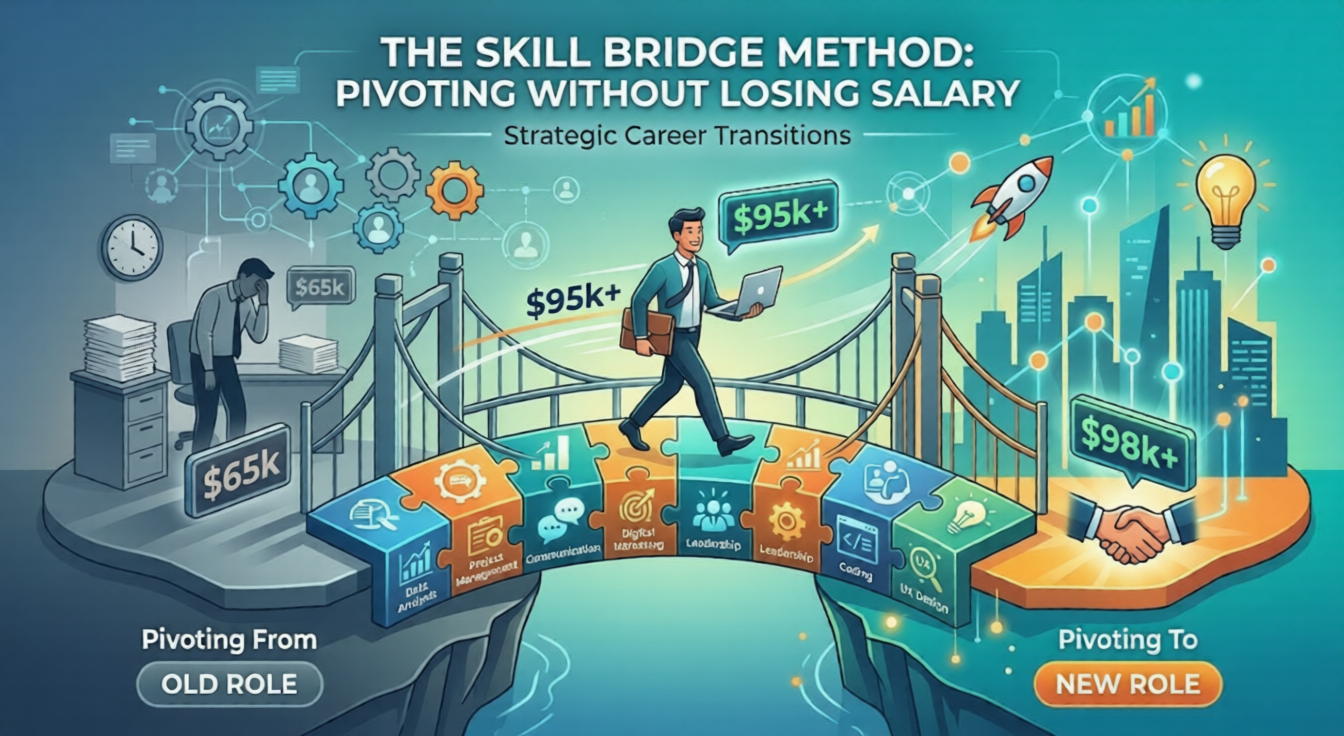
It’s called The Skill Bridge Method. And it’s going to change your life.
The Myth of the “Entry-Level” Pivot
Society conditions us to believe that a new industry means a reset button on our worth.
This is categorically false.
You aren’t starting from scratch; you are starting from experience. The Skill Bridge Method is about weaponizing the invisible, high-income skills you already possess and packaging them for a new audience.
Here is the four-step psychological playbook to make the leap.
Step 1: Extract Your “Apex Skills”
Your job title is not your identity. It’s just a temporary container for your skills.
To build your bridge, you must strip away your industry jargon and find your Apex Skills. These are the high-leverage abilities that every single Fortune 500 company on earth will pay top dollar for.
- Did you manage a restaurant? No, you executed complex operational logistics and high-stakes conflict resolution.
- Were you a school teacher? No, you specialized in curriculum development, stakeholder communication, and performance metrics.
- Did you write copy? No, you drove behavioral psychology and conversion optimization.
Your action: Brainstorm your daily tasks. Strip the industry paint off them. Find the raw, universal mechanics underneath.
Step 2: Build the Micro-Bridge (The Gap Analysis)
Now that you have your foundation, you need to know what’s missing.
Find five job descriptions for your dream role. Highlight the hard skills you don’t have. This is your “Gap.”
Do not quit your job. Do not go hundreds of thousands of dollars into debt for a new degree.
Instead, build a Micro-Bridge on nights and weekends. Take a high-ROI certification. Build a portfolio project. Volunteer to handle a cross-departmental task at your current job that uses the new skill.
You just need enough baseline knowledge to make your Apex Skills dangerous in the new arena.
Step 3: The “Trojan Horse” Positioning
Your resume is likely a liability right now. It screams “I belong in my old industry!”
We need to rewrite it as a Trojan Horse.
You must translate your past into the language of your future. If you are pivoting from HR to Tech Sales, your resume shouldn’t highlight “benefits administration.” It should highlight “persuading internal stakeholders and managing complex negotiations.”
- Mirror their vocabulary: Use the exact keywords from their job descriptions.
- Focus on outcomes: Cut the fluff. Show them numbers, revenue, and efficiency metrics.
- Hide the old industry: Make them focus on what you achieved, not where you achieved it.
Step 4: The Premium Pitch (How to Demand Your Salary)
This is where the magic happens. When you get to the interview, they will eventually ask: “Why should we hire someone without traditional experience in this field?”
If you apologize for your background, you lose. You get the pay cut.
Instead, you lean in and use a psychological trigger called Reframing. You don’t have less experience. You have a premium advantage the other candidates lack.
Say something like this:
“Traditional candidates in this field only know how to think one way. Because of my background in [Old Industry], I bring a mastery of [Apex Skill 1] and [Apex Skill 2]. I’ve combined that with my recent training in [New Hard Skill]. I won’t just do the job; I’ll bring a totally new perspective to solve your bottlenecks.”
You aren’t a newbie. You are a cross-disciplinary expert. Experts don’t take entry-level pay.
Your Past is a Launchpad, Not Baggage
You have spent years acquiring professional maturity, resilience, and problem-solving abilities. Do not discount that just because you want to change your job title.
The Skill Bridge Method is your permission slip to pivot with power.
You can have the career that lights you up, and you can keep the paycheck that secures your family. It just requires a shift in how you package your worth.
Your Next Step: Don’t just close this tab and go back to dreading your job. Grab a pen right now. Set a timer for 3 minutes, and write down three Apex Skills you possess that have nothing to do with your specific industry.
Reply in the comments below with your top Apex Skill—I want to see what you’re working with!