Let’s cut the fluff.
I had a coffee yesterday with a buddy of mine. He’s a “Content Strategist” at a mid-sized tech firm. Makes good money. Nice apartment. Two kids.
He looked tired.
“I don’t know what I did today,” he told me. “I sat in front of Claude 3.5. I fed it three bullet points. It wrote the strategy document I used to spend a week on. It took four minutes.”
He paused, staring at his cup. “They’re paying me $120k a year to paste prompts. How long until they figure out they can just pay an intern $40k to do the same thing?”
That right there? That pit in your stomach?
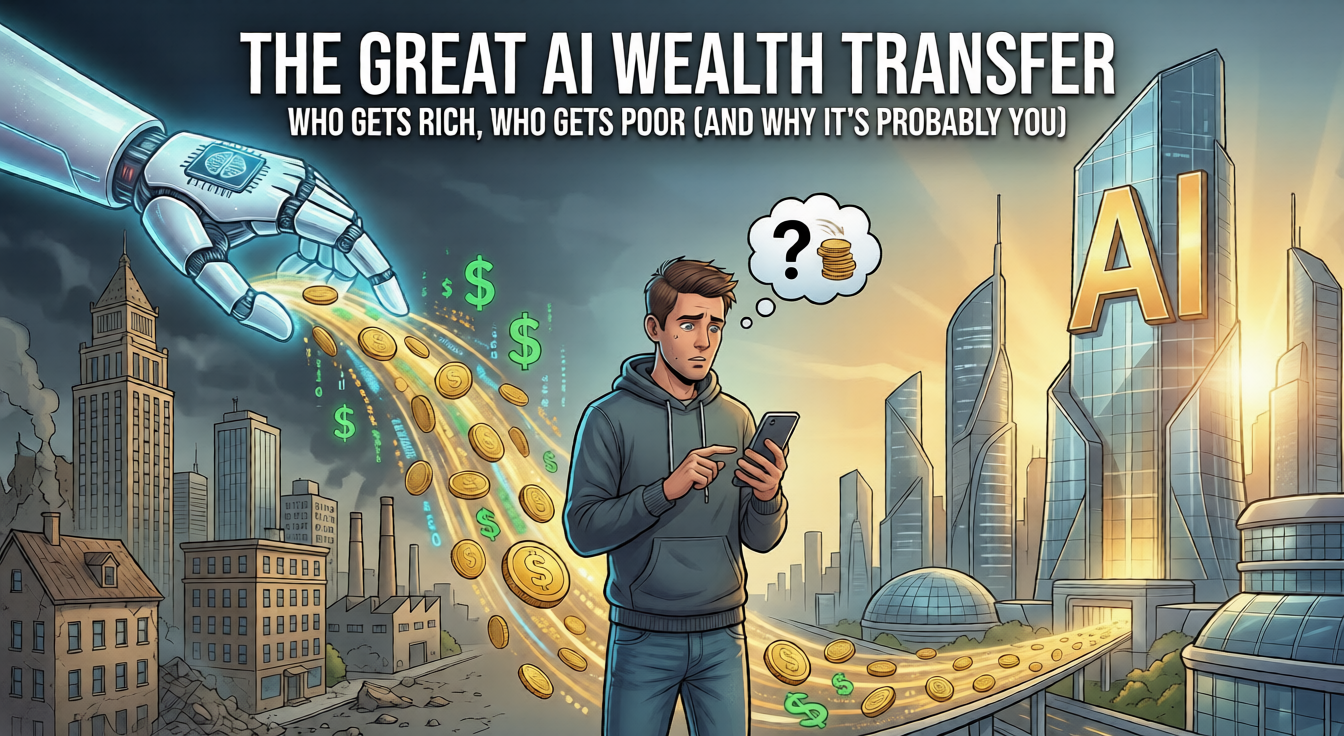
That is the sound of the Great AI Wealth Transfer.
It’s not coming. It’s here. And unlike the industrial revolution, which took decades to replace muscles with motors, this is happening in months. It’s replacing your brain.
If you want to know if you’re going to be on the side that buys the yacht or the side that cleans it, read this.
The “Squeezed Middle” (This is where the pain is)
Here is the dirty secret the tech bros on Twitter won’t tell you: Mediocrity is now free.
For the last twenty years, you could make a very comfortable living being “pretty good.”
- You wrote decent code.
- You designed solid logos.
- You wrote clean emails.
That version of the world is dead. Buried. Gone.
Basic economics says that when the supply of something goes to infinity, the price drops to zero. AI has made the supply of “average work” infinite.
If your job involves sitting at a computer, taking information from one tab, processing it in your head, and typing it into another tab… you are in the kill zone.
Your boss isn’t evil. They just can’t justify paying you $50 an hour for something a software subscription does for $20 a month.
So, Who Actually Gets Rich?
Money doesn’t evaporate. It moves. It’s moving away from “Labor” (you selling your hours) and pouring into “Leverage” (people owning the bots).
1. The “Taste-Makers” (The Editors) AI is like a really fast, really confident intern on caffeine. It produces a lot of stuff, but it has no taste. It doesn’t know what’s “cool.” It doesn’t know what’s “cringe.” The people getting rich are the ones with Elite Taste. They are the ones who can look at 50 AI-generated images and say, “That one. That’s the one that will sell.” You stop being the creator. You become the Director.
2. The “Dirty Hands” Crew Ironically, the safest jobs are the ones we spent decades telling kids to avoid. Plumbers. Electricians. specialized nurses. ChatGPT can write a poem about a clogged toilet, but it cannot come to your house and snake the drain. If your job requires you to be in a physical room, smelling the air, shaking a hand, or fixing a wire—your wages are about to go up. Why? Because everyone else is fighting for the digital scraps.
3. The 10x Cyborgs These are the people I’m terrified of. And impressed by. This is the solo entrepreneur who uses AI to do the work of a 15-person marketing agency.
- They use AI to write the copy.
- They use AI to generate the ads.
- They use AI to handle customer support. They keep 100% of the profit because they have 0% of the staff. They are capturing the wealth that used to be spread across 15 salaries.
How to Stop the Bleeding
If you’re reading this and feeling a little sick, good. Panic is a useful energy if you aim it at the right target.
Don’t go back to school for a generic degree. Do this instead:
1. Stop being a “Doer.” Start being a “Owner.” If you write code, stop defining yourself as a “Coder.” Start defining yourself as a “Product Builder.” The code is just a tool. If AI writes the code, fine. You build the product. Shift your mindset from processing tasks to owning outcomes.
2. Lean into your Humanity This sounds cheesy, but it’s pure economics. In a world flooded with fake text, fake videos, and fake emails, Trust is the most expensive asset on the planet. Pick up the phone. Go to dinner with clients. Shake hands. Be the person who solves the messy, emotional problems that require empathy. AI is a sociopath. It can’t navigate office politics or calm down an angry client. You can. That’s your moat.
The Bottom Line
The train has left the station. You can’t stop it.
But you can decide where you’re sitting.
You can stay in the “Middle Class” car, clutching your old job description while the ticket collector comes to kick you off. Or, you can walk up to the front, grab the controls, and drive the damn thing.
This weekend, don’t watch Netflix. Find that one part of your job that takes you four hours. Figure out how to make AI do it in four minutes.
Don’t tell your boss. Just do it.
And then ask yourself: What do I do with the free time?
That answer will determine your net worth in 2026.
The End of the Line
Look, I’m not writing this to scare you. Okay, maybe I am a little bit.
Fear is a better alarm clock than “inspiration.”
We are standing on the edge of a cliff. Most people are just standing there, arguing about whether the cliff is real, or if the government will build a bridge, or if it’s “fair.”
It’s not fair. Economics never is.
The people who win in this “Great Transfer” won’t be the smartest people in the room. They won’t be the ones with the Ivy League degrees.
They will be the ones who stopped complaining about the rain and started selling umbrellas.
You have a choice to make when you wake up tomorrow. You can keep doing your job the exact same way you did it in 2022, hoping the algorithm doesn’t notice you.
Or, you can look at this alien intelligence and say, “Okay. You’re strong. But I have thumbs and a soul. Let’s get to work.”
Don’t let the future happen to you. Happen to it.
Q&A: The Stuff You’re Too Scared to Ask Your Boss
I know what you’re thinking. You’ve got questions that feel a little too dangerous to ask in a Slack channel. Let’s tackle them here, just between us.
“I’m 45. I’ve been a mid-level manager for 15 years. Am I honestly screwed?”
Short answer: No.
Long answer: Only if you refuse to change. The 22-year-olds know how to prompt the AI. But they don’t know what to ask it because they’ve never navigated a crisis, managed a budget, or fired a toxic client. You have Context. They have Speed. If you learn the tools (Speed), you become unstoppable because you already have the Context. If you don’t learn the tools, yeah… the kid with the laptop eats your lunch.
“Won’t the government just step in? What about Universal Basic Income (UBI)?”
Do not bet your mortgage on a government check. Seriously. Even if UBI happens, do you really want to live on a stipend that barely covers rent while the “owners” are buying islands? Governments are slow. Tech is fast. By the time they pass the bill, the damage is done. Build your own lifeboat. Don’t wait for the Navy.
“But AI can’t be creative, right? It can’t write a novel or paint a masterpiece.”
Stop comforting yourself with this lie. AI is already winning art competitions. It’s writing code that is more creative than human code. But here’s the catch: AI is “average” creative. It can make a million good pop songs. It can’t make The Dark Side of the Moon. If you are “kind of” creative, you’re in trouble. If you are visionary, you just got the most powerful assistant in history.
“I’m overwhelmed. Where do I even start?”
Stop trying to learn “AI.” That’s like trying to learn “The Internet.” It’s too big. Just pick one thing you hate doing. Hate writing emails? Learn how to automate that. Hate organizing spreadsheets? Learn how to make an agent do that. Solve one problem. Then solve another. Before you know it, you aren’t just surviving the transfer—you’re profiting from it.