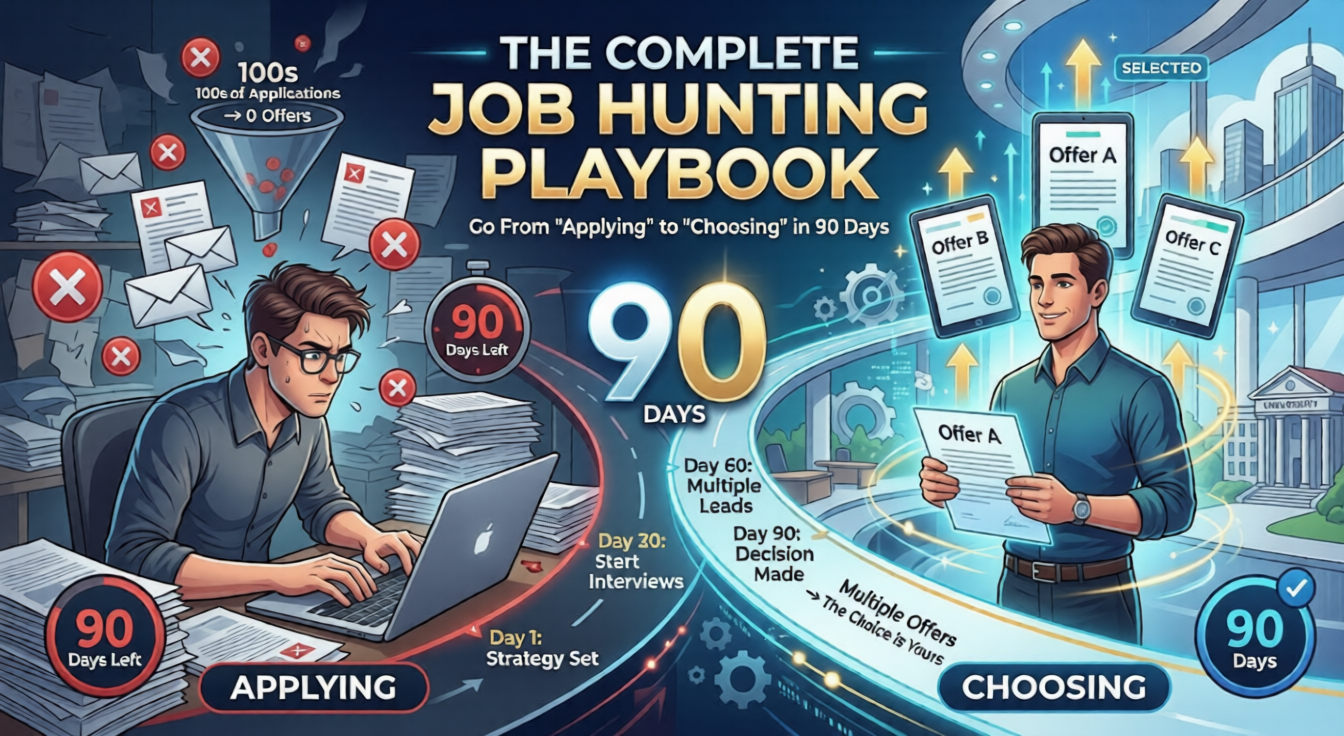
Introduction
Let me describe the average job seeker’s strategy:
- Open Indeed.
- Type “Marketing Manager.”
- Apply to 50 jobs with the same generic resume.
- Wait.
- Hear nothing.
- Repeat.
- Spiral into existential dread.
This is not “job hunting.” This is lottery ticket buying.
And just like the lottery, the odds are stacked against you. You are throwing your resume into a pile of 500 identical resumes, hoping a robot (the ATS software) picks yours.
There is a better way.
I am going to give you the Complete Workflow—from “I need a job” to “I’m choosing between three offers.” Step by step. No motivational fluff. Just the mechanics.
🔍 PHASE 1: The “Self-Audit” (Before You Touch a Resume)
Most people fail at job hunting because they skip this phase entirely. They start applying before they start thinking.
Step 1: Define “Good Job” in Numbers, Not Feelings. Stop saying “I want a good job.” That means nothing. Write down:
- Role: What specific title? (Not “anything in marketing.” Be exact: “Product Marketing Manager.”)
- Industry: What sector? (SaaS? HealthTech? E-commerce?)
- Salary Floor: What is the minimum you will accept? Write the number. Below this, you say no. Period.
- Non-Negotiables: Remote? Hybrid? City? Team size?
Step 2: Identify Your “Unfair Advantage.” You need an answer to: “Why should they hire me instead of the other 499 applicants?”
- Not “I’m a hard worker” (everyone says that).
- Think intersections:
- “I’m a Marketer who also knows SQL.”
- “I’m a Developer who has 5 years of client-facing sales.”
- “I’m a Designer who understands Conversion Rate Optimization.”
- Your “Unfair Advantage” lives at the crossroads of two skills.
Step 3: Create a “Hit List” of 10-15 Companies. Do not spray 200 resumes into the void.
- Research 10-15 specific companies that match your criteria.
- Follow their executives on LinkedIn.
- Read their blog.
- Understand their pain points.
- You are about to go hunting. Hunters don’t wander. They stalk.
🛠️ PHASE 2: The “Arsenal” (Your Weapons)
You need three weapons. Each one must be a precision tool, not a blunt instrument.
Weapon #1: The “Impact Resume” Throw your old resume in the trash. It is a list of duties. Nobody cares about duties.
The Formula: [Action Verb] + [Specific Task] + [Quantified Result]
- ❌ “Managed social media accounts.”
- ✅ “Grew Instagram from 5k to 85k followers in 6 months, driving $120k in attributed revenue.”
Rules:
- One page. No exceptions. No one reads page two.
- No “Objective Statement.” Replace it with a “Value Proposition”: “Product Marketer who has generated $2M+ in pipeline for B2B SaaS companies.”
- Every bullet point must have a number. Revenue, percentage, speed, users. No number = No proof.
Weapon #2: The “Proof Portfolio” A resume says “I can do this.” A portfolio says “I already did this.“
- For Marketers: A case study showing a campaign from strategy to result.
- For Developers: A GitHub repo with 2-3 clean projects.
- For Writers: 3 published articles with engagement data.
- For Anyone: A 1-page “Consulting Style” PDF that solves a specific problem for the target company.
Weapon #3: The “Magnetic” LinkedIn Your LinkedIn is not a resume. It is a landing page.
- Headline: Not your job title. Your value. “I Help SaaS Companies Reduce Churn by 20% | Product Marketing”
- Banner Image: Custom. Brand yourself.
- About Section: Write it in first person. Tell a story. End with a CTA.
- Activity: Post 2-3 times a week. Comment on industry posts. Be visible.
🎯 PHASE 3: The “Hidden Market” (Where the Real Jobs Are)
Here is a stat that should make you angry: 70-80% of jobs are never publicly posted.
They are filled through referrals, internal moves, and direct outreach. If you are only applying through job boards, you are fishing in a pond that has 20% of the fish.
Strategy 1: The “Value Bomb” Cold Email Do not send: “Hi, I’m looking for opportunities. Here is my resume.” (That is professional begging.)
Send this instead: “Hi [Name], I noticed [Company] recently launched [Product X]. I wrote a short analysis of how you could improve [Specific Metric] by [Specific Strategy]. No strings attached—just thought it might be useful. [Link to 1-page PDF]. If you’re ever looking for someone who thinks like this full-time, I’d love to chat.”
You just proved your value before asking for anything. Reciprocity kicks in. They feel obligated to respond.
Strategy 2: The “Warm Intro” Machine
- Find someone at your target company on LinkedIn.
- Don’t ask for a job.
- Ask: “I’m researching [Industry]. Would you be open to a 15-minute chat about your experience at [Company]?”
- At the end of the chat, ask: “Who else should I speak to?”
- Within 3 conversations, you will be introduced to the hiring manager.
Strategy 3: The “Create Your Own Role” If the company doesn’t have a job posting that fits you, write one.
- Identify a gap in their business.
- Draft a 1-page “Role Proposal.”
- Email it to the VP or Founder: “I think [Company] needs a [Role]. Here is why, and here is what I’d deliver in 90 days.”
- This is how you skip the line entirely.
🎤 PHASE 4: The Interview (You Are the Prize)
Most people walk into an interview like a defendant at trial. Nervous. Defensive.
Flip the script. You are not begging for a job. You are a Consultant evaluating whether this company deserves your talent.
1. The “STAR on Steroids” Method
- Situation: Set the scene (short).
- Task: What was the problem? (1 sentence).
- Action: What did you specifically do? (Be detailed).
- Result: What happened? (Use a number. Always a number).
- Lesson: What did you learn? (This is the “steroid.” It shows self-awareness.)
2. The “Reverse Interview” You must ask questions that make them sell the job to you:
- “What does success look like in this role in the first 6 months?”
- “What is the biggest challenge the team is facing right now?”
- “Why did the last person in this role leave?”
These questions signal that you are evaluating fit, not begging for acceptance.
3. The Salary Negotiation
- Rule 1: Never give the first number. Ever. Say: “I’d love to understand the full compensation package before discussing numbers.”
- Rule 2: When they give a number, pause. Count to 5 silently. Then: “I appreciate that. Based on my research and the impact I plan to deliver, I was expecting something closer to [X].”
- Rule 3: Negotiate Total Compensation (base + bonus + equity + flexibility), not just base salary.
🏆 PHASE 5: The First 90 Days (Cementing the Win)
Getting the job is not the finish line. It is the starting gun.
Days 1-30: Listen.
- Do not try to change anything.
- Map the power structure. Who makes decisions? Who has influence?
- Identify the “Quick Win”—a visible, achievable problem you can solve fast.
Days 31-60: Execute the Quick Win.
- Deliver one undeniable result that makes your boss look good.
- Send the “Weekly Wins” email we discussed earlier.
- Build internal alliances. Buy coffee. Ask for advice.
Days 61-90: Propose the Big Bet.
- You now have credibility.
- Pitch a larger initiative tied to the company’s top priority.
- You are no longer the “new hire.” You are the “person with ideas.”
💥 THE CONCLUSION
Job hunting is not about luck. It is about engineering.
Most people fail because they treat it like a lottery: mass-apply, mass-pray.
The winners? They treat it like a campaign.
- They research.
- They target.
- They build proof.
- They reach out directly.
- They walk into the interview like a partner, not a beggar.
Stop looking for a job. Start manufacturing an opportunity.
🏁 YOUR CALL TO ACTION
Today (not Monday, TODAY):
- Rewrite the top 3 bullets on your resume using the Impact Formula. (Action + Task + Number).
- Identify one dream company. Go to LinkedIn. Find one employee. Send them a message asking for a 15-minute “research chat.”
- Start your “Proof Portfolio.” Create one case study of a problem you solved.
You don’t need 100 applications. You need 1 perfect sniper shot.
❓ FAQ: “But Everyone Is Hiring Freeze…”
Q1: “The market is terrible right now. Is this strategy still relevant?” The Catalyst: It is more relevant.
- In a bad market, everyone is mass-applying. That means the hiring manager’s inbox is flooded with generic resumes.
- Your “Value Bomb” email and personalized approach stands out 10x more when everyone else is just spraying and praying.
Q2: “I don’t have any ‘numbers’ to put on my resume. I just did my job.” The Catalyst: Yes, you do. You just haven’t framed them.
- Reframe: “Managed customer support inbox” → “Resolved 200+ customer tickets per month with a 95% satisfaction rating.”
- Every job has metrics. Time saved, errors avoided, customers served, revenue touched. Find them.
Q3: “Cold emailing feels desperate. Won’t they just ignore me?” The Catalyst: Cold emailing with a resume is desperate. Cold emailing with free value is impressive.
- You are not asking for something. You are giving something. That is the difference between a “beggar” and a “consultant.”
Q4: “What if I’m switching careers and have no relevant experience?” The Catalyst: Then your “Proof Portfolio” is everything.
- You can’t show past work in the new field? Create mock work.
- Switching to UX? Redesign a real company’s app and publish it.
- Switching to Marketing? Run a $50 Facebook ad campaign for a friend’s business and document the results.
- The Rule: If you can’t show experience, show initiative.