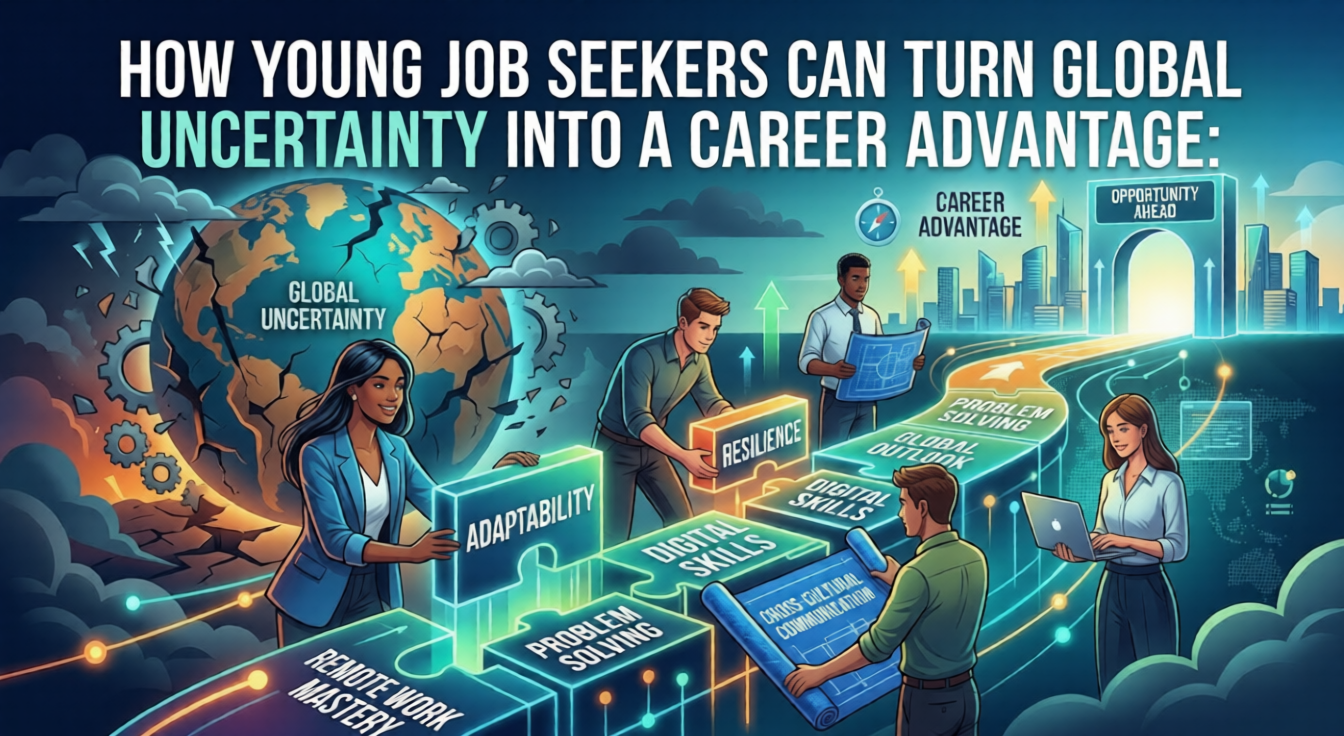
Let’s be honest: if you’re a young job seeker today, the headlines are terrifying. Inflation, geopolitical conflict, AI disruption, and supply chain chaos. It feels like trying to build a career on a moving sidewalk.
But here is the truth most career coaches won’t scream loudly enough: **Uncertainty is not your enemy. It is your unfair advantage.
While established professionals cling to sinking ships called “the way things used to be,” young job seekers have something more valuable: agility. You can pivot before the wave hits. You can see new patterns because you aren’t blinded by old ones.
This article isn’t about toxic positivity. It’s about a practical strategy to turn global instability into a launchpad. Here is how you do it.
1. Stop Chasing “Stable” Jobs. Start Building Flexible Skills.
The old rule: find a stable company and climb the ladder.
The new rule: stable companies no longer exist. Stable skills do.
Global uncertainty means entire industries can vanish overnight. But certain skills become more valuable during chaos. Focus on these three flexible skill buckets:
Digital & Data Literacy:You don’t need to be a coder. Learn to read a spreadsheet, use an AI prompt, interpret basic analytics, or automate a repetitive task. In uncertain times, data-driven decisions win.
Adaptive Communication: Can you explain a complex problem simply? Can you write a clear email, run a remote meeting, or calm an angry client? These skills never expire.
Problem-Framing: The highest paid skill of the next decade isn’t solving problems—it’s finding the right problem to solve. Uncertainty creates messy, undefined challenges. Learn to ask: “What are we missing?”
SEO Tip:If you’re writing your resume or LinkedIn profile, use keywords like “adaptable,” “cross-functional,” “rapid prototyping,” and “crisis communication.”*
2. Build a Portfolio Career (Not a Single Job)
When the economy shakes, single-income job seekers fall. Those with multiple income streams bounce.
Global uncertainty rewards redundancy. You don’t need a second full-time job. You need small, complementary income sources that act as shock absorbers.
Three practical ways to start today:
The Freelance Hedge: Offer one skill you already have on Upwork, Fiverr, or directly to small businesses (social media, copyediting, virtual assistance, basic design). Even $200/month changes your stress level.
The Digital Asset: Create a simple digital product (Notion template, resume guide, Canva pack, short ebook). Sell it for $5–$15. It works while you sleep.
The Service Swap:Trade a skill you’re learning (e.g., website setup) for a skill you need (e.g., financial coaching). Lowers costs while expanding your network.
Real talk:You do not need permission to start a side income. A recession doesn’t cancel your ability to dog-sit, tutor, or consult.
3. Choose Industries That Thrive on Disruption
Most job seekers run toward “recession-proof” industries like healthcare or utilities. That’s fine—but crowded.
The real advantage? Move toward disruption itself.
When the world is uncertain, certain sectors don’t just survive—they accelerate. These are your target industries:
Industry, Why It Benefits from Uncertainty
- Cybersecurity : More remote work + more digital threats = massive demand
- Supply Chain & Logistics:Disruptions create need for smarter, leaner systems
- Renewable Energy:Energy price volatility drives shift to alternatives .
- Mental Health & Wellness: Global anxiety creates growing need for support roles
- AI & Automation Tools: Companies cut costs by automating; builders win |
- Debt Counseling & Personal Finance: Economic pressure = need for financial guidance
Action step: Search for junior roles, internships, or even free projects in these sectors. Then tailor your “flexible skills” to their specific pain points.
4. Reframe “Uncertainty” on Your Resume & Interviews
Here’s where most young job seekers fail: they hide their fear.
Instead, use the language of advantage. When an interviewer asks, “Why should we hire you in this economy?” don’t stammer. Say this:
“Because uncertainty is where I perform best. I’ve learned to work with incomplete information, adapt quickly, and find opportunities others overlook. While traditional candidates need stability, I build momentum from change.”
Then prove it with a small example: a class project that pivoted mid-semester, a side hustle you started during a lockdown, a volunteer role where you solved an unexpected problem.
That is not inexperience. That is evidence.
Final Thought: The Unfair Advantage of Starting Rough
Veteran workers built their careers during relative peace and stability. They don’t know how to navigate a world where the rules change weekly.
You, on the other hand, are starting *in the storm*. That means every skill you build, every income source you launch, and every industry you choose is already battle-tested.
Global uncertainty is not a problem to survive. It’s a filter. It removes the rigid, the entitled, and the slow. And it rewards the adaptable, the resourceful, and the brave.
That’s you.
Your move: Pick one flexible skill to learn this week. Set up one small side income this month. And apply to one job in a disruption-friendly industry tomorrow.
Uncertainty isn’t waiting. Neither should you.
Liked this article? Share it with a fellow young job seeker who needs to hear this. And subscribe below for more actionable career strategies in a changing world.