
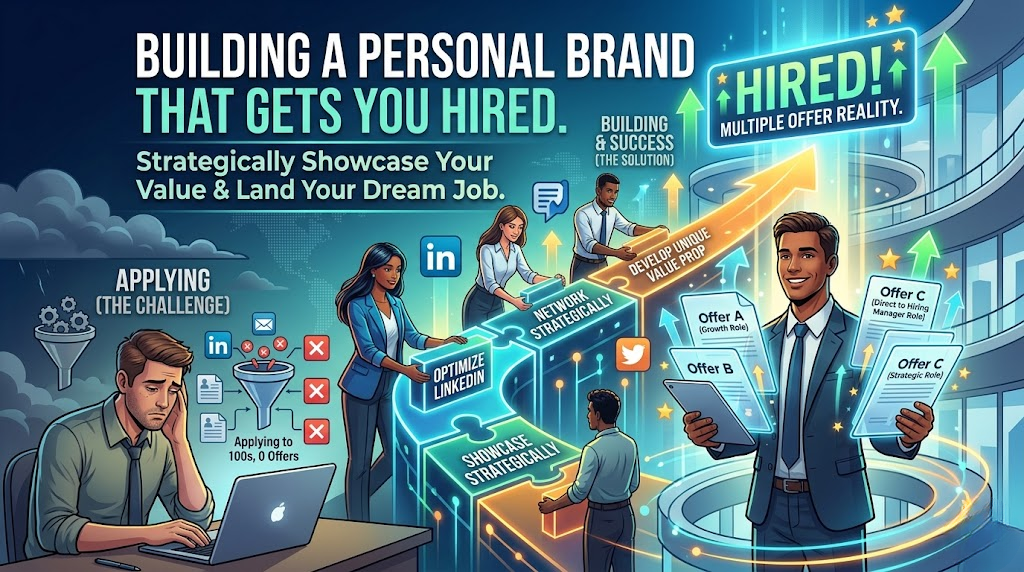
Building a Personal Brand That Gets You Hired
Your resume gets you considered. Your personal brand gets you chosen. Here’s how to build one that works while you sleep — and lands you the job before the interview even begins.
Imagine two candidates applying for the same role. Both have similar degrees, similar experience, and similar skill sets. But when the recruiter Googles Candidate A, they find a blank LinkedIn profile and a two-year-old headshot. When they Google Candidate B, they find a polished LinkedIn presence, a portfolio of thoughtful articles, endorsements from respected industry figures, and a clear, consistent professional story.
You already know the answer. And the uncomfortable truth is this: in 2026, your personal brand is often deciding your career fate before you even submit your resume. Recruiters are “shopping” for candidates long before job postings ever go live. Your digital footprint is your silent salesperson — either working hard for you or quietly working against you.
The good news? Building a powerful personal brand isn’t about being famous. It’s not about going viral or having 50,000 LinkedIn followers. It’s about being strategically visible, consistently credible, and unmistakably you — to the right people, at the right time.
In this guide, we’ll walk you through exactly what a personal brand is, why it matters more than ever in today’s job market, and a practical step-by-step playbook to build one that actually gets you hired. Whether you’re a fresh graduate, a mid-career professional, or someone navigating a career change — this is for you.
What is a personal brand — really?
Let’s cut through the buzzword fog. A personal brand is not your job title. It’s not your number of followers. It’s not a perfectly curated Instagram aesthetic.
Your personal brand is your professional reputation — how others experience you when they encounter your work, your words, or your name online. It’s the consistent answer to the question: “What do people say about you when you’re not in the room?”
“Your brand is what people say about you when you’re not in the room. In today’s digital era, that room includes LinkedIn, industry forums, podcasts, and search results.” — Jeff Bezos
Here’s the thing most people miss: your personal brand already exists. Every post you’ve liked, every comment you’ve made, every article with your name on it — it’s all out there, painting a picture. The only question is whether you’re painting it intentionally or letting the internet do it for you.
A strong personal brand positions you as a trusted authority, not just a candidate. It opens doors to roles, collaborations, and opportunities that never appear on a job board.
Why personal branding matters more than ever in 2026
The hiring landscape has fundamentally shifted. Ten years ago, your resume was your introduction. Today, it’s often the last thing a recruiter looks at — after they’ve already formed an impression of you online.
Add AI to the mix and it gets even more interesting. Companies are now using AI tools to screen candidates at scale. Algorithms scan for keyword consistency across your LinkedIn, resume, and online presence. An incoherent or absent digital footprint can knock you out of the running before any human eyes ever land on your name.
Your personal brand, when done well, is the thing that makes you undeniable. It’s what gets a recruiter to stop scrolling and start thinking, “I need to reach out to this person.”
How to build a personal brand that gets you hired — step by step
Here’s your complete, actionable playbook. Follow these steps in order and you’ll have a brand that works for you around the clock.
Define your Unique Value Proposition (UVP)
Before you build anything, you need to know what you stand for. Your UVP is the intersection of your skills, experience, values, and what employers in your target field actually need. Ask yourself: What problems do I solve? What makes me different from someone with a similar background? What do people always come to me for? Write it down in 1–2 clear sentences. This becomes the foundation everything else is built on.
Audit and clean your digital footprint
Before you build forward, clean up what’s already there. Google yourself right now. What comes up? Check every social platform — LinkedIn, Twitter/X, Instagram, even Facebook. Remove or private anything that doesn’t serve your professional story. Consistency is key: your photo, tone, and bio should tell the same story everywhere a recruiter might land.
Build a LinkedIn profile that’s impossible to ignore
LinkedIn is ground zero for personal branding in 2026. Over 100 million professionals in India alone are on the platform — and recruiters are actively searching it every single day. Your headline isn’t just your job title. Make it a tagline. Instead of “Software Engineer,” try “Software Engineer | Building Scalable Systems | Cloud & AI Enthusiast.” Your About section should tell a real story — not a boring list of duties — written in first person with short, punchy paragraphs. Lead with accomplishments: “Increased team delivery speed by 40%” hits harder than “Responsible for project delivery.”
Create content that shows how you think
Here’s the secret weapon most job seekers ignore: content. When you post thoughtful insights, share lessons from your work, or weigh in on industry trends, you’re answering employer questions before the interview even happens. You don’t need to post every day. Even 2–3 posts per week of genuine, useful content — a lesson learned, a perspective on an industry shift, a breakdown of a project — builds compounding visibility and trust over time.
Build a portfolio or personal website
A personal website is your 24/7 career ambassador. It gives you a space to showcase work samples, case studies, testimonials, and your professional story in a way no resume can replicate. Even a simple one-page site with your UVP, key projects, and contact details is vastly more powerful than nothing. For creative, tech, and marketing professionals, a portfolio is increasingly expected — not just impressive.
Network with intention — not desperation
Networking isn’t about collecting contacts. It’s about building genuine relationships that put you on people’s radar before they have a vacancy. In 2026, “micronetworking” is the move — short, thoughtful outreach and consistent engagement that keeps you top of mind without coming across as transactional. The rule is simple: give before you ask. Share value, offer perspective, make introductions. Referrals and recommendations will follow naturally.
Collect endorsements and recommendations
Let others speak for you. LinkedIn recommendations from former managers, colleagues, or clients are some of the most persuasive content on your profile. A genuine, specific recommendation is worth more than 10 self-descriptions. Ask former managers who mentored you closely, professors, or leaders of organizations you’ve worked with. And always offer to write one in return.
Craft your elevator pitch
In 30–60 seconds, can you clearly explain who you are, what you do, and why it matters? Your elevator pitch is the spoken version of your UVP. It should feel natural, confident, and memorable — not scripted. Use it at networking events, industry meetups, informational interviews, and even casual professional conversations. The goal isn’t to close a deal on the spot. It’s to make someone curious enough to want to know more.
Common personal branding mistakes to avoid
Building a personal brand is powerful — but these common traps can quietly undermine everything you’re working to create.
Your personal brand checklist
Before you call your brand “ready,” run through this checklist:
- Your UVP is defined and written in 1–2 clear sentences
- You’ve Googled yourself and cleaned up your digital footprint
- Your LinkedIn headline is a tagline, not just a job title
- Your About section tells a real story, written in first person
- Your experience section leads with accomplishments and metrics
- You have a professional, high-quality profile photo
- Your tone and messaging are consistent across all platforms
- You’ve started creating and sharing content regularly
- You have at least 3 LinkedIn recommendations
- You have a personal website or portfolio (if relevant to your field)
- Your elevator pitch is practiced and feels natural
- You’re engaging with your network consistently, not just when job hunting
You don’t have to do all of this overnight. Start with steps 1, 2, and 3. Get those right first — then layer in the rest over the following weeks. Consistent progress beats perfect preparation every time.
Here’s the truth that most job seekers are slow to accept: the job market is no longer just a skills competition. It’s a visibility and credibility competition. And your personal brand is the single most powerful tool in that arena.
Recruiters are evaluating you before you submit your application. Companies are hiring people they already know, like, and trust — often from social feeds, recommendation chains, and industry conversations. If you’re not actively shaping how the world perceives your professional self, you’re leaving one of the most important career decisions entirely to chance.
The professionals who are landing the best opportunities right now aren’t necessarily the most qualified people in the room. They’re the most visible, the most consistent, and the most intentional about how they show up.
Building a personal brand takes time — but so does a career. Start today. Define your UVP. Polish your LinkedIn. Share one insightful post. Reach out to one person with genuine value. These small, consistent actions compound into something extraordinary over months and years.
Your brand is already being written. The only question is — are you the one holding the pen?