Introduction
You know that feeling in the pit of your stomach?
That subtle, nagging suspicion that the software update IT just installed is doing your job a little too well?
Most people bury that feeling. They cover it with busy work and “seniority.” They tell themselves, “They can’t replace me. I know the systems. I have relationships.”
I am here to be the friend who tells you you’ve got spinach in your teeth. Except the spinach is an algorithm, and it’s eating your career.
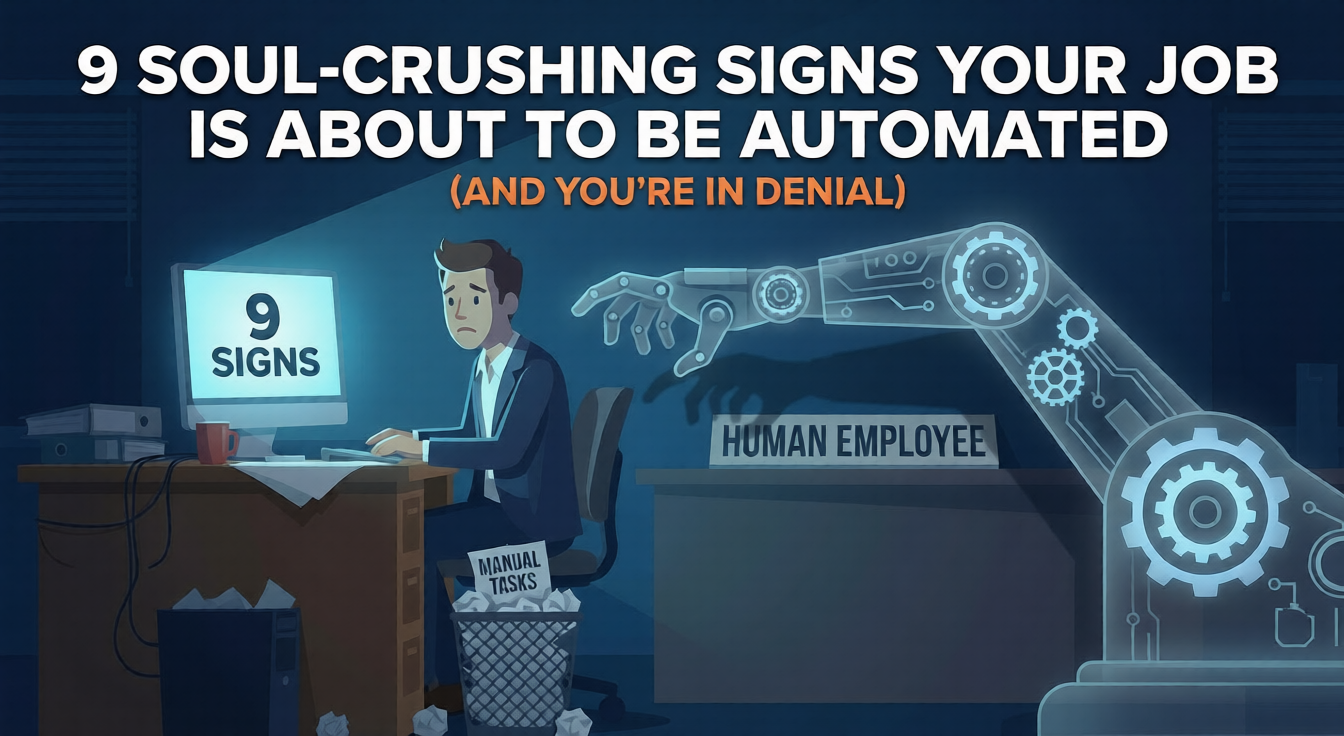
Automation doesn’t kick down the door with a Terminator robot. It enters quietly. It starts as a “tool.” Then it becomes an “assistant.” Then it becomes the employee.
If you recognize more than three of these signs, you don’t have a job anymore. You have a countdown clock.
🚩 The Red Flags You Are Ignoring
1. You Are a Human Flowchart Be honest. Can you write down exactly what you do every day on a napkin using “If This, Then That” logic?
- If email comes in -> Tag as “Urgent” -> Forward to Steve.
- If number is below 50 -> Highlight red -> Paste into Excel. If your judgment relies on strict rules rather than intuition, you aren’t a knowledge worker. You are a biological script. And scripts are free now.
2. The “Good Enough” Shift Two years ago, your boss demanded perfection. Now, they demand speed.
- The Signal: If the company suddenly prioritizes “shipping 50 articles a week” over “writing 5 masterpieces,” they are prepping for AI.
- AI is the king of “Good Enough” at scale. If quality is no longer the primary metric, you have lost your leverage.
3. You Are Tagging Your Own Demise Has your company introduced a new software where you have to “categorize” or “label” things?
- “Is this customer angry or happy?”
- “Highlight the key clause in this contract.” Wake up. You aren’t doing work. You are creating the training data for the model that will replace you. You are digging your own grave and calling it “data entry.”
4. The “Copilot” Trojan Horse Management gave you a shiny new AI tool to “boost your productivity.”
- First, it writes the email drafts for you.
- Then, it suggests the replies.
- Soon, management realizes the tool is doing 90% of the work, and you are just the expensive button-pusher.
- The Reality: The “Copilot” is actually the Pilot. You are just warming the seat.
5. You’re Invisible You can go a whole week without speaking to a human being. Your entire output is digital files sent to an anonymous folder.
- If your job requires zero persuasion, zero negotiation, and zero empathy, you are simply a slow, expensive API.
- The Rule: If you can do your job entirely from a laptop in a basement without talking to a soul, an AI agent can do it from a server farm in Nevada for pennies.
6. The “Legacy” Trap You are the only one who knows how to fix the “old system.”
- You think this is job security. It is actually a trap.
- Companies hate legacy systems. They are actively trying to kill them. Once they migrate that data to a modern cloud architecture (which AI handles beautifully), your “exclusive knowledge” becomes worthless overnight.
7. The “Outsourcing” Echo Was your department downsized five years ago and moved to a cheaper country?
- That was Step 1 (lowering cost of labor).
- AI is Step 2 (eliminating cost of labor).
- If a job can be done by someone halfway across the world with no context, it is prime real estate for automation.
8. Management Has Stopped Investing in You When was the last time the company paid for you to go to a conference? Or a workshop?
- If the budget for your professional development has hit zero, it’s because you are a Depreciating Asset.
- Smart companies invest in the future. If they aren’t investing in you, you aren’t the future.
9. The “Black Box” Phenomenon You put data in, something happens, and data comes out. But you don’t actually create anything new.
- You summarize meetings.
- You compile reports from other reports.
- You format presentations.
- The Harsh Truth: Synthesizing existing information is the #1 superpower of Large Language Models. If you are a “middleman of information,” you are being disintermediated.
💥 THE CONCLUSION
Take a breath.
I didn’t write this to ruin your day. I wrote this to save your year.
If you read this list and saw yourself, you are currently standing on the train tracks. The train is silent, but it is fast.
But you have an advantage the algorithm doesn’t have: You have awareness.
An AI will blindly execute tasks until it is turned off. You can pivot. You can learn. You can change the game.
Denial is a comfort zone that will kill you. Step out of it.
🏁 YOUR CALL TO ACTION
Perform the “Value Audit” right now.
Take a sheet of paper. Draw a line down the middle.
- Left Side: Tasks I do that are repetitive, logical, and screen-based.
- Right Side: Tasks I do that require empathy, complex judgment, physical presence, or high-stakes trust.
If the Left Side is longer than the Right Side, you have 30 days to change that ratio. Start delegating the Left to AI, and double down on the Right.
⚠️ DISCLAIMER
This article is a psychological and economic analysis of current labor market trends. It is not a personalized career diagnosis. Technology moves fast; use your own judgment to assess your specific industry risks.
❓ FAQ: “Am I Paralyzed or Am I Preparing?”
Q1: “I checked 7 out of 9 boxes. Is it too late to save my career?” The Catalyst: No. But the “job” you have is dead. The career is not.
- The Pivot: You know the workflow better than anyone. Stop being the person who does the tasks. Become the person who designs the automation for those tasks. Go to your boss and say, “I can automate 50% of our department using these tools.” You just went from ‘redundant’ to ‘innovator’.
Q2: “My industry is ‘creative’ (Graphic Design/Copywriting). Surely I’m safe?” The Catalyst: You are actually the most at risk.
- Generative AI is coming for creative execution first.
- The Fix: Stop selling “assets” (logos, blogs). Start selling “results” (brand identity, conversion rates). An AI can make a logo; it can’t build a brand strategy that resonates with human psychology.
Q3: “I’m close to retirement (5 years). Can I just ride it out?” The Catalyst: It’s a risky gamble. 5 years in AI time is like 50 years in normal time.
- Advice: Make yourself the “Human Shield.” Focus entirely on client relationships and mentorship. Be the person the young team trusts and the clients love. Algorithms can’t play golf or calm down a panicked CEO.
Q4: “Should I hide my use of AI from my boss?” The Catalyst: Short term? Maybe. Long term? Suicide.
- If you hide it, eventually they will find out and realize they are paying you full salary for AI work.
- Better Move: Be transparent. “I used AI to do this in 20 minutes instead of 4 hours. Now, I’m going to spend those saved 3 hours working on [High Value Project].” Show them you are reinvesting the time, not just slacking off.