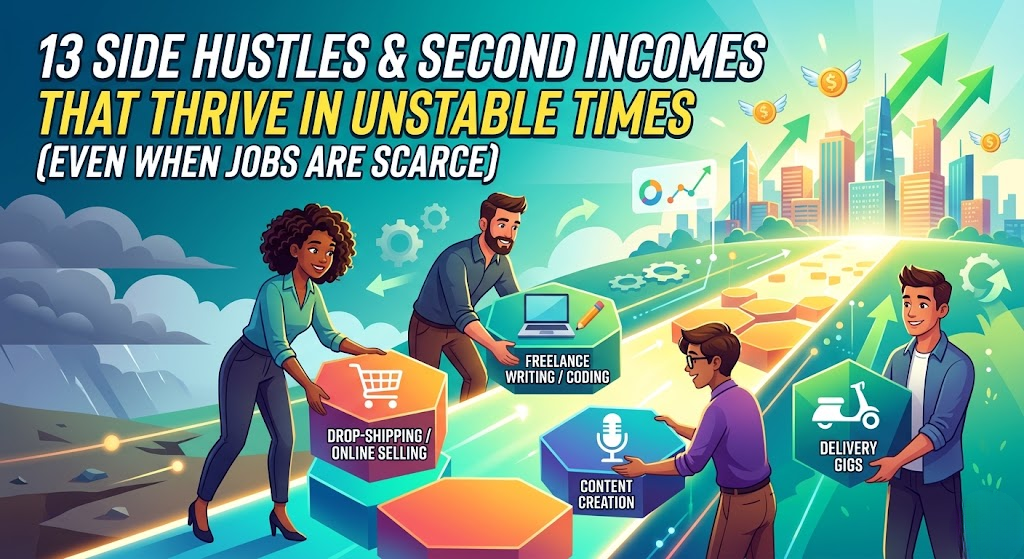
Introduction: When the Economy Shakes, Smart Earners Adapt
Let me paint a picture you probably know too well.
You open the news. Another round of layoffs. Your friend’s job application got rejected again. Your own paycheck feels like it’s shrinking while rent isn’t.
It’s easy to feel helpless.
But here’s what the news won’t tell you: Some people don’t just survive unstable times. They actually build wealth during them.
Not because they’re geniuses. Not because they inherited money. But because they stopped waiting for the “perfect job” and started creating their own small income streams.
These aren’t get-rich-quick schemes. They’re real, boring, proven side hustles that work because the economy is shaky—not despite it.
In this post, I’ll show you four categories of side hustles that thrive when formal job growth slows:
– ✅ Tutoring (people never stop learning)
– ✅ Content writing (businesses always need words)
– ✅ Local service apps (neighbors need help now)
– ✅ Digital marketing (small businesses are desperate for visibility)
Plus, I’ll give you a 7-day action plan and answer the most common questions beginners ask.
Let’s turn your uncertainty into income.
1. Tutoring: The Recession-Resistant Income You’re Ignoring
When the economy dips, parents panic about one thing: their child’s future.
They cut vacations. They cut dining out. But they rarely cut education. In fact, many spend more on tutoring to give their kids an edge.
Why tutoring thrives in unstable times:
– Remote learning left gaps that still need filling.
– College admissions stay competitive regardless of the economy.
– Adults also need tutoring (English, tech skills, certifications).
What you can teach (no degree required):
– Math (K-12 is always in demand)
– English as a second language (ESL)
– Test prep (SAT, ACT, GRE)
– Music, coding, or even study skills
How to start today:
– Platforms: Wyzant, TutorMe, Preply, or local Facebook groups.
– Rate:$15–$50/hour depending on subject.
– Time commitment: 3–5 hours/week = $200–$500/month.
Real example:A college student tutoring algebra two evenings a week can earn $400/month—enough to cover groceries, gas, and a small emergency fund.
Your move: List three subjects you could teach right nowwithout studying. Post that list in one local Facebook group today.
2. Content Writing: Businesses Are Hungry for Words
When times get tight, businesses cut marketing budgets—but they can’t stop marketing completely. Instead, they shift to content: blog posts, emails, LinkedIn articles, website copy.
And they don’t want to write it themselves. That’s where you come in.
Why content writing grows during uncertainty:
– Companies need SEO to stay visible.
– AI writes fast, but humans write trust.
– Small businesses can’t afford agencies, but they can afford you.
Types of content writing in demand:
– Blog posts (1,000–2,000 words)
– Email newsletters
– Social media captions
– Product descriptions
– Landing pages
How to start with zero experience:
1. Create 3–5 sample articles (use free Google Docs).
2. Offer your first client a discount ($50 for a post instead of $150).
3. Use job boards: ProBlogger, r/HireAWriter, LinkedIn, or cold email local businesses.
Realistic earnings:
Experience Level :Per Article (500–800 words) |
Beginner ( $20–$50 )
3–6 months ( $75–$150 )
Experienced ($200+ )
Your move: Write one sample article today on a topic you actually enjoy (cooking, fitness, gaming, parenting). Then email three small business owners offering help.
3. Local Service Apps: Get Paid for Being Neighborly
This is the most underrated side hustle of unstable times. Why? Because people still need things *done*, even when they’re worried about money.
They just don’t want to do those things themselves.
apps that connect you to paid local tasks:
App ,What You Do Average Pay
TaskRabbit: Furniture assembly, moving help, cleaning ( $20–$40/hour )
Rover : Dog walking, pet sitting ( $15–$30/walk )
Care.com : Babysitting, senior care, tutoring ( $15–$25/hour )
Why this works during uncertainty:
– No long-term commitment from clients.
– You get paid immediately after each task.
– Skills not required—reliability is the only requirement.
Real story: A teacher earning $45k/year added $800/month using TaskRabbit on weekends. That covered her car payment and student loan interest.
Your move: Download ONE of the apps above today. Complete your profile fully (photo, bio, reviews from friends). Then accept your first small task this week.
4. Digital Marketing: Help Small Businesses Survive (and Pay You)
Small businesses are bleeding during unstable times. They need customers. They need sales. They need visibility.
But they don’t know how to get it online. You can learn the basics in weeks, not years.
Digital marketing skills that pay fast:
– Social media management:Schedule posts, reply to comments, grow followers ($300–$800/month per client).
Email marketing: Write newsletters, set up automations ($200–$500/month).
– Google Business Profile optimization:Help local shops appear on Google Maps ($100–$300 one-time).
– Basic ads (Facebook/Instagram):Manage $10/day campaigns ($300–$600/month).
How to learn for free:
– Google’s Digital Garage (certification)
– HubSpot Academy
– Meta Blueprint (Facebook ads)
– YouTube: “Social media manager for beginners”
Where to find your first client:
– Walk into a local coffee shop, salon, or bakery.
– Say: “I’ll manage your Instagram for one month for $100. If you don’t see more engagement, you pay nothing.”
– Do a great job. Ask for a testimonial. Repeat.
Your move: Pick one local business you already love. Offer them a free audit of their social media (just 30 minutes of your time). Then show them what’s missing. They’ll likely hire you.
Why These Four Work When Formal Jobs Don’t
You might be thinking: “But I want a real job with benefits.”
I hear you. And you should keep applying.
But here’s the truth about unstable times: **waiting for the perfect full-time job is a trap.
The four side hustles above give you something more valuable than money—they give you control.
– Control over your hours.
– Control over your income.
– Control over your stress.
And when the formal job market wakes up again? You’ll walk into interviews with confidence, because you already know how to earn without anyone’s permission.
Your 7-Day Action Plan to Start This Week
Day 1: Choose ONE side hustle from this article. Only one.
Day 2: Set up your profile on the relevant platform (Wyzant, Upwork, TaskRabbit, etc.)
Day 3: Tell three friends or family members what you’re doing. Ask for referrals.
Day 4: Complete your first small task (even if it’s low-paid or free for a testimonial).
Day 5:Set a weekly income goal (start small: $50/week).
Day 6: Track your time. See what works best.
Day 7:Repeat. Then increase prices by 10–20%.
Frequently Asked Questions (FAQs)
Q1: I have a full-time job. Can I still do a side hustle?
Absolutely. Most people start with just 5–10 hours a week. Tutoring on two weeknights or dog walking on weekends fits easily around a 9-to-5. Just be sure to check your employment contract for any conflict-of-interest rules.
Q2: How much money can I realistically make in the first month?
Be honest with yourself. In month one, aim for $100–$300. That’s realistic for a beginner. By month three, many people reach $500–$1,000/month. The key is consistency, not perfection.
Q3: Do I need to pay taxes on side hustle income?
Yes. In most countries, any income above a small threshold needs to be reported. The good news: you can deduct expenses (internet, software, travel, even a portion of your phone bill). Set aside roughly 25–30% of your side income for taxes. When in doubt, consult a local accountant.
Q4: What if I have no experience or special skills?
You have more skills than you think. Can you write a clear email? That’s content writing. Can you help a neighbor with their phone? That’s tech tutoring. Can you walk a dog? That’s Rover. Start with what feels easy and obvious to you—it’s probably not obvious to someone else.
Q5: Which side hustle is best for shy or introverted people?
Content writing is your best friend. You never have to get on a video call or sell face-to-face. Tutoring can also work well one-on-one. Avoid local service apps like TaskRabbit if you dislike in-person interaction.
Q6: How do I avoid getting scammed?
Follow these three rules:
– Never pay money to get a job.
– Never accept a check and send part of it elsewhere.
– Use platform payment systems (not Venmo/CashApp) for your first few months.
– Trust your gut. If it feels weird, walk away.
### Q7: Can I do more than one side hustle at once?
Yes, but don’t. Not at first. Choose **one** and do it well for 30 days. Then add a second if you have time. Beginners who try three hustles at once usually burn out and earn nothing.
Q8: What if I fail or don’t make any money?
That’s not failure—that’s data. Maybe you chose the wrong platform. Maybe your price was too high. Maybe you need better photos. Adjust one thing and try again. The only real failure is not starting.
Conclusion: Unstable Times Reward Action, Not Anxiety
Let’s circle back to where we started.
The news will keep telling you the economy is scary. Layoffs will keep happening. Formal jobs will grow slowly.
But none of that stops you from earning **today**.
Tutoring one student. Writing one blog post. Walking one dog. Helping one small business with their Instagram.
These aren’t dreams. They’re choices. Small, daily, boring choices that add up to something powerful: **income you control, no matter what the economy does.**
You don’t need permission. You don’t need a degree. You don’t need to wait for things to get better.
You just need to start.